★★★★☆
A triumphant twist on the Charles Dickens classic Great Expectations has premiered at the Royal Exchange theatre – but did it exceed expectations?
Jay Darcy
Charles Dickens remains relevant because he wrote about the most quintessentially British thing of all: class. With the country in a cost of living crisis, and millions living in poverty, his class commentary could not be more relevant. Yet, many of his stories – including Great Expectations – have been done so many times before that one wonders what more could anybody add.
The Royal Exchange Theatre and Tamasha’s co-production of Great Expectations – adapted by Tanika Gupta MBE FRSL and directed by Tamasha’s Artistic Director, Pooja Ghai – transports the play to Bengal at the turn of the 20th century. Dickens’ class commentary now intersects with race and colonialism (and a little bit of caste and religion, e.g. Hindu and Muslim characters living side-by-side).
Whilst the location has been changed, and there are new (albeit similar) issues at hand, it really is remarkable how faithful Gupta has been to the original text. It has been lifted and put into another context but it hits all the same plot points, so purists shan’t be too disappointed. Gupta just gives the classic new relevance.
The play takes place before, during and after the Partition of Bengal, a little-known territorial reorganisation which preceded the Partition of India by decades. The former was, essentially, a trial-run of the latter. An example of divide and rule, Bengal was to be split down religious lines (as it was in the later partition, with part of it given to India and the other part given to Pakistan).
This adaptation, then, is two-fold: we have the classic story, which most Britons are familiar with, and an historic event in a land far away which even a lot of South Asians (myself included) knew nothing about. Gupta weaves them together seamlessly. Nothing is forced. The story works wonderfully in this new context.
The production has stunning set design – some of the best I’ve seen at the Royal Exchange. As soon as you enter the auditorium, you are transported to historic Bengal. The set and costumes are historically and culturally accurate. You can tell that South Asians are behind this production: it has not become an oriental spectacle.
The visual highlight of the play is the scene in which (spoiler) Miss Havisham accidentally sets her house ablaze. Flames flicker at either side, and the stage is overcome with smoke. It is hauntingly beautiful.
I do wish they had gone bigger – and I heard that it was bigger at press night, which I was unable to attend – but I was gripped nonetheless.
The Bengali-inspired music, which was previewed by Arun Ghosh at the panel event, is aurally paradisiacal. It is used masterfully to aid in scene transitions, and if ever a scene change takes awhile, the momentum is kept up with the music; it keeps audiences from slipping away.
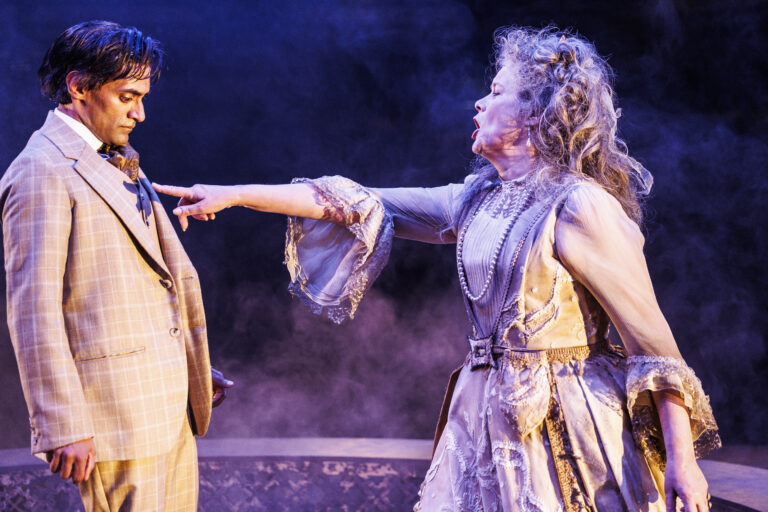
Catherine Russell is captivating as Miss Havisham. Whilst the character is only in her 30s in the original novel, we have come to see her as an elderly spinster, trapped in the past. Whilst Miss Havisham is a gothic character, she is often portrayed as existing in a liminal state: both glamorous and grotesque.
This adaptation, however, is more faithful to Dickens’ original description of the character. Russell walks with a slump, weighed down by her dusty wedding gown, as if she is about to sink into the ground or even turn to ash. She is a ghostly figure, emotionally frozen in time, still bitter over being burned by her lover – but also longing for the days when the Indians put up less of a fight.
The story is confused by combining race and class. They are, of course, related, but they complicate Miss Havisham’s motivations. In the original text, Miss Havisham, jilted by her lover, despises men, and the working-class Pip becomes her social experiment. In this production, she hates not only men but Indians too, so the abuse faced by Pip (renamed “Pipli”) is doubled. This dislocates her motivation from her fiancée’s betrayal.
Estella (Cecilia Appiah) is now a person of colour, which layers her relationship with Miss Havisham, who vacillates between avenging herself through Estella and destroying the Indian in her.
Whilst these changes complicate the story, they are all interesting and allow for an intersectional exploration of issues: Pip is not just a poor man but a poor brown man, employed by an old, rich, White woman whose ancestors colonised his country and brutalised his people.
Esh Alladi is wonderful as the wide-eyed and inquisitive Pipli – even as a child. I was charmed from start to finish.
The play, running 2 hours and 50 minutes, is long. There is lots of talking and exposition; some scenes could be sped up. But the creatives succeed in breathing new life into this classic (perhaps overdone) story.
Katie Bray
Great Expectations follows young Pipli (Esh Alladi) as he discovers social, economic and racial divisions between hardworking Indian families and the wealthy, exploitative English colonisers. After a chance encounter with a mysterious escaped prisoner Malik (Andrew French), and meeting the cold-hearted Miss Havisham (Catherine Russell) and her adopted daughter Estella (Cecilia Appiah), Pipli becomes smitten by the idea of living in wealth – an idea that becomes reality thanks to a mysterious benefactor and the help of his friend Herbert Pocket (Giles Cooper).
There have been many adaptations of Great Expectations since its original debut as a novel in 1861, with 20 film adaptations since 1917, starring actors like Anthony Hopkins, Ioan Gruffudd, Robert De Niro, Ethan Hawk and numerous other major celebrities. It has also been recreated in play form several times, before this special adaptation by Tanika Gupta and directed by the talented Pooja Ghai. In fact, it was previiusly adapted by Gupta – starring Ghai!
Whilst this play has received mixed reviews, I can safely say that this show was the best play I have ever seen. It’s a beautiful and candid revelation of the divisions created by British capitalism and colonialism in India, with our protagonist grappling with his own identity and nationality, much like the majority of the show’s characters.
There are no real heroes or villains as each character is morally greyed by personal and inherited traumatic experiences creating such genuinely sophisticated characters.
Miss Havisham was my personal favourite character, played with eccentricism and empathizable misery by the great Catherine Russell (Holby City), who certainly held her own against previous Havishams, such as award-winning actresses Helena Bonham Carter and Olivia Colman!
The character is haunted by her past as a jilted bride, still daydreaming of her lover, wearing a tattered wedding dress and sitting beside her similarly rotten wedding cake. She believed the best way to protect her adopted daughter Estella is to isolate her from all joy, sunlight and positivity, inevitably causing Pipli to experience the same heartbreak Miss Havisham had experienced so many years prior when he open-heartedly confessed to Estella that she was “in every line [he had] ever read”.
Even our protagonist, Pipli, becomes morally ambiguous as he loses his childhood innocence and rejects his own culture after tasting the life of a wealthy British civilian (albeit one who is still neglected from ‘truly British’ activities). This loss and self-loathing is acted with such rigour, passion and confusion by Esh Alladi (Hobson’s Choice, The P Word) that it becomes truly
heartbreaking to watch as he dismisses his beloved brother-in-law’s crude clothing, customs and education, despite his previous etiquette displayed over a comedic dinner with Herbert.
Esh Alladi was the perfect choice for the role, as he displayed in his ability to oscillate between the excitement and erratic behaviour of a child in Pipli’s early years (especially in his hilarious bloody fight with Herbert), and yet he slowly adapts this behaviour in a way that the audience are able to see Pipli’s attitudes, voice, mannerisms and demeanour change, along with his class and status.
His ability to portray a character strung between childhood and adulthood, British and Indian, and a rich
and poor life was simply outstanding, and is the main reason I believe the show resonated so well with its audience, alongside the ingenious addition of the colonial narrative present but neglected in the original Dickensian tale. It is carefully devised and integrated into a story that sticks true to the original, yet interweaves an authentic sense of cultural upheaval and unrest often
neglected in British literature of the era- making it all the more important to talk about.
Even the music itself was a gorgeous integration of classical piano with Indian rhythms that perfectly surmised the play’s themes. Costumes performed similar roles, both representing different ends of the culture and class divide, yet for Pipli, also symbolising his experience living in between these worlds as he casts off his ‘English clothes’ yet also doesn’t return to his traditional clothing when he returns home towards the end of the show.
Other great casting choices were Giles Cooper as Herbert Pocket and Asif Khan as Jagu; both emanated such lovable energy and enthusiasm which often lifted the play in its darkest moments.
The show made use of its limited circular space immensely well, using platform benches as places to run as characters changed. Set-pieces were moved or chase scenes occurred – a simple but effective technique that transported and distracted the audience from scene changes that ultimately may have ruined the show’s tension. Their use of several entrances kept the show fast-paced and interesting, almost feeling interactive, especially as Andrew French comedically broke character in awe at an audience member’s strange laughter (he looked back at him with raised eyebrows) – what an amazing sense of humour!
At once, the stage could be transformed into a dried out mud-hut before being transformed into the regal house of Miss Havisham, with its dusty chandelier, cobwebbed clock and flower-covered golden gates.
One particularly memorable scene was the Havisham fire, in which a combination of impeccable acting, ticking clocks, fire and smoke effects, and orange lighting created an unexpectedly realistic sense of endangerment, along with gunshots and brilliant blood effects seen in previous segments.
Perhaps some of the less positive reviews of this show could be attributed to its length and the heavy impact of its story, however it is the tragedy, mixed with sweet childhood naivety and a sprinkling of jokes that makes the show so endearing. If the original asked us to prioritise love and affection above monetary value, this adaptation also emphasises the importance of one’s self-image and national identity in spite of adversity.
In any case, despite a long run time, I was left craving more.
Great Expectations runs at the Royal Exchange Theatre until October 7.
Photo: © Ellie Kurttz

 JADAR
JADAR 