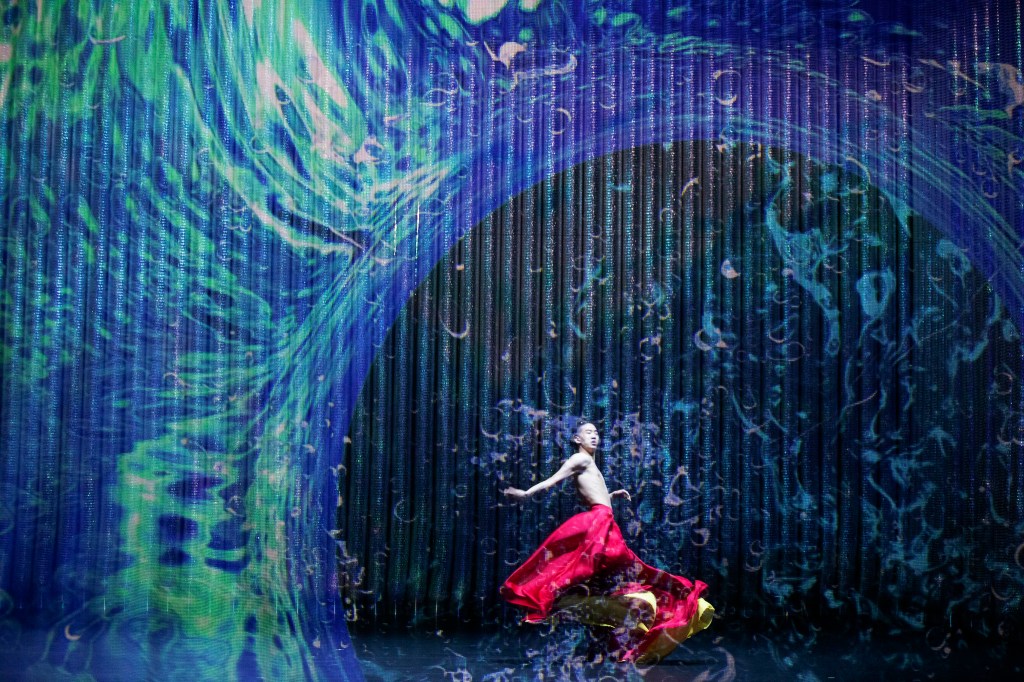
★★★★☆
Billed “Kaleidoscopic Korean dance”, Dragons is a celebration of East Asian history, identity and culture.
Eun-Me Ahn is one of the most important artists from South Korea. Her latest piece, Dragons, brings together modern and traditional dance styles from across Asia. An avant-garde production, it could be considered an East Asian response to Afrofuturism (a cultural aesthetic that combines science-fiction, history and fantasy to explore the African-American experience).
Whilst dragons are feared in the West, in Asia they contain more room for ambiguity, with popular representations including resilience, joy and optimism. By celebrating the dragon, Eun-Me Ahn celebrates East Asia.
As we walked into the auditorium, we were transported to a mythical forest. Gorgeous green leaves were projected onto a screen onstage. For a moment, I thought the plants were real. As I sat, I realised that they moved gently in a nonexistent breeze.
The production has no real narrative. Rather, it’s a surrealist collection of scenes, segments, and ideas which come together seamlessly.
Soft, flexible, silver, metallic tubes are the one recurring prop or motif. They curtain three sides of the stage, with a screen separating the audience from the performers, adorned by beautiful hologram projections (Taeseok Lee) of the aforementioned dancers, nature, and more (albeit multi-coloured) metallic tubes.
After a slow, comic beginning, the piece suddenly becomes high-velocity, with high-pitched electronic music and fast-paced robotic movement. Projections are fired on the screen, creating a futuristic, fantastical world.
Jang Young-Gyu seamlessly blends contemporary pop and electronic musical with a traditional score, fusing together different eras in an incredible celebration of Asian culture.
Eun-Me Ahn (who performs at the beginning and end) and her company of seven South Korean performers are joined onstage by five young guest performers from various East Asian countries, all born in the year 2000 – the Year of the Dragon – and all appearing as holograms.
Their appearance as holograms is a consequence of the pandemic: in-person rehearsals came to a halt and instead took place on Zoom. This is, as the show’s description puts it, “a nod to the hyper-connected ‘Gen-Z’ and their vitality and willingness to adapt to our rapidly changing world”.
The onstage performers each introduce themselves; through voiceover, tell us when and where they were born and how they came to dance.
Eun-Me Ahn is known for her fluid, liberal and inclusive approach to performance. She unashamedly subverts traditional Asian and Western attitudes to age and gender. Dragons is no exception.
An early scene, in which the dancers (male and female) wear metallic skirts is particularly captivating. They spin in such a way that it is as if the skirts are being held up with sticks or tubes inside of them. In actuality, they are merely being kept up by the dancers.
The countless costumes were captivatingly camp. At times, the production looked like an East Asian take on ballroom; I half-expected the dancers to begin voguing. Forget Paris is Burning – Seoul is on fire!
Dragons is a kaleidoscopic feast of East Asian culture – past, present and future – and though I did not always know what was happening, the creativity of the piece and the talent of the cast and creatives had me in awe.
Dragons runs at The Lowry (Lyric Theatre) until September 27.
Photo: Sukmu Yun
 JADAR
JADAR 