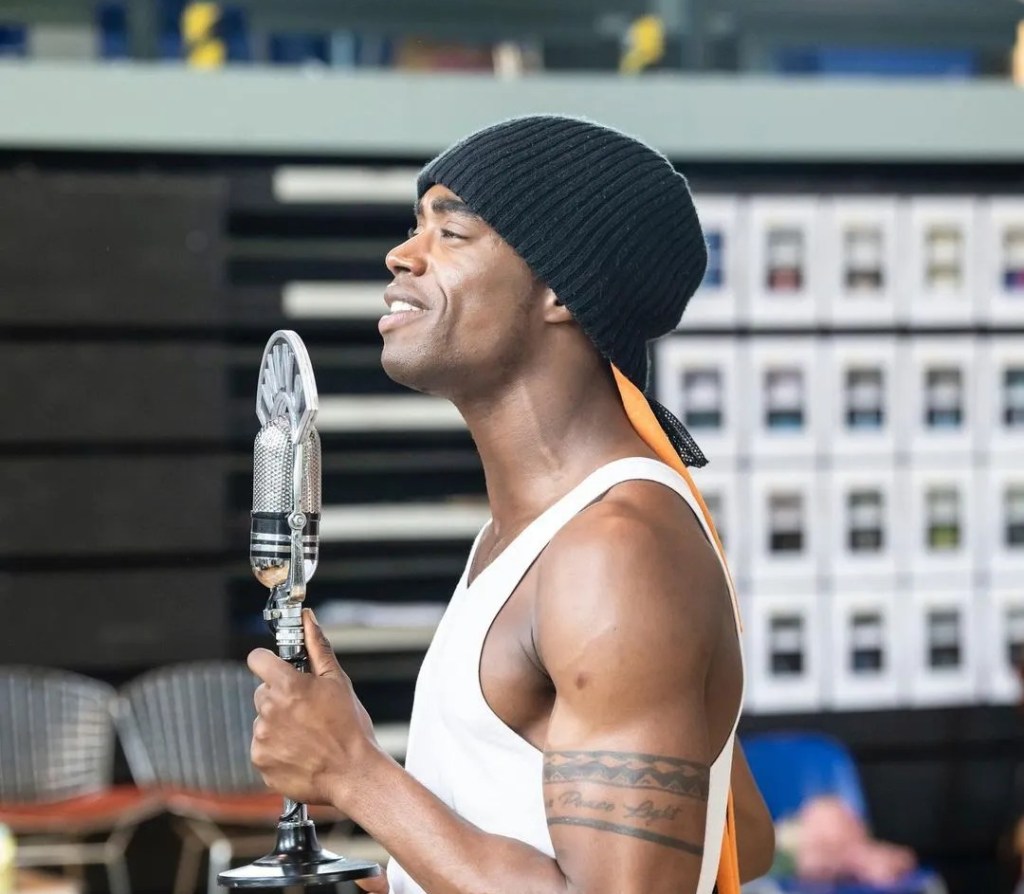
Following its world premiere in Newcastle. andWest End transfer in 2021, The Drifters Girl – a jukebox musical about The Drifters and their manager, Faye Treadwell – is on tour around the UK. Ahead of its Manchester run, I had the chance to speak to Dalton Harris, who is is best-known for winning the most recent season of The X Factor. He is one of the core four men, each of whom plays several members of The Drifters (the lineup varied massively over the years).
Trigger warning: Dalton discusses abuse, exploitation, mental illness, and suicide.
So, what is The Drifters Girl and what makes it special?
D: “The Drifters Girl is the story of how the Drifters became a household name and got ownership of their music and made the best of their gifts and talents. It shows their trajectory, journey and how many members were in the Drifters. It shows the inside business of the industry and how it moves. It also shows other poignant time in racist culture, where Black artists and Black musicians didn’t get the respect of their White counterparts. It shows how devastating having success and then losing that success can be. It shows the effects of love, hate, drugs, community support, and what a woman can step in and do – the level of intelligence that women innately have.
“The show is going to push and pull. You’re going to laugh; you’re going to find moments where you’re going to feel heart-wrenched. It’s high-octane so you’re going to get up and dance, you’re going to clap… Once it starts, it doesn’t stop going!
“I think how the script was written and how the music is used to tell the story is incredible when it all comes together. It’s physically demanding but it’s incredible. It’s a good freaking time and we have a lot of fun. On my day off, when I’m away from the show, I miss the show!”
What’s been your favourite time in rehearsal?
D: “I think my favourite time in rehearsal was the day I finally got the moves right because I struggled a lot coming into this since I’ve not done choreography on that level before or acting. I never went to school for acting and dancing. I’ve been doing music professionally all my life but I’ve never gotten formally trained so stepping into that room was challenging. But I have a great group of people around me. We’re stupid backstage, and I think all of us are idiots, but it’s a great group of fun people to be around.”
Were you a fan of The Drifters before this?
D: “I had no idea of the Drifters, in terms of the group, but I knew Nat King Cole and ‘Stand By Me’ by Benny King. I had no idea that all these guys were in the same group. So, I’m like, ‘What?’ It was like a light bulb.
“So, I had no idea that this music I grew up with was from this group so that was kind of a moment of realisation, but it was very inspiring… It restored my faith in music and in talent and hard work because sometimes – especially where I’m coming from the recording side of music where I was a recording artist and transitioning to theatre – there’s a time where I lost faith in my talent. I stopped believing. And I think that’s – oh, we’re getting deep – it’s one of the things that I think this tour has done for me as well.”
“We all understand and see ourselves in this because we all can find 1, 2, 3, 4 instances where we identify with the characters and the story as we know all too well how the world can sometimes depreciate your value and make you believe you’re less valuable because of the colour of your skin. It’s that uncomfortable conversation that a lot of us don’t like to have or hear, myself included. But it’s just a part of life that we must either learn to deal with or learn to not accept.
“But also, you can take inspiration from that and learn how to love people better, treat people better, treat yourself better. So, it’s just a beautiful, good, fun, loving, awe-inspiring, good time. And I think that that’s what the story is for anyone that comes to see the show. It’s a human conversation. It’s a human.”
You mentioned playing several roles in the show. Is it a challenge to play so many different characters?
D: “Lemme tell you something, you don’t get all the information when you’re going into auditions sometimes, so when I went into audition for this role, we had songs to prepare for the first set, then in callback we have two sides to learn the script, then you do a bit of choreography. But when I got into the first day of rehearsals and got the script and I thought, ‘Huh, how am I? But I can’t be seven people. The cast is like, it’s five of us. I can’t be seven people.’ And then you go in and you realise how it works.
“I think it’s so fun, but it’s so stretching because I never considered myself an actor. Growing up, I was always the class clown! I was a kid that did theatre arts in school but I never pursued it, and my mom, my peers didn’t believe in it that much, nor was there any real plan for my future really growing up. So, I just had to take that into my hands.
“Unfortunately, I didn’t get to go to uni to study theatre because by the time I was 15, I was already a recording artist. So, I’d go to school, go home to study, then I’d have a show and would have to pay the bills since I lived on my own. It never stopped until obviously X Factor and then obviously here. So, I went in with a lot of insecurities since everybody here has gone to theatre school and they’ve done this before. It’s the most difficult thing I’ve done. And I’m 29 and I’ve been doing this for almost 20 years, but it’s so rewarding!”
I’ve also seen that you’ve spoken out about gender identity and mental health. Would you say it’s important to talk about these things in the entertainment industry?
D: “When it comes to gender identity and mental health – I’m Jamaican so this is something that is not spoken about. I talk about how in the Caribbean community, growing up, you can’t go to your parents and say, ‘Hey mom, I’m depressed’. They’ll tell you to get out of their face or you’ll be physically abused. There’s no safe space for mental health in the Caribbean, and it’s the most homophobic place. And I think that prepared me for the entertainment industry.
“But when you’re an entertainer, oftentimes you are dealing with a lot of things. I wouldn’t put it down to the industry, but you’ll find that people in the entertainment industry are most times dealing with deep traumatic events in their lives.
“That’s where we currently are. I know for myself, I’ve gone through a horrible series of events. My last suicide attempt was three years ago, and I think mental health isn’t something you get over; it’s something you just have to keep pouring back into. And I think the more support that is out there, the better.
“But I think people are beginning to speak up and speak out about it and dealing with that trauma. It’s one thing to speak up and speak out, but it’s another thing to try and create a change – that’s where the real difference is made.”
I agree, I think that’s the main problem, and even when you see mental health shown on TV it’s just not represented correctly.
D: “Yes! If you see it on TV, it’s this caricature of what it really is. And nobody wants to really hear about your mental health because people judge and people think you’re either incapacitated or they are afraid of that level of vulnerability being shown to anyone.
“But every human being is dealing with and facing some form of mental health situations, and nothing is immediately fixable with mental health. Not everybody might have the same trauma but everybody has some form trauma to someone. Some trauma could be like, for me, my mom would beat you until they were bleeding, you were passing out.
“And I remember being a child and taking two weeks off school so I could heal. And then going to school and my friends saying, ‘Where were you?’ And I’d be like, ‘Oh, I went to America’ because you protect the persons that are hurting you. Or the teachers would be like, ‘Why do you have this scar over your eye?’ or ‘Why is your hand in a cast?’, and that became so normal to me.
“And it’s funny that you asked that because when I was getting ready to come on here this morning, I was watching this random thing on YouTube. I’m super into astrophysics… I’m a fucking nerd when it comes to that. And this guy said that when you’re a child and you see every goodness, your parents are all forms and kinds of goodness. So when you’re a child, you look to your parents or whatever they do is automatically right and wonder, ‘Maybe I deserve that’, ‘I’m bad’, and so on.
“So, all of us have different trauma basically. I think sometimes in going into a situation, instead of trying to turn our nose up, we should just sit down and try to turn our ears to them because that might be the difference between somebody getting through to a healthy place in their self-care journey or regressing into a place of self-sabotage and self-infliction. Having that support, having somebody you could talk to, having something you can do, or just taking time to rediscover yourself: I put my phone downstairs, I watch my videos, I read my books, I do sel-care, do my little skincare and stuff.
“And having good people in your life – sometimes, it’s not about having 10 people that get to tell you what you want to hear; they want a certain side of you. Sometimes, when you go out with people, they just want the fun you out because you’re drunk and all those things. If you have one good friend, it’s more valuable than a million people in a room because that one good friend is never going to put [anything] before your wellbeing.
“Just show up as your authentic self and you’ll find the people for you that are prepared and willing to support and be there for you. I think I’ve done that and been doing that in this tour as well. Before I did the tour, I was working and gigging and you do a gig there, but I definitely fell out of love with music because my journey with record labels and after X Factor has been extremely traumatising and it drove me to want to end my own life. And it’s something you’re not supposed to talk about, right? Because you’re supposed to protect people and there can be repercussions legally or whatever.
“But I just wasn’t okay. And I think I put all of this in my documentary. I put all of this in my documentary, so sometimes just speaking up and out, and it’s not about who did you wrong or whatever. I’m using my gift for myself or it’s not being exploited, and I don’t feel like I’m being seen through, I’m saying, and I’m establishing myself in a way that secures myself and I’m in control of what happens to me for the next couple of months. And I am in charge of how I use my talent and the trajectory of where my music goes and stuff like that.”
You post a lot about body image and health routines. How important would you say that is?
D: “Yes. I feel like when it comes to your outer body image, you have to learn to appreciate what is there. I don’t think anybody should go in with the mindset that, ‘I need to look like this person, and I need to look like…’ I don’t have a specific [idea] of how I want to look. I grew up as a skinny, small guy. But I have an older sister that lived in Miami, and she’d wake up, go to the gym, go to work, and I was like, ‘She’s crazy’, until she asked me to go to a class with her. I went and I sat in the corner, and I don’t remember it ever being about her body. I just saw how happy she was. And then I was like, ‘Okay, this is a part of her care’.
“So, my physical body is attached to my mental wellness, and the gym is where I anchor that – it’s my happy place, my zone. And cycling too. The biggest payoff for me when I go to the gym is the mental aspect of it because I feel so much more positive. And I’m into science a lot, so I think: ‘I can’t travel to space, and I’ll never be able to figure out what microbial life there is on Jupiter, but I do know that I can sit here and watch while I do my own little science on my own body.’
‘I don’t think more people should go to the gym but I think more people should find something that anchors them to a better state of being.’
Have you got any advice for anyone that’s pursuing their musical passions?
D: “Find out what you love. Find out where you’re comfortable [with] and evacuate it. If you begin to feel comfortable, you’re not growing. If there’s anybody that’s from the Caribbean that might read this interview, tap into a different ecosystem. If your parents don’t believe in you, you must show them why they should. Do not wait for somebody to say yes. You might not have it figured out all the way but trust yourself. You’re going to have to work hard.
“I know this is going to sound like, ‘Oh, it’s easy for you to say [that] because you’re in a great place’, but I’m not where I want to be yet in my career, and I’ve been doing this for almost 20 years. Never make decisions about where you want to place your talent because of money, and that’s tough, but you’ll see what I mean when you get there. Have fun. Take care of yourself. Be nice to people and be kind to yourself and protect your gift. I believe in self-development a hundred percent. I don’t think I’ll ever not be wanting to improve something. But I think where I’m at now is just a place that I’ve worked so hard to be at, and it’s not just in my career, it’s personally as well.”
You can catch Dalton Harris in The Drifters Girl at Opera House Manchester from October 10 to 14 2023 and tours the UK until May 11 2024.
Photo: Johan Persson

 JADAR
JADAR 