★★★★☆
There are few reality TV moments as controversial as the Who Wants to Be a Millionaire? coughing scandal. So shocking was that incident that it has been turned into a stage play!
For those of you who have been living under a rock for the past two decades, Charles Ingram, a major in the British army, appeared on Who Wants to Be a Millionaire? in 2001, where he correctly answered fifteen questions to win the show’s maximum prize of £1 – becoming the third contestant to do so.
However, he was denied the winnings due to suspicion of cheating. How did he cheat? Allegedly, somebody in the audience would cough to indicate a correct answer – amongst some other theories.
Following a lengthy trial, he, his wife, Diana, and another man were convicted of procuring the execution of a valuable security by deception.
Quiz premiered at Chichester Festival Theatre, as many great productions do, ahead of a West End run, a TV adaptation, and now a UK tour.
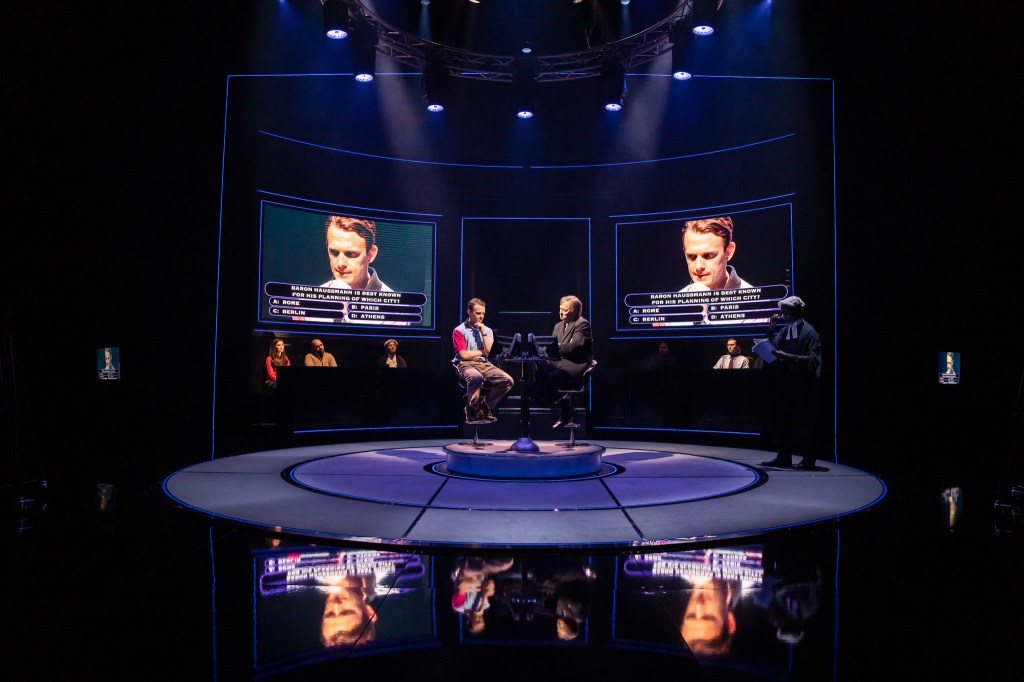
The play is unique in its approach. The stage is designed to look like a hybrid between a British court and the Who Wants to Be a Millionaire? set, with its signature in-the-round audience, designed to make the contestant feel trapped and stressed.
The present/actual setting is the courtroom, and there are many flashbacks. The first flashback sees the creator of the show (Stefan Adgebola, charismatic and charming) talk us through the history of the show, before we eventually meet the Ingrams and Diana’s brother, Adrian Pollock. We are then introduced to an underground network who are playing the show rather than playing the game. It really is quite shocking.
The play acts out several Who Wants to Be a Millionaire? questions. Some of the questions are hilarious. One question asked the name of Audrey’s daughter in Coronation Street. The audience were asked to vote, and like 95% got the answer right: Gail. Presenter Chris Tarrant (perfectly embodied by Rory Bremner, FKC) remarked, “You can tell you’re in Manchester”. These interactive moments make you feel like you’re a part of the show; like you are actually in the TV studio’s audience and a member of the jury. It’s genius.
There is even an Emmerdale question, referencing Charley Webb, who is making her stage debut as Diana Ingram. We were sat right behind a few Emmerdale cast-members; I could see Gaynor Faye smirking.
The second act opens with the Ingrams being hounded by members of the public coughing at them and a montage of international news reporters covering the trial. The latter is funny but a bit long.
The play has some great design elements and attention to detail. For instance, during a karaoke sequence, there is a flashback. The screens, which previously showed the lyrics, now read “flashback”, and as is the case with karaoke, the letters gradually change colour as the flashback plays out. These little design choices are a real nice tough.
One of the most interesting aspects of the play is the TV show’s creative teams’ frustration that most of the contestants are middle-class and White – and mostly male. This is touched on a few times. The Ingrams are, of course, noticeable middle-class.
Before entering the auditorium, you are given branded key pads with four voting options: ABCD (reflecting the multi-choice questions used in the TV show). The key pads are only used on a few occasions. They are very much a novelty but a nice touch, especially at the end of the show when you are asked to vote “guilty” or “not guilty”.
I’m pretty sure that almost everybody is convinced that the trio are guilty after the first act – indeed, I said “guilty” during an interval vox pop without a second thought – but the second act flips the script. The play makes use of unreliable narrators: the flashbacks we see are how the characters describe them in court, rather than objective portrayals.
At the end of the show, our audience voted 51% not guilty, 49% guilty – the result, showed onscreen, was followed by a great, big gasp. The previous three audiences had very mixed results but they leaned towards “guilty” – one of them heavily so.
I voted “not guilty” but, honestly, I’m not sure.
What the play does not tell us is that Ingram was subsequently convicted of an unrelated offence involving insurance fraud in 2003 and ordered to resign his commission as a major by the Army Board, which pushes me towards “guilty” – but maybe he just became the fraudster that everybody had told him he was, especially because he and his family were now struggling financially.
The ending of the play offers a few theories of how the trio might have cheated. Ultimately, we don’t know – but, legally, they are guilty.
In this scene, the cast speak directly to the audience. Torrent remarks, “Charles is not a good actor”, with Lewis Reeves (Unforgotten, I May Destroy You) breaking out of character and saying, “Hey!”. Torrent responds, “The real Charles”. By breaking out of character and tearing down the fourth wall, the creatives are reminding us that this is merely a dramatic, fictional account of what happened. We don’t actually know, for sure, if the trio is guilty or not.
I will admit that I was low-key rooting for the Ingrams. Not only are they incredibly likeable but the effort they went to to get on the show and then win it is incredible.
The supporting cast is spectacular, especially Sukh Ojla (Hospital People, Victoria & Abdul, The Emily Atack Show) and Leo Wringer (The Moonstone, Heirs of the Night), who excel at playing a number of very different comedic characters. Marc Antolin (Keeping Faith), Danielle Henry (Emmerdale, Doctors), and Jay Taylor (Donkey Punch, Prime Suspect 1973) all shine whenever they are onstage.
Sadly, Mark Benton was off. I had been watching Shakespeare & Hathaway – Private Investigators, my new favourite TV show, when I found out that he was in the play. Whilst I was disappointed not to see him onstage, understudy Dean Graham was terrific in all of the roles that he covered.
Graham is usually a member of the epic ensemble, alongside Valerie Antwi and Simon Victor – all three cover an impressive number of roles.
Quiz is a riveting rollercoaster of a play which will have you on the edge of your seat, whether you remember the scandal or not.
Quiz runs at The Lowry (Lyric Theatre) until October 28 and tours the UK until November 25.
Photo: Johan Persson

 JADAR
JADAR 