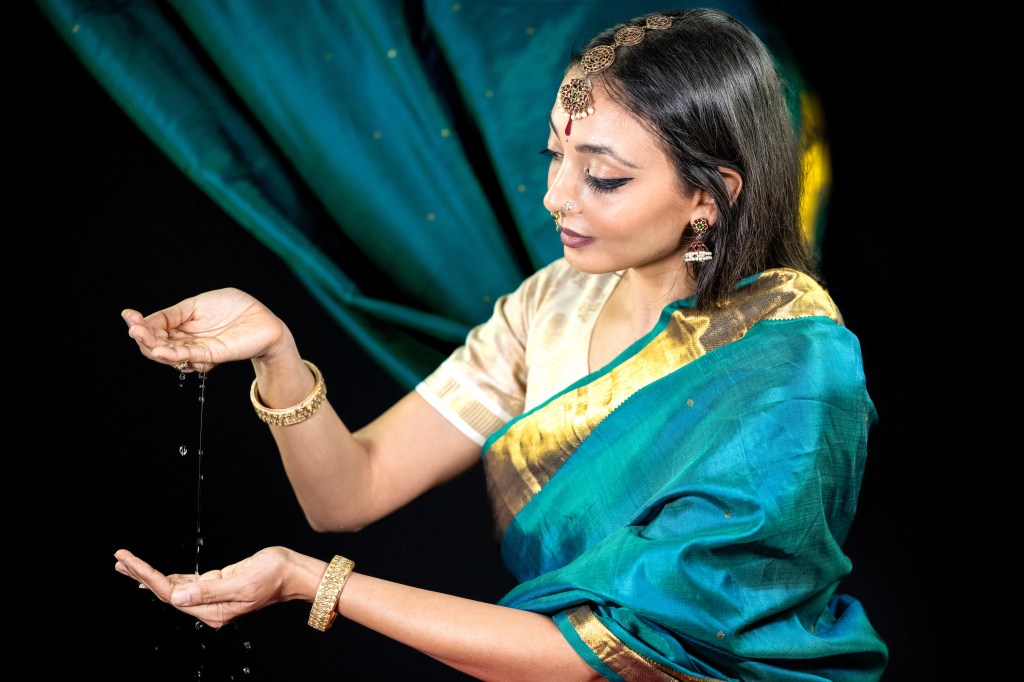
Seeta Patel is an award-winning British choreographer and dancer of South Asian origin; her background is in the South Asian dance form of Bharatanatyam.
Seeta’s reimagining of Igor Stravinsky’s The Rite of Spring premiered at Sadler’s Wells and is set to embark on a mini UK tour, which will visit Manchester. We sat down with Seeta ahead of the tour to talk about her background, her hopes, and her ambitious new show.
Dance is an important part of South Asian culture and identity but South Asian parents often place more value on academic careers. My dad has always valued my brothers’ aspirations and success more than mine because I work in entertainment whilst they have more “serious” career paths. Do you recall your family’s response to you wanting to dance professionally?
S: “I studied Medicine at Nottingham. My father didn’t want me to study medicine because he believed being a doctor was an incredibly difficult profession and he really just wanted me to go into business, have a more financially lucrative role without having to work long hours like you do if you’re a doctor.
“I was lucky because my older sister trained as a fine artist so there was already one artist in the family who was taking it quite seriously, went to art school and that sort of thing, so I didn’t feel a heavily negative pressure. I didn’t get the major pushback that I know a lot of people face within South Asian culture.
“But the way I segued into dance as a profession was a little bit stealthy to be honest. During the end of my third year in Med School, I got a job at a dance company so my university gave me a sabbatical, and then a one-year sabbatical turned into two, and by that point, I knew I wanted to do this full-time. I suppose this was a soft way in for my parents and my family to consider me as a professional dancer because it wasn’t a big dramatic ‘I’m leaving and never going back’.”
This year marks 20 years since you started dancing professionally, and you recently received Arts Council England National Portfolio Organisation. Congratulations! What was that experience like?
S: “What a year. These milestones of decades passing creep up on you, and all of a sudden it’s 20 years since I left university to become a dancer. So much has happened, it’s strange to take a second to reflect.
“Obviously, this has been a very big year with The Rite of Spring having its premiere at Sadlers Wells’ main stage. One of the biggest works I’ve ever staged to date as well as becoming a National Portfolio Organisation which has given my company and I an infrastructure and stability to deliver more with a bit more support.
“It is different for me now that, after 20 years, I am no longer a freelancer. It is wonderful to think that I am in this position now. It comes with different challenges and more responsibility, but I am very, very grateful that this level of support from the Arts Council means that I can hopefully keep doing this a bit longer, and a bit better and bit bigger if I want to. I feel like it’s definitely a real milestone and I hope I can inspire other younger dancers with the successes I’ve had through hard work.”
South Asian performers are underrepresented in the arts, and I imagine things were even worse 20 years ago. What were things like when you first started?
S: “I think with regards to the representation of, not just South Asian artists but other diasporic artists from different cultural backgrounds, there’s always going to be a disparity in representation which is such a shame. I would love to think that it has shifted seismically from when I started, but I don’t know if it has.
“I know that there are definitely good intentions and initiatives, and people talking more about diversity, equity and inclusion. And there’s more accountability if people aren’t supporting more diverse practices. But when you’re immersed in a field you put yourself in places where you see that kind of work, but I think deep down we all know, in these sort of fringe sectors like South Asian dance or other diasporic forms, that we are a minority in this space of arts and often we can be treated in a very particular way as token representation. A voice that’s invited to the table but only under certain parameters.
“I feel very strongly about speaking out against bad practices but it is a tiring burden. However, if we don’t speak out against bad practices and push for increased representation, I don’t think that we will get further. In fact we might start to regress which would be a terrible thing.”
I have noticed an increase in South Asian art in the past year. There are more South Asian commissions and productions, and as aforementioned, you received Arts Council England National Portfolio Organisation. Last year, the BBC commissioned my queer South Asian documentary, Bend It Like Bollywood, at Sheffield DocFest – which might not have been considered a few years back. Do you think that South Asian artists are finally being recognised and respected?
S: “Congratulations on your documentary! I absolutely think South Asians are being respected and valued more than ever. I definitely think there’s more empowerment, there are more artists who are much more clued-up and politicised, and it always helps when younger artists are engaged in this sort of dialogue.
“So many South Asian artists across theatre, dance, music, film, TV, radio are doing incredible things, and it is being increasingly recognised, and I definitely think we have to keep pushing for it.
“Personally I feel like I don’t want to be exotified or put in a museum box as a ‘world’ or ethnic artist, but sometimes, sadly, that does happen, no matter how subtle it can be. But I still get a lot of joy when I see good South Asian work succeeding and being recognised, and it’s really heartwarming, it’s brilliant. I’m so glad to be a part of a community so rich with talent.”
Your latest work, The Rite of Spring, is a reimagining of Stravinsky’s iconic ballet. Why did you want to reimagine that specific work in the Bharatanatyam dance style?
S: “My background is in the South Asian dance form of Bharatanatyam and the solo practice (which is the normal way this dance form is often presented). It is still very dear to me. Funnily enough, I actually never really liked group work, but it got to a point in my career where I thought, ‘Well, why don’t I try to create something within an ensemble format in the Bharatanatyam genre?’
“So it really started as an experiment with some well-known Western contemporary ballet works such as Swan Lake and Bolero. The Rite of Spring was one of them because it has been interpreted by many choreographers from Western Contemporary forms and ballet, and it was clear straight away that Bharatanatyam and Stravinsky’s Rite of Spring are incredible bedfellows. They absolutely work together.
“I still can’t believe I’d never seen any other Bharatanatyam maker make work in the style to this score because it perfectly fits. It’s brilliant, it’s so powerful, and the rhythmic nature of Bharatanatyam somehow elevates everything and brings it to this even more powerful world.
“So yes, I did it as an experiment and it just called to be made. From starting with a small cast to growing it to a large cast of 10-12 dancers, it’s absolutely flourished into exactly what it should be.”
How faithful is your reimagining to the original?
S: “I don’t normally want to look at other people’s choreographies but when I started to meaningfully research and consider making the entire work of The Rite of Spring, I thought it was important to understand how the original by Nijinsky was made, and another iconic version by Pina Bausch, in terms of the narrative.
“I used some elements to inspire me, however, I didn’t follow the narrative exactly in so much as often the Chosen One who is sacrificed is identified closer to the end, and then there’s a big crescendo when they dance themselves to death so that Spring can come.
“My approach is slightly different, where I identified the Chosen One much earlier in the work, and then we go on a journey with them as they accept the burden of their fate. Mine is also slightly different in that the Chosen One isn’t the one who is sacrificed but is elevated to a deity status by the community who then sacrifice themselves one by one and disappear between the Chosen One’s legs at the end – almost like a reverse birth.
“To me, that speaks more to the cycles of nature, seasons, the world and the universe. Also, I thought it reflected more of an Eastern philosophical way of thinking, something less linear and terminal in terms of death, but a circularity of a reverse birth that can lead to a rebirth. That speaks to me of reincarnation or something where we really feel like it could start again in order for life to remain in motion.
“So yes, I have remained faithful to some of the deeper concepts of paganism, ritual, and nature, and there is a Chosen One, but there is a different take and twist in my version.”
Tanika Gupta MBE FRSL said that it is hard to get original work commissioned so playwrights often instead reimagine classics as a way around that restriction. Her South Asian reimagining of Great Expectations recently played at the Royal Exchange Theatre. Is this also the case in dance or is dance commissioning more open?
S: “I actually think that in dance, you often see more new commissions and original ideas, and it’s actually quite scary to take on or reimagine an existing piece. I think, for me, it was more scary to do something that is well-known than make an original composition because I feel the burden and weight of the history of this piece.
“Also, it’s almost a running joke within the dance community that there are quite a few different Rite of Springs on tour at any given time – it’s funny but it’s also testament to a composition and piece of music that has inspired, and continues to inspire, over 100 years after it was first premiered.”
Your art is inherently political. Do you have a target audience? Are there specific groups who you would like to enlighten about certain topics?
S: “I feel inherently political because I’m a woman of colour from a migrant family, living in a place where ethnically my people aren’t from. However, I was born and raised in the UK and have British sensibilities as well, which in and of itself is inherently political as you can’t erase those different aspects of yourself.
“I don’t really feel like I have the privilege to function in an apolitical way. I also don’t think it’s very responsible to be apolitical in this current climate’ I think we need to be strong otherwise we will be outrun by right wing fascists which is a terrifying thought.
“I think I have absolutely made work and been in work that has some sort of political message, and I hope will speak to audiences that will come and understand something that maybe they didn’t before, or provoke thinking to broaden perspectives and experiences. People who don’t have the same experience should see themselves and people whose experiences are reflected on stage by someone like me should come and see it – it’s for everyone because it’s about humanity and the richness of what that is.
“With a work like The Rite of Spring, what you see on stage may not be considered political in the way I’ve done it, but the context of it, in as much of where it’s being invited, where it’s being staged, what we’re doing in the sector by creating larger scale work in higher profile spaces, where these kinds of things aren’t often seen, how it’s being spoken about, how it’s being received, and the kinds of challenges I have faced in getting to this point.
“All of those things are political and they always come up in post-show talks or interviews. Even the dancers during the creative process were constantly self-aware of our place and situation within the wider context of dance and the arts in the UK and globally. So, it may not manifest aesthetically in the work but it definitely sits within a very political space.”
The Rite of Spring tours the UK this November: it plays Lighthouse, Poole’s Centre for the Arts on November 15; The Lowry (Lyric Theatre), Salford on November 21; and The Anvil, Basingstoke on November 23. For more information on Seeta Patel, head to her website.

 JADAR
JADAR 