★★★★☆
Whether you find the opera playful or tragic, you are no doubt having fun with Falstaff.
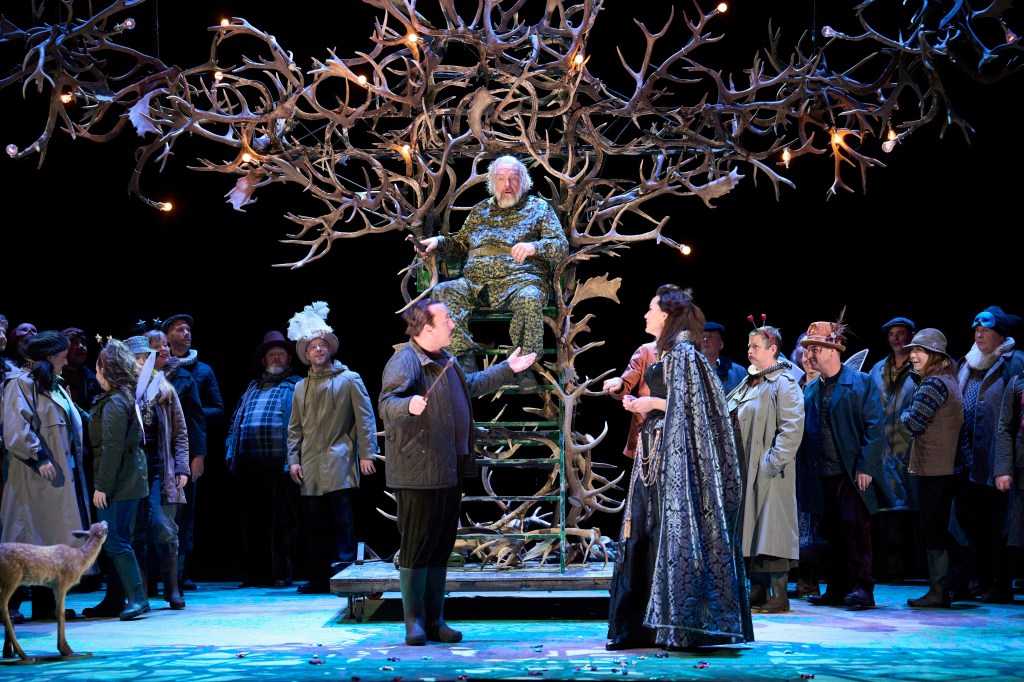
This week, the Lowry welcomed Opera North’s “Green Season“, which kicked off with director Olivia Fuchs’s sustainably staged production of Verdi’s Falstaff, which is based on Shakespeare’s The Merry Wives of Windsor.
Opera North surprised audiences by blending the atmosphere of the 80s with Shakespeare’s fairytale, intertwining creatures and people in a mysterious tapestry.
Our “huge” hero, Sir John Falstaff (Henry Waddington), appears to the audience in a rundown caravan parked up behind a pub, assessing all the physical and financial damage of his latest night of excess. That is when he comes up with a “great scheme” to get his hands on some cash by seducing two wealthy wives of Windsor: Alice Ford (Kate Royal) and Meg Page (Helen Évora).
His powers are not only in his fat belly, referred to by Mistress Quickly (Louise Winter) as his “big asset”, but also in his immunity to embarrassment and, in some way, a simple but open mind.
Throughout the whole play, Falstaff and other characters have fun of their own in attempts to fool each other. In a grotesque twist of irony, Falstaff, who always give horns to others, voluntarily puts antlers on after a brief terror of growing old and sensing an approaching demise. By the end of the play, however, you realise that even in the most tricky situation (by the Oak tree in Windsor Park), he is the one who enjoys the show and gazes from above.
The finale, ‘Life is a Burst of Laughter’ (“Tutto nel mondo è burla”) gives you a bouquet of feelings so that you laugh at life itself.
The opera is sung in English. While I get that it enhances the perception, I personally did not enjoy it as much as if the opera was in the original Italian language. It feels like the charm of the whole performance is lost, and since the music is supposed to coincide with the libretto, a final piece of this whole puzzle is missing when it is translated into English.
This doesn’t impact, of course, Henry Waddington’s bass-baritone and his incredibly funny “Alice is Mine” (“Va, vecchio John”) aria. The Opera North debuts of Kate Royal and Isabelle Peters (playing Nannetta) cannot be unnoticed either. Kate’s soprano is so magnificent and impeccable that you unconsciously fall in love with it. Isabelle’s ability to keep the highest notes can impress the toughest audience. Even if you are not a fan of soprano, you will be after hearing this performance.
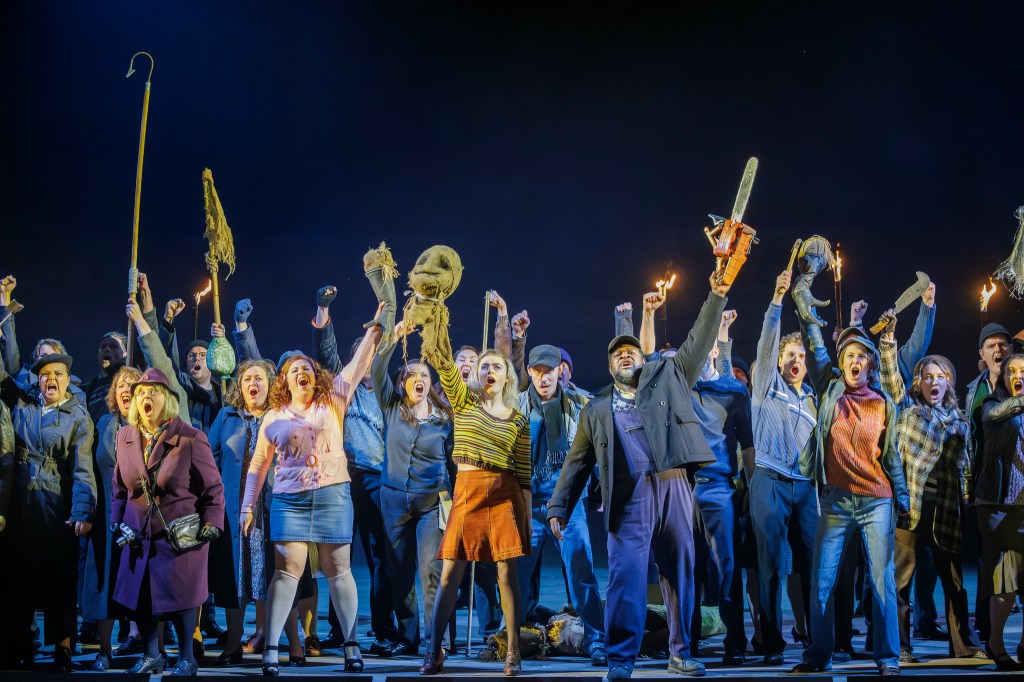
At the end of Act 3, you realise that the opera is stingy on chorus. The whole opera is sung by 10 people, and only at the last scene is there a choir of fairies and nymphs, which creates a magical feeling of dozens of voices entangled together in something enchanting.
The conductor, Garry Walker, and the orchestra maintained Verdi’s initial opera’s energy and grace. The music accompanied every scene in the best possible way and stressed attention at some movements so perfectly that the audience could not save a giggle or a sigh.
At some moments, the music was so loud that all the voices would vanish into the background. This is, however, a feature of many operas where the orchestra is so grandiose that it is impossible to turn the volume down.
A bit confusing at first, but quite interesting in the end, were the pauses between the scenes. The rainbow-striped butcher’s curtain, silence, and dimmed light delimit the scenes. At first, you think that the pause is too long, and the excitement that you just got from the previous scene starts to fade. Throughout the play, however, you realise that not only do these pauses give you time to process and swallow what you have just seen but they also create a good anxiety of what is coming up next.
This opera is watched with ease and laughter and will have you in a good mood afterwards.
Opera North wraps up its Green Season at The Lowry (Lyric Theatre) on November 18. Masque of Might (a new piece using the music of Purcell) played last night, Puccini’s La rondine plays tonight, and Verdi’s Falstaff returns for a matinée performance tomorrow.
Photo: © Richard H Smith
 JADAR
JADAR 