★★★★☆
Sir Matthew Bourne OBE is one of only two theatre-makers whose shows I will never miss. Ballet is a prestigious art form which many find alienating and inaccessible – or even boring. Bourne breaks down barriers and breathes new life into the restrictive art form, welcoming in people who might not traditionally watch ballet. Whilst he generally reimagines and modernises iconic ballets, Edward Scissorhands is, of course, a dance adaptation of the acclaimed Tim Burton film.
Whilst Bourne brings a ballet to the Lowry around this time every year, we were blessed this year with a ballet in the summer – the halfway point. Romeo + Juliet differs to most of Bourne’s ballets in that it is not a visual feast; the set is bare, white and fixed. Rather, the substance is seen in dancing; the clinical set allows the technical dancing to take centre-stage and become the star of the show.
This is in contrast to last winter’s Sleeping Beauty and this winter’s Edward Scissorhands, which are spectacles, with sumptuous sets but not the most striking dancing. Beautiful, of course, but not breath-taking. Nutcracker!, which came to the Lowry the year in late 2021, offers the best of both worlds.
Edward Scissorhands follows the plot of the film quite closely with a few changes – some of which add context and motivation whilst others remove it.
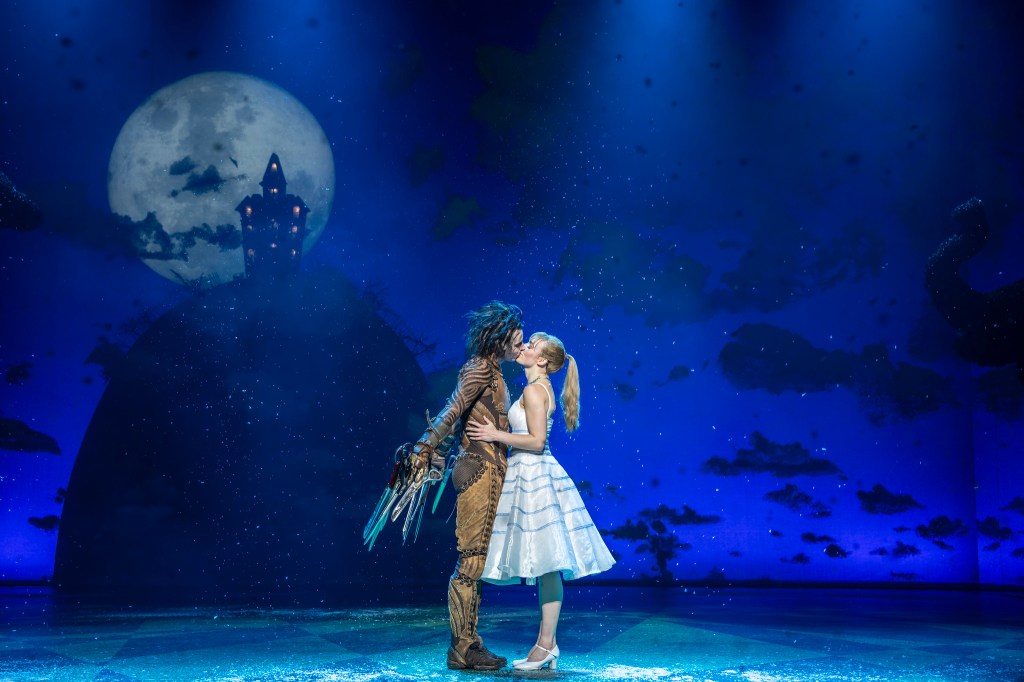
On press night, Edward was played by the sensational Liam Mower, who superbly captures the mannerisms of Johnny Depp’s original version of the character.
Edward is the creation of an old inventor but Bourne provides the inventor with a motivation: Edward is an ageless replacement for his dead son. The inventor dies of a heart attack after being spooked by a bunch of teens, as we are shown in the dim-lit prologue, before the stage opens up and we are transported to suburbia.
Designer Lez Brotherston masterfully recreates the iconic neighbourhood from the film, a pastel-coloured suburb which seems to have inspired other films and TV series which satirise sickly sweet suburban life, from The Stepford Wives to Desperate Housewives, the latter, no doubt, a thematic nod to the former.
The neighbourhood is aesthetically unified with each house painted one of four colours, which the film’s production designer, Bo Welch, described as “sea-foam green, dirty flesh, butter, and dirty blue”.
Brotherston makes the suburb extra quirky, with two house facades so small that the dancers have to shrink down to creep through them, perhaps referencing the ridiculous superficiality of suburbia, and tiny faces of houses plastered behind the two upfront.
The ensemble-led suburban sequences are splendid. Bourne excels at creating background characters as beguiling as the protagonists. Whilst the suburban characters all have distinct personalities, they are also eerily similar and quirky, like characters in a simulation – or, indeed, Stepford Wives.
The main family, who take in Edward, are the adorable Boggs. On press night, Peg and Bill were played by Kerry Biggin (New Adventures’ Creative Director) and Dominic North, whilst their kids, Kim and Kevin, were played by Katrina Lyndon and Xavier Sotiya.
I was particularly enthralled by the religious fanatics. Esmerelda from the film has been given a family – and a surname! On press night, the Evereech family were portrayed by Mami Tomtani (Esmerelda), Reece Causton (Rev Judas – quite the name for a Christian!), Molly Shaw-Downie (Marilyn-Ann) and Perreira De Jesus (Gabriel).
There is even a gay couple, which is a nice touch, but they are performed in quite a stereotypically gay way. On the one hand, it is nice to see two unashamedly gay characters, but on the other, whilst it is not played for laughs, it inevitably humours some members of the audience.
Joyce Monroe, a bored housewife who attempts to seduce Edward, was played to perfection by Stephanie Billers. Sadly, Bourne omitted the storyline in which she attempts to turn the neighbourhood against Edward, as revenge for his rejection, alongside the storyline involving a jealous James “Jim” Upton (Kim’s boyfriend) setting Edward up in a burglary.
This meant that Edward’s “downfall” all came down to him getting drunk (thanks to Jim) and accidentally slashing the face of Kevin Boggs, the son of the loving family which took him in and stood by him even when the initially curious and quickly delighted neighbourhood had turned against him. For the Boggs, this was the final straw. In the ballet, there is no build-up or gradual degradation of the townspeople’s trust in Edward, which decreases the drama and feels less impactful.
I suspect that Bourne wanted to condense the story but there were other bits which could have been cut, or cut down, including the group dance at the ball, which lasted too long, especially because, as aforementioned, the dancing is not as captivating as seen in some of his other productions.
The production value is incredible, from the sumptuous sets to the incredible costumes (including Edward’s titular scissorhands) and even Edward’s remarkable creations, including the iconic topiary. Early on, Edward trims down a bush into a star, with leaves flying all around. This received an applause from the audience. A woman with a shaved poodle then walked past and Edward hilariously chased after them. In the second act, they return, with the poodle donning a new, sharp look, much like the people brave enough to visit Edward’s salon.
There is even a number in which trimmed bushes come to life and dance alongside Edward and his love interest, Joyce. Then there’s the huge ice statue which he creates of her. The set design is enhanced by Howard Harrison’s luscious lighting. Harrison excellently captures multiple moods, sometimes simultaneously.
Terry Davies’ score – which is, in part, based on Danny Elfman’s iconic film score – is aurally delightful, especially his rendition of the much-loved ‘Ice Dance’, which plays when Edward and Joyce dance around the ice statue.
The design is truly bewitching, so much so that it overshadows the dancing. Sometimes, the dancing is merely movement, as if the performers are merely communicating without words, which might disappoint some people.
Bourne prioritises creating a surreal world with eccentric characters. It is remarkable how easy to follow the story is, even though the performers do not utter a single word. The simpler dancing (relatively – compared to his other works) arguably aids in helping the viewer follow the plot more easily.
Edward Scissorhands is a magnificent production with majestic design, marvellous music – and movement which will move you, even if it falls short of mesmerising you.
As far as contemporary ballet is concerned, Bourne remains a cut above the rest.
Edward Scissorhands runs at The Lowry (Lyric Theatre) until December 2 2023 and tours the UK until May 25 2024, before heading to Koninklijk Theater Carré, Amsterdam, The Netherlands from May 29 to June 2 2024.
Photo: Johan Persson
 JADAR
JADAR 