
★★★★☆
“I am a Jew. Hath not a Jew eyes? Hath not a Jew hands, organs, dimensions, senses, affections, passions; fed with the same food, hurt with the same weapons, subject to the same diseases, healed by the same means, warmed and cooled by the same winter and summer as a Christian is? If you prick us do we not bleed? If you tickle us do we not laugh? If you poison us do we not die? And if you wrong us shall we not revenge?”
— Shylock, 3.1.60–70
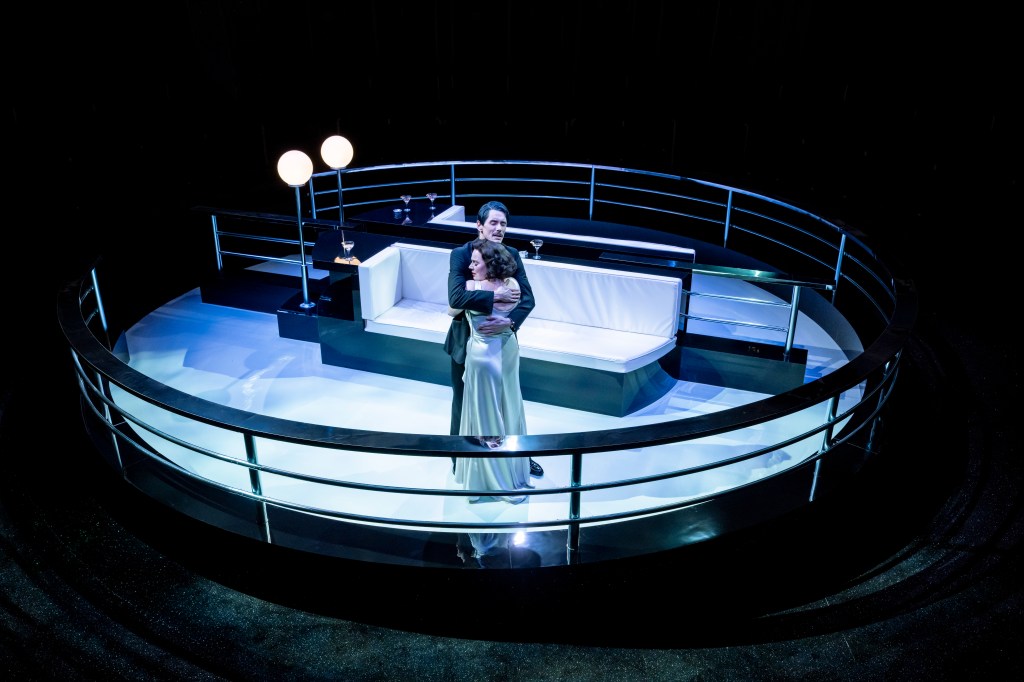
The Merchant of Venice 1936, directed by Brigid Larmour, is a passion project conceived between Brigid and leading lady Tracy-Ann Oberman. It intriguingly adapts Shakespeare’s original play and places it within the context of the fascist and antisemitic culture in Britain during the 1930s, with Shylock portrayed as a loving matriarch hardened by the cruelty and discrimination she faces at the hands of cruel men like Antonio. It simultaneously brings to light the forgotten culture of racism within Britain’s history, allows us to reflect on the abysmal continuation of such prejudices, and echoes the original Shakespearian context.
Like the original, no character is truly pure-hearted; Shylock is so down-trodden by the cruelty of Christians that she becomes fixated on exacting the “pound of flesh” from Antonio beyond all mercy; Antonio acts as a great friend to Bassiano yet is irredeemably arrogant, hypocritical and antisemitic; Portia has prejudices to all the men that pursue her hand in marriage and is cunning and deceitful despite her loving temperament with Bassiano; and so on.
Even Shylock’s daughter, a starry-eyed, naïve lover, turns her back on her mother, abandons her faith, steals all of her mother’s jewels, and runs away. Despite the similarities, the play brings a more sympathetic approach to Shylock’s character. While we are shocked by her obsession with vengeance, the matriarch angle allows us to gain a closer insight to her emotions and understand her feelings of helplessness after her daughter, possessions, and all sense of justice and humanity are robbed from her by a world that criticises, damns and abuses her faith. This new angle allowed for a more emotional retelling, as well as the revelation of a darker aspect of British history that’s often hidden by the Britain vs the Nazis narrative.
These themes were also brought to life by increasing propaganda, anti-semitic posters, slurs and damage across Shylock’s house, as well as projections of war-time newspapers and videos that reflect the rising tensions in a nation of hate, and the inescapable feeling of entrapment Shylock finds herself in.
Extra on-stage seating, an introductory wave to the audience as cast-members enter the stage from the stalls and stage doors, and a concluding request for the audience to stand with them against racism as they finish the segment with the Battle of Cable Street, just after Shylock is forced to denounce her faith and half her estate as the law is flipped viciously on her head, much to the amusement of the Duke and rival party.
The only minor flaw I could note (which was of personal taste rather than anything significant) was that transitions between scenes were sometimes a little distracting, with a rather dramatic walk-on from Shylock or other characters as the scene is set up by a range of other cast-members that occasionally withdrew me from the immersion into this well-crafted world.
With raw and passionate acting, interesting additions to the original text, and a brand-new lens to understand Shylock, The Merchant of Venice 1936 is an astounding emotional rollercoaster that deserved its standing ovation.
The Merchant of Venice 1936 runs at HOME (Theatre 1), Manchester until December 2 2023 and poetically ends its UK tour at Swan Theatre RSC, Stratford-Upon-Avon, where its runs from January 24 to February 10 2024.
Photo: Marc Brenner


 JADAR
JADAR 