★★★☆☆
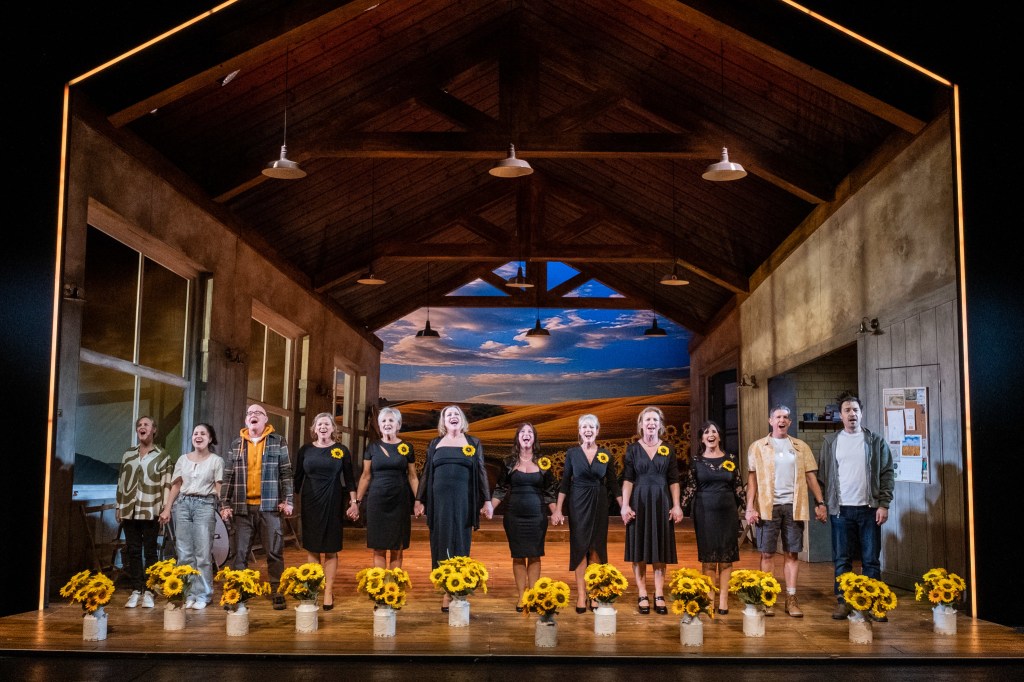
Calendar Girls, formerly known as The Girls, is a stage musical based on the film (and its stage play adaptation) of the same name, with music by Gary Barlow, lyrics by Barlow and Tim Firth, and a book by Firth (who also wrote the film and the play).
Based on a true story, it follows a group of middle-aged and elderly Yorkshire women who, following the death of one of their husbands, decide to create a nude calendar for a cancer charity.
The story goes exactly like you would assume: one of the women outrageously suggests creating a nude calendar; there are disagreements and even arguments but in the end they all come around and create the calendar, which is a roaring success.
Unfortunately (or perhaps fortunately because the musical sometimes drags), the musical omits the later scenes in which the success of the calendar causes rifts between the women – especially the main two (Annie and Chris), who are best friends – before they eventually smooth things over. In the musical, there is a brief heated moment between Chris and Marie, but it is a last-minute attempt at drama which is quickly dismissed. The story, as it stands, has low stakes and is thus never that exciting, though it is certainly inspiring.
The all-star cast, which was presumably assembled because each actress used to be in something which some people used to watch, deserve praise. Each character is distinct, though they arguably each embody an archetype.
The 2024 core cast differs slightly to the 2023 cast, with only Maureen Nolan, Lyn Paul and Honeysuckle Weeks remaining.
Laurie Brett (EastEnders, Waterloo Road) leads the cast as Annie, a friendly, frumpy woman who is foiled with Chris (Coronation Street‘s Samantha Seager), her wild-child best friend who admirably refuses to conform to society’s idea of what a middle-aged woman ought to be like.
Honeysuckle Weeks (Foyle’s War) plays the criminally underwritten Cora, the Sporty Spice of the group (a down-to-earth, salt-of-the-earth, small-town mother), whilst Celia (Hollyoaks‘ Helen Pearson) is a designer-loving, M&S-shopping tot who has “had a little work done”.
Maureen Nolan of The Nolans plays Ruth, a seemingly ordinary woman who is later revealed to have a bit of problem with alcohol (also known as her “Russian Friend”).
Whilst Nolan excels at showing two sides to the character, the reveal comes too late for the audience to care. The problem could have been handled with more sincerity and seriousness; it feels a little flippant, and nothing is really done with it until Ruth, who initially refused to do the calendar, turns up to the shoot late, the alcohol giving her newfound confidence. This raises questions about consent.
The core six is rounded off with an older woman, Jessie (Lyn Paul of the New Seekers), a retired teacher who used to teach the other women. She’s good fun but calmly demands respect from her former students, who even refer to her as “Mrs”. It’s relatable – if I bumped into an old teacher, I’d still address them as such!
The local Women’s Institute is led by the prim-and-proper Marie (Liz Carney, who was previously a member of the ensemble). She is very much an outsider – and arguably for good reason. If the other women were Desperate Housewives, she would be Edie (minus the sex-mania).
The women are all good vocalists. Paul is almost 75 but she can still sing wonderfully. Seager and Carney deliver the best vocals. Carney, the only actress who does not have a Wikipedia page, has been cast because of pure, unadulterated talent. The number in which Marie ferociously lambasts Chris is tantalising – and it allows you to appreciate both women’s viewpoints.
Most of the women (bar Cora, for some reason) get to lead a number in which we learn more about them – if this was a TV series, it would be like each woman getting an episode which focuses on them – and these are all diverse in both tone and sound.
However, the score, overall, is a little flat – and certainly not what you would expect from the main songwriter of Take That. It is very Yorkshire – perhaps too Yorkshire. Indeed, the musical seems to be defined by its Yorkshire setting, which makes it feel very much like a soap (especially Yorkshire-set Emmerdale), which most of the actresses are known for having appeared in.
There are some lovely lyrics, especially in the metaphoric number ‘Sunflower’, where the ladies compare life to a sunflower (“Like a sunflower following the sun, won’t give up until the day is done”) and a sunflower to a satellite dish (“Like a satellite dish for sunshine”). But these are not songs you’re going to be humming along to for days – mainly because you forget them the moment they’re finished.
However, the repeated signature song, unsurprisingly called ‘Yorkshire’, is a lovely ear worm, but it does become a little tiresome; you’ll be picking your ear to get it out.
The static set is well-designed but unexciting. There are set pieces which are brought on and off whilst hospital signs are lowered from above to transport us from the principal setting of the Methodist church to the secondary setting, the hospital. Riveting…
The narrative is bottom-heavy, with all of the exciting stuff occurring in the second act. The first act is just getting to know the women, and Annie’s husband’s health decline and death, with the prospect of the nude calendar (the women produce a calendar each year) not being brought up until the end of the first act.
Whilst the musical was probably originally called The Girls to differentiate it from the earlier stage play adaptation, that might have been a better title because the calendar very much comes second. The chips are not salted until the end of the first act – and by then, they have gone cold.
The moment we were all waiting for – watching middle-aged and older ladies strip and celebrate their diverse bodies – comes towards the end of the show. The photoshoot is excellent. Each pose received an applause from the audience. The women get to put a bit of themselves into their photos, for example, Jessie hides herself with a cloth she has knitted. Weeks is especially brave – she bares it all!
Calendar Girls is not so thrilling but it is fun and feel-good – and it might just be capable of bringing both tears of sadness and joy to your eyes.
Calendar Girls runs at The Lowry (Lyric Theatre) until January 20 and tours the UK until April 13.
Photo: Jack Merriman

 JADAR
JADAR 