★★★☆☆
After almost 30 years since the show ended, the political satire Drop The Dead Donkey is back in the unexpected form of a theatre show, seeing the original cast and a couple of new characters return to the spotlight as they reveal the bizarre yet cut-throat world of news journalism – and the tendency for some news outlets to lean towards algorithms and fake news for the clicks.
Previously, the television series had been set in a company named Globe-link news, which created entertaining comedic sketches that exposed the tropes of disaster media, for instance, Dimbles the teddy (who makes his return in the show via a flashback video and reappearing for new gags) being placed at disaster scenes as an exploitative way of garnering sympathy – a callback to a trope still seen in news broadcasts today.
Their mocking of political figureheads like Margaret Thatcher also gained the show attention as they were using current news stories and willing to mock the way politics and the news worked in ironically inventive skits.
In some sense, the original can be compared to some combination of shows like Have I Got News For You and The Office, blending comedy sketches with acting segments for satirical purposes.
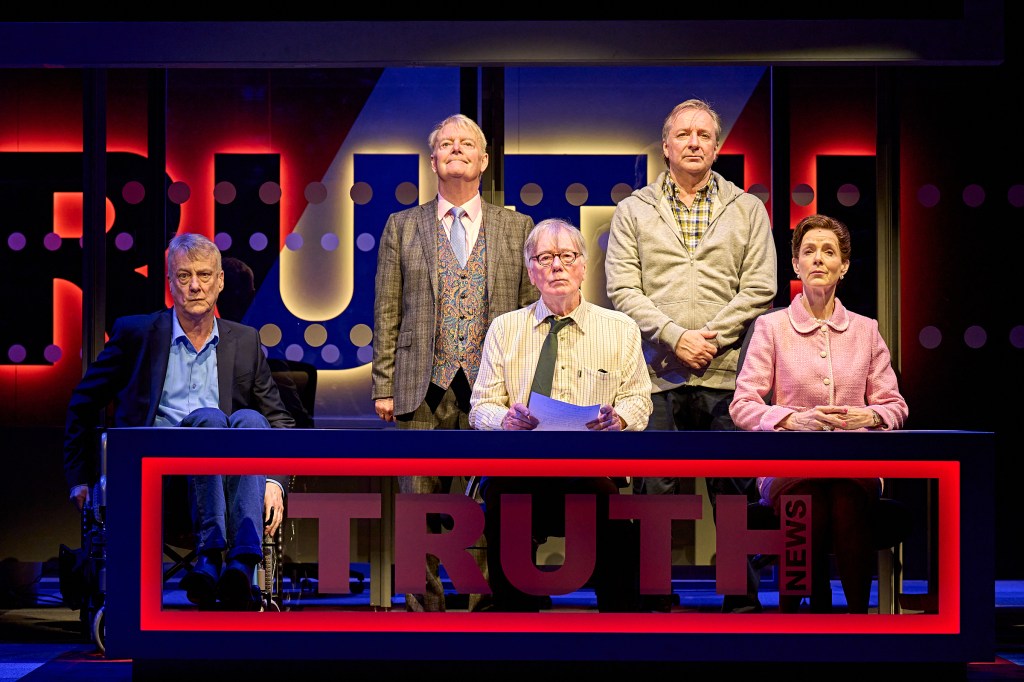
The new play, like the previous play, follows the antics of the original cast: Joy, Mairead, Helen, Dave, George, Damien and Sally as the old friends reform after Gus invites them to work for Truth News, a strange news company ran by the algorithm, an unknown foreign benefactor, and mischievous voice-activated coffee machines drowning the set in Espresso and the like.
Also invited to the group is the new 19-year-old “weather girl-presenter” Rita, offering a fresh perspective on their antics and comedically pointing out the age of Sally with requests for selfies for her grandmother to enjoy.
DTDD particularly finds success in the reunion of this witty and personality filled cast, whether it be the snide remarks and pessimism of Joy, the Cavalier arrogance of Sally, who was commonly mocked for her part in an underwear-based gameshow and her obsession with being the centre of attention, the gentle yet absentminded George, and the skits between resident liars Dave and Damien.
The plot is a bit slow and aimless to begin with but things soon get going.
While a newcomer to the series like myself misses out on some of these heavy hues of nostalgia, the charismatic cast and their endearing personalities make the reunion feel just as fun and authentic.
Ironically, despite her haughty nature, I found myself most intrigued by Sally and her relentless self-centred endeavours as she complains about having the first line, victimises herself, threatens legal action, and is forced into making more ‘cutting edge’ interviews filled with ignorance and evocative fake news.
One particularly hilarious sketch had a digital interview with renowned journalist Sir Trevor McDonald end in disaster as they electrocute the national treasure on air, among accusing Sir David Attenborough of bestiality, misnaming Xi Jinping as eleven, and insulting figures like Matt Hancock and Rishi Sunak.
However, at times, I did feel I was out of the age range of the show, with jokes about gender fluidity and inclusivity, such as: having a “non-white” person, a “disabled” person and a lesbian on the team to boost the inclusivity ratings of the news channel, feeling a little on the nose and awkward at times.
This, alongside jokes about shared bathrooms, Damien’s “vehicular” mobility and woke culture were few and far between but felt rather uncomfortable.
Whilst it is later revealed that Damien was using the wheelchair for attention, leading to a gag where he is thrown from the chair by a disbelieving Dave, and a moment where he finally stands while taking a passionate speech, these moments are also overshadowed by an uncomfortable feeling that they are toeing the line between comedy and offensive stereotypes and ideas.
There were also some cringe-worthy social media references.
Overall, while most of the comedy was fun and light-hearted banter that felt accessible even without knowing much about the show’s history, I felt some of the jokes were a little aged for younger viewers and that dialogue about disability and inclusivity felt rather dated and clunky, leaving me a little uncomfortable in these moments.
However, the show was filled with great acting, fun gimmicks from coffee machines to teddy bears, and most importantly, a sense of their long-lasting friendship as they reunited so long after its original TV stint.
Drop the Dead Donkey: The Reawakening runs at the Lowry (Lyric Theatre) until February 17 and tours the UK until June 22.
Photo: Manuel Harlan
 JADAR
JADAR 