★★★★☆
The Full Monty was the highest-grossing film in the UK until it was outsold by Titanic (fair enough). The film was followed by a TV series sequel and two stage adaptations. A Broadway stage musical adaptation relocated the action to the US, before the film’s writer, Simon Beaufoy, brought the story back to Sheffield in his stage play adaptation.
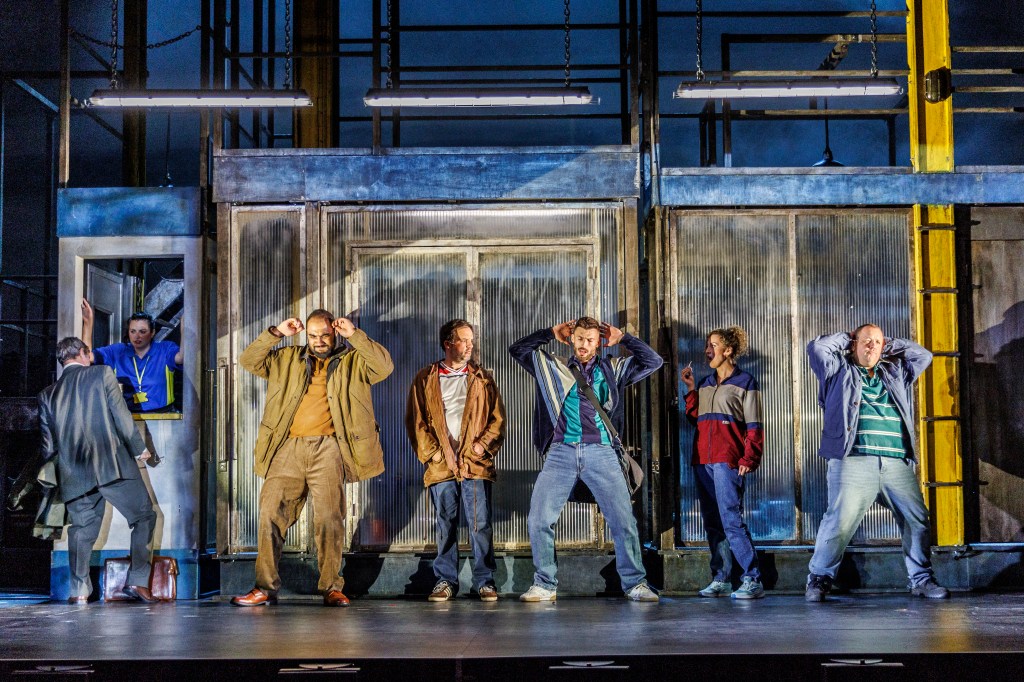
Set during the 1990s, The Full Monty tells the story of six unemployed men, four of them former steel workers, who decide to form a male striptease act (à la Chippendale dancers) in order to make some money – and for the main character, Gaz, to be able to see his son.
Gaz declares that their show will be much better than the renowned Chippendales dancers (who some of the female characters see perform early on in the play) because they will go “the full monty”, i.e. butt naked!
Despite being a comedy, the film is surprisingly touching (metaphorically and literally!). It touches (oh dear) on some serious subjects, such as unemployment, fathers’ rights, depression, impotence, homosexuality, body image, working-class culture, and suicide.
Whilst the film’s core cast was completely White, this production has two people of colour amongst the six amateur strippers. The play employs colourblind casting, which is admirable, but this renders race irrelevant, which it is not, especially in working-class British societies. For a play to tackle so many issues but not race/racism is a missed opportunity.
The dark humour is quite laddish but it works. Even suicide is treated humorously – but not flippantly – which might be a little uncomfortable for more sensitive younger folk and, frankly, anybody who has dealt with suicide or suicidal thoughts. But the play, quite beautifully, allows comedy to be a coping mechanism for getting through troubles and trauma.
Beaufoy presents his characters as flawed, and sometimes a little offensive in the way they talk about women, but that is not to endorse this behaviour. It merely reflects the defeatist attitude of many working-class men in the increasingly egalitarian society of the 1990s, where women were now independent working people – and this remains relevant, with the rise of incels in recent decades and proudly misogynistic commentators and influencers in recent years.
The play is incredibly well cast. Danny Hatchard (EastEnders) makes for a very sympathetic Gaz, who clearly adores his son, Nathan (a fantastic Rowan Poulton, whose proud mother was sat next to us), but does not always know how to father.
Neil Hurst (Fat Friends) often steals the show as Gaz’ supportive but arguably equally dysfunctional best mate, Dave.
Nicholas Prasad had no easy job playing the suicidal, closeted and ostensibly emotionless Lomper – but he sure earned his paycheck and held his own against his better-known cast-mates.
The play repeatedly references the anti-Tory sentiment of many Northerners in the 90s, with a few digs at Thatcher (in the first scene, Dave bluntly calls her a “blue bitch”), but it does not seek to vilify all Tories.
Indeed, Gerald (Emmerdale‘s Bill Ward) shows that Tories have feelings too; they might be Blue but they also bleed red!
Gerald’s snobbish wife is unaware that he has been unemployed for half a year. He has appearances to keep up, not only as an ostensibly well-to-do Northerner (with a sun bed in his house), but also, more simply, as a man. He is too ashamed to reveal the truth to his financially dependent wife, even though her spending is frivolous.
Ben Onwukwe (London’s Burning) makes a late appearance as the hilarious Horse (whose name is ironic), but he immediately demands attention from the audience.
Jake Quickenden makes a long-awaited appearance at the end of the first act as the ballsy (pardon the pun) Guy, an openly gay manual labourer who almost immediately rips off his pants to reveal his envious derriere (he clearly does his squats).
Quickenden is naturally charming and likeable – and Guy’s act 2 exchange with the closeted Lomper is heart-warming.
The play manages to tackle a large number of serious issues without ever becoming soppy or preachy, and it is unafraid to go places where other stories might shy away from – but when the literal premise is men getting their bits out, you can get away with anything!
The production is well-designed. There are some fantastic costumes (especially the sparkly cop costumes in the final scene).
The industrial set is made up several frames, which the cast smoothly move around to establish different settings, completely transforming the stage with each scene-change. Other set pieces are brought on and off with ease. The play lacks a musical’s budget but it makes the most of what it has.
Whilst it is a play, unlike the earlier musical adaptation, it makes use of some of the iconic 80s and 90s songs memorably used in the film, including Hot Chocolate’s ‘You Sexy Thing’, Donna Summer’s ‘Hot Stuff’, and, of course, Tom Jones’ cover of Randy Newman’s ‘Leave Your Hat On’ for the long-awaited strip show.
The only criticism one could level at the play is its unevenness. The first act is quite slow and begins to drag a little. It’s not even just a case of establishing all the characters because the play is very much Gaz’ story, with Dave as the secondary protagonist, and we don’t even meet two of the main characters until the final scene of act 1. But there is a lot to establish, including the ins and outs of the strip show, with act 1 ending with the complete troupe finally formed.
The fast-paced second act closely follows the shaky production of the strip show, as well as further character development and, of course, Gaz’ relationship with his ex-wife and their son. The slowness of the first act actually increases the passion, tension and drama of the second.
The iconic final scene is played for laughs but it is empowering to see men of different shapes and sizes all strip proudly. Whilst there is full-frontal nudity, the play cleverly uses lighting to (mostly) obscure the Montys!
The play’s poster reads, “Sometimes you have to bare everything”. Indeed, The Full Monty proves that less is more.
The Full Monty runs at Opera House Manchester until February 17 and tours the UK until April 13.
Photo: ©EllieKurttz
 JADAR
JADAR 