★★★★☆
This season, Opera North captivates us with a double bill featuring one of the most popular operas of all, Cavalleria rusticana by Pietro Mascagni (sung in Italian), and the equally impressive Aleko by Sergei Rachmaninov (sung in Russian). Both works were composed when the creators were remarkably young – Mascagni at 25 and Rachmaninov at just 19. Despite their distinct narratives, they both delve into themes of betrayal, despair, and tragedy.
Director Karolina Sofulak and designer Charles Edwards skillfully created the dramaturgical link between the two pieces, resulting in a cohesive and fulfilling performance.
Opera North has consistently impressed with its magnificent combination of actors and singers, and this production is no exception. A powerful cast of Giselle Allen (Santuzza), Robert Hayward (Alfio/Aleko), Andrés Presno (Turiddu/A lover), Helen Évora (Lola), and Elin Pritchard (Zemfira) delivers a breathtaking performance.
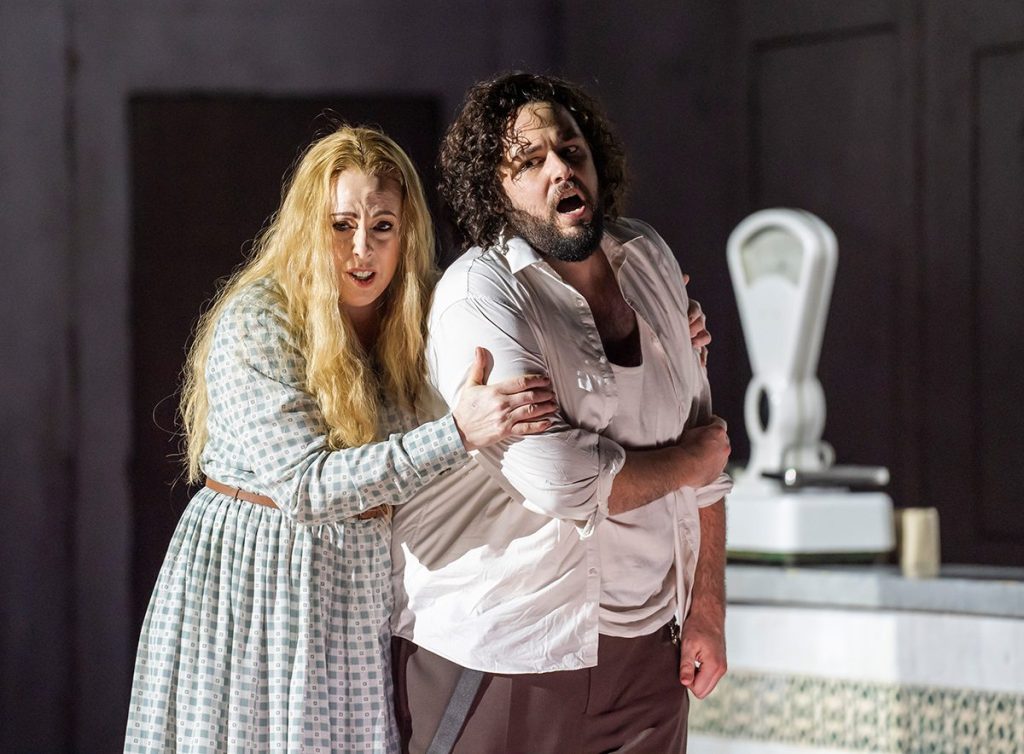
Having previously witnessed Allen and Hayward as Tosca and her nemesis Cavaradossi in 2023, it was a pure delight to see their thrilling duet once again. Not only did Allen impress the audience with her soprano, but she also depicted her character’s emotions ranging from shame and embarrassment to hatred and revenge. Observing her on stage, one can truly acknowledge the unparalleled power of a betrayed woman.
Cavalleria rusticana tells us a story of the young villager Turiddu, who returns from military service to find out that his fiancée Lola has married the carter Alfio while he was away. In revenge, Turiddu seduces Santuzza, a young woman in the village, while Lola, overcome by her jealousy of Santuzza, begins an adulterous affair with Turiddu.
This production offers a modern representation of an old masterpiece, transporting the audience unexpectedly to Soviet Poland with Lucia’s (Anne-Marie Owens) sklep (polish for “shop”), ration stamps, and the only taxi in the village that creates a sensation among the villagers.
Additionally, the inclusion of a religious community surprisingly fits the narrative of seduction and treason, adding more layers of drama and irony to the plot.
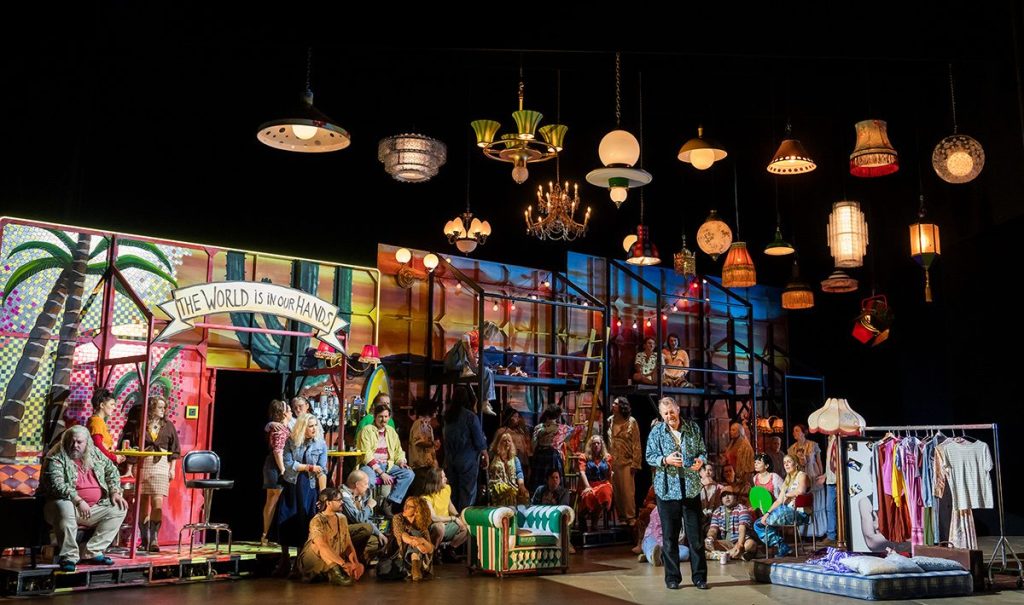
Aleko, on the other hand, depicts a segment of modern society reminiscent of gypsies – the hippie. The story follows Aleko who flees his homeland, pursued by the law for some crime, and lives with his wife, Zemfira, in a Gypsy camp.
Discovering Zemfira’s infidelity, Aleko broods on the catastrophe of his relationship and the failure of his attempt to flee the ordinary world. In a torment of jealousy, he kills both Zemfira and her lover, and is cast from the gypsies forever.
The story failed to be fully unleashed in this production. There was a noticeable absence of passion between Zemfira and her lover, as well as a lack of the sense of freedom within the depicted community.
The link that was created between the two pieces flawlessly intertwines their narratives, shedding light on Aleko’s transition to a new life and the crimes that brought him there.
Notably, viewing the performance in its entirety unveils the tragic tale of a man (portrayed by Robert Hayward as both Alfio and Aleko) who loses two loves to betrayal and subsequently to jealousy and revenge. It’s no wonder he perceives the haunting presence of Lola and Santuzza while experiencing another failed relationship with Zemfira.
Despite any imperfections in this production, its most remarkable aspect lies in the versatility of the cast, who deliver performances in both Italian and Russian (which is not the easiest language to learn). As a Russian myself, I can only evaluate the quality of Aleko, which left me thoroughly impressed despite some unclear moments.
The overall performance of Hayward, Presno, Pritchard, and Matthew Stiff (portraying Zemfira’s father) brought me immense pleasure and delight. Furthermore, the production benefits from the rich chorus of 36 fantastic voices combining sopranos, mezzos, tenors, and basses in a magnificent whole.
Despite some shortcomings, the overall quality of the production, enhanced by the rich chorus and Antony Hermus’s conducting of the Opera North Orchestra, promises an evening filled with drama, emotion, and beautiful music.
While Cavalleria rusticana made its debut at Leeds Grand Theatre in 2017, Aleko marks its first performance by Opera North this year, offering audiences a chance to be part of its premiere. While not an absolute must-see, this production is sure to enrich your evening, especially if you are fond for opera.
This is my final review for JaDar, until I return to the UK next year – and this was a lovely final show.
Cavalleria rusticana / Aleko runs at Leeds Grand Theatre until February 24 and tours the UK until March 22, playing at the Lowry (Lyric Theatre) on March 20 and 22.
The other touring opera in this season is Così fan tutte (Wolfgang Amadeus Mozart), which runs at Leeds Grand Theatre from February 21 to 23 and tours the UK until April 6, playing at the Lowry (Lyric Theatre) from March 21 to 23.
Lastly, Albert Herring (Benjamin Britten) continues playing at Howard Assembly Room, with performances on February 29 and March 2.
Photo: Aleko by © Tristram Kenton
 JADAR
JADAR 