
★★★☆☆
The Gap is a new romantic comedy by acclaimed playwright Jim Cartwright, starring local legends Matthew Kelly and Denise Welch. A Lancastrian story about love, loss, longing, and a little lasciviousness, press night was poetically held on Valentine’s Day.
The play follows the lives of old lovers, Walter and Coral (“Carol – she added the extra ‘R’ herself,” Walter scoffs), over the course of 50 years. Cartwright’s witty writing required two established actors who possess a great deal of gravitas, and Kelly and Welch are perfectly cast.
Opening with a duologue, in which the bitter pair tell the audience about the other, we are soon transported back to the early days of their relationship, when everything was exciting. It’s bittersweetly relatable – as is the entire play, from start to finish.
The time-travel allows for some devastating dramatic irony, for we, the audience, know that this love will not last and the pair will be apart for half a century – but there is a glimmer of hope for we know that the pair eventually reunite.
The first act focuses on the pair, bored of their Lancastrian town and its lack of opportunity, moving to the Big Smoke. Sadly, there’s not so much opportunity for them in London either. Things soon turn sour.
The second act is a whistle-stop tour of the five decades in which the pair spent apart.
There is an imbalance in which the first act, focused almost solely on the couple’s relationship as young people, is drawn out, whilst the next five decades fly by in minutes (literally).
In the 90s, Walter ends up putting cherries on bakewells in a factory, surrounded by women who love the music of the day – and the occasional show tune, including Irving Berlin’s ‘There’s No Business Like Showbusiness’ from Annie Get Your Gun, which then blasts from the speakers.
The play’s use of music is marvellous, from Petula Clark’s ‘Downtown’ to Candi Staton’s ‘Young Hearts Run Free’. The play covers a long period of the time so the music (alongside the gorgeous, period-appropriate costumes and countless projected images and videos) tell the audience where we are – and also how old Welch and Kelly, who play both teenagers and pensioners, are supposed to be.
More superficially, the music breaks up the action; this is a two-hander so there is a lot of talking.
Corral marries well, for a time, but eventually ends up as a sex worker: from pornography to adult-calling and eventually selling underwear.
Welch is especially wonderful when Corral becomes a gold-digger and even better as a sex-worker. Though, whilst the sex work scenes are hilarious, the issue is treated too flippantly. The effects of a woman resorting to selling her body, and the possible loss of integrity, is not explored. It’s strictly comic, but not even darkly comic, which is a real missed opportunity.
Nary a minute goes by without something humorous being said. A memorable moment comes when Walter and his wife look outside to see the corpse of a prostitute who he had recently welcomed inside his home for some warmth and safety. Walter is devastated but his wife shames her for both her career and her outfit. “Who’d be caught dead in those?” she scoffs. “Well, she would!”
The dark comedy need not sideline the social commentary which the play finally began to address when Walter sheltered the woman before finding her dead. All of a sudden, there’s a dead young woman, who desperately turned to prostitution, and we’re laughing again.
This speaks to a wider issue with the play: it’s a shallow comedy not a social commentary. The play masterfully explores relatable themes such as love, loss, friendship and, well, fucking, but it does not delve deep enough into the issues at play, which leaves it feeling a little undercooked.
Whilst the main themes are universal and timeless, the play’s target audience is very much so older millennials and upwards. The play covers a long period of time, and it is scattered with references from over the years, which (along with the casting of national treasure Matthew Kelly) arouses nostalgia in older viewers but risks alienating younger viewers. I love history and old culture, especially old music, but the constant nods to times-gone-by had me feeling a little lost.
However, not everything has to have universal appeal; that would result in art being watered down, sanitised and mainstreamed. It is perfectly fine for productions to have a target audience. I was, possibly, the youngest person in attendance, drowning in a sea of people old enough to remember the 80s. They were all in hysterics throughout – though it must be noted that half the audience were friends of Denise Welch!
Cartwright writes characters and dialogue incredibly well. Walter and Corral are brought to life wonderfully by Kelly and Welch, warts and all. They are flawed but fabulous.
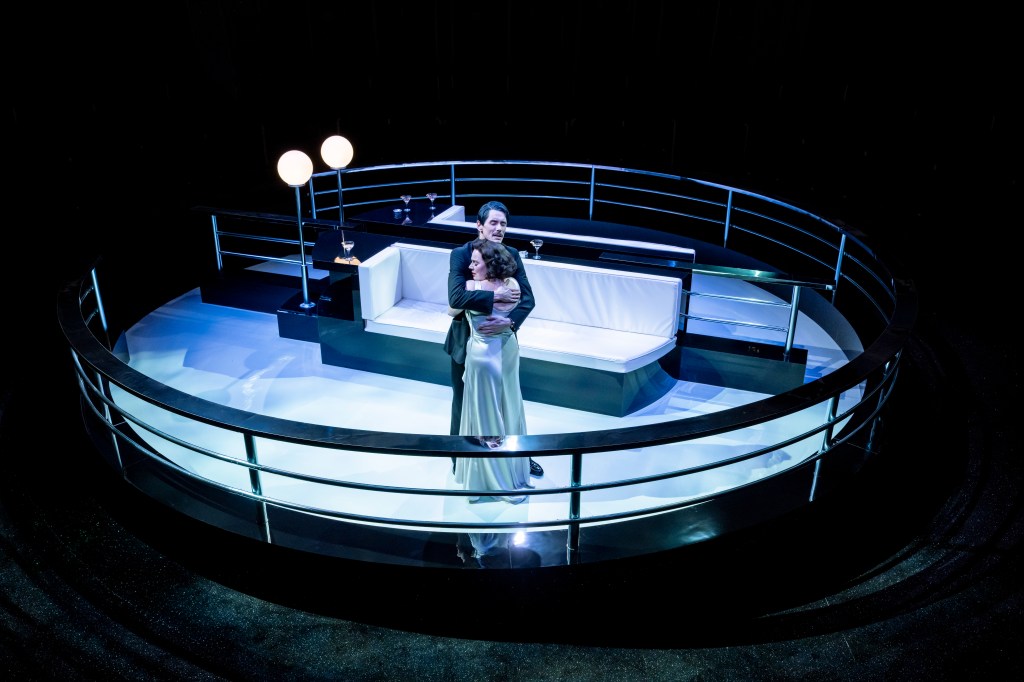
Anthony Banks’ stage design (with set consultancy from Andrzej Goulding) is ambitious and creative. The clinical, pristine, bare, white set is made up of two levels, with small steps at either side. Occasionally, screen-doors cover most of the top level, allowing set pieces and props to be brought on and off, and there are also lots of moving images projected on to the walls and doors, including delightful images of Kelly and Welch in their younger years.
The only issue with the set is that if you are sat at the far stage right (and possibly the far stage left, though the seats do not go as far to the left as they do the right), you are able to see behind the doors. This means you can see the stage hands moving things around, which distracts from the main action. These seats, no cheaper than the others, offer the opposite of a restricted view: you see too much!
We were sat slap-bang in the middle of the stage, and even though the giant in front of me blocked the centre of the stage, the two-handed nature of the play meant Kelly and Welch were usually stood at either side of his head – and when they were on the top level, they were above it.
“The Gap” can be a metaphor for various things – most obviously, “the gap” between the two pairs parting ways and reuniting half a century later – but also the disconnect between me and the play.
The play often warmed my heart but overall failed to resonate with me. I left unsure of what it was trying to achieve. However, I recognise that this play was not made for somebody too young to remember Stars in their Eyes.
The Gap runs at Hope Mill Theatre until March 16.
Photo: Pamela Raith
 JADAR
JADAR 