★★★★☆
“There was a fork in her face. An actual fork. He dug a fork into her face. A fork stood on end in her cheek. A fork,” reads the quote on the play’s page on the Royal Exchange Theatre’s website. There was very little information about the premise of this new play online. It was clear that it was about relationships but it was only when my friend, Emily, noticed a sign on the ladies’ loos that we realised it was probably about domestic abuse. Suddenly, the quote made sense – and our initial excitement about the award-winning new play exploded.
Phoebe Eclair-Powell’s Shed: Exploded View, which won the Bruntwood Prize for Playwriting, takes its title from Cornelia Parker’s art installation, Cold Dark Matter: Exploded View. A visual reference point for the play, it is a constellation of shards from a blown-up garden shed, frozen in stasis.
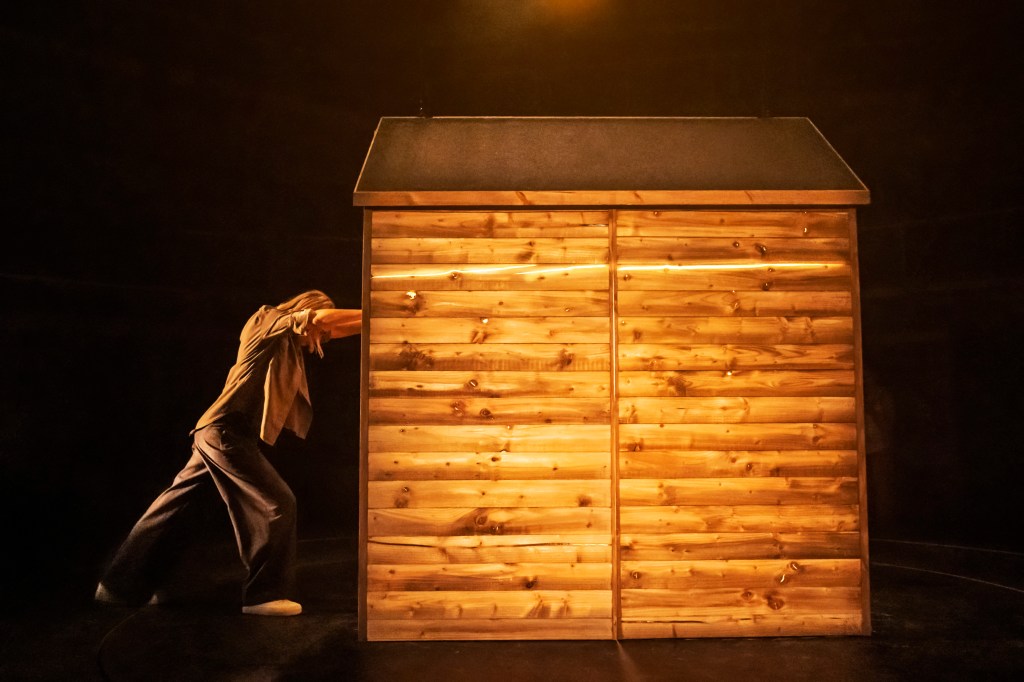
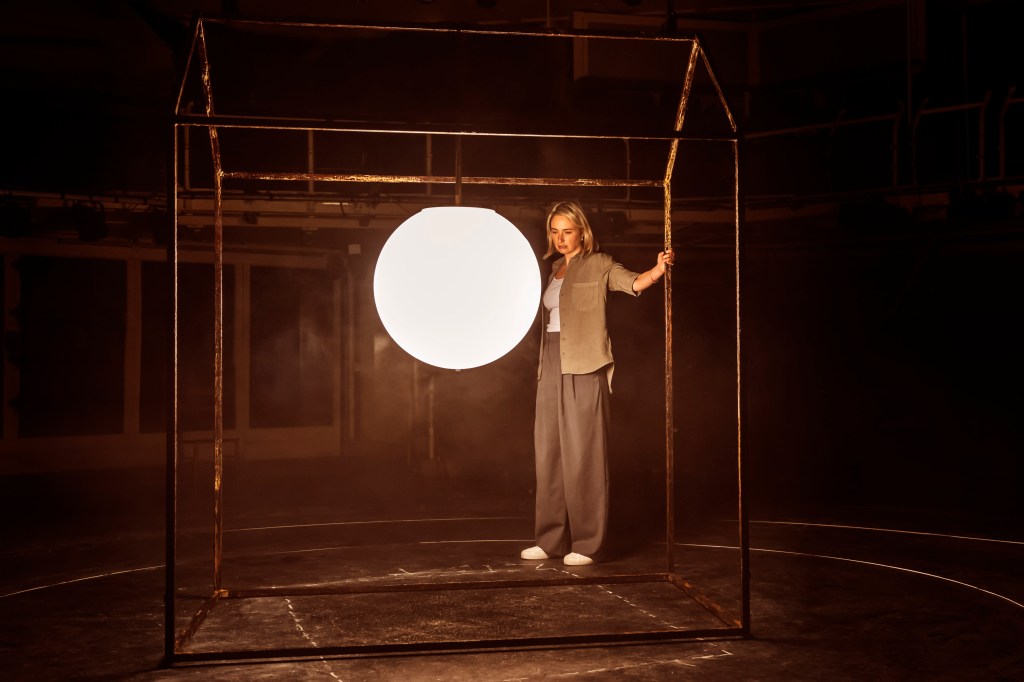
Shed takes a more minimalistic approach, with a glowing shed in the middle of the stage, the panels soon removed to reveal a metal frame which rises and lingers above the action, creating a liminality in which the characters are free but trapped. The frame of the shed is a constant reminder – or perhaps foreshadowing, as the opening scene, in which the above quote is said, is chronologically towards the end – which paradoxically creates claustrophobia in the abyss.
The panels of the shed lay on the floor. There are no fragments. The characters are the fragments – bent, broken and beautiful.
The play covers a period of time from the late 1990s to now but Eclair-Powell takes a non-linear approach, with constant time-travel and sometimes two, or even three, timelines clashing and playing out at once. There are screens above which reveal the year – without these, you’d probably be lost.
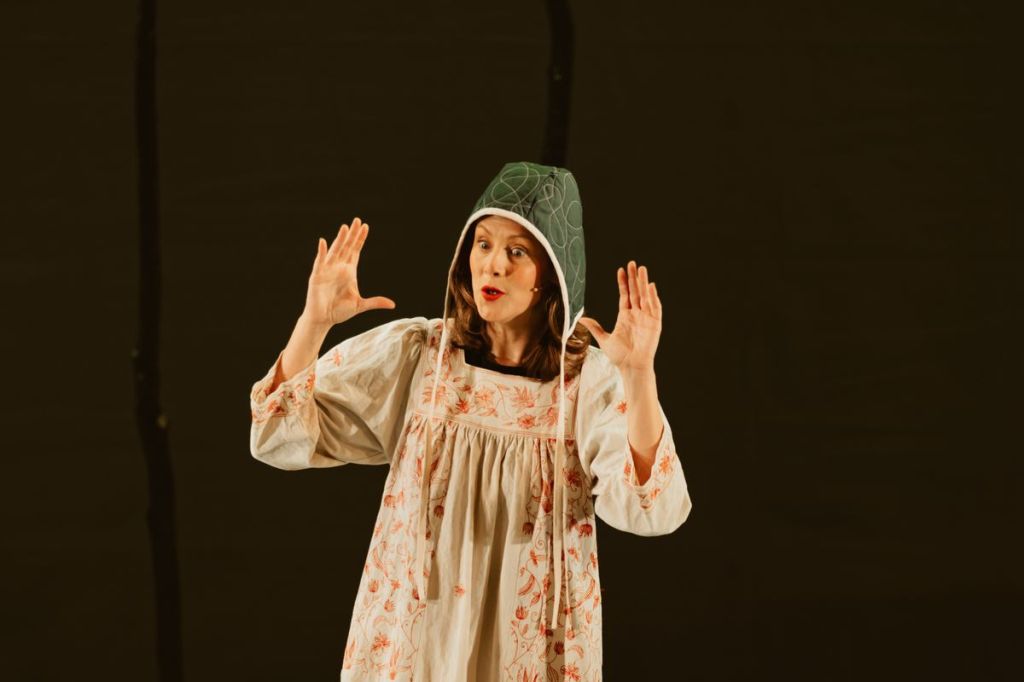
The play’s six-strong cast play three couples. Hayley Carmichael and Wil Johnson play an older couple (Lil and Tony) who met newlyweds Naomi (Lizzy Watts) and Frank (Jason Hughes) on their honeymoon in the late 1990s, and the women accidentally reunite years later. Naomi and Frank’s daughter, Abi (Norah Lopez Holden), meets Mark (Michael Workéyè) at university, and they soon begin a romantic relationship. Lil then meets Abi on the latter’s honeymoon, unaware that she is Naomi’s daughter.
All three couples are dysfunctional. Lil, who escaped her violent first partner, enjoys a good relationship with Tony, but the latter becomes terminally ill, which leads to confusion and violence. They are foiled with Frank and Naomi, especially when both men lose their jobs: both women are sympathetic to their husbands, and whilst Tony appreciates the support, Frank takes his anger out on Naomi.
Frank is cold and patronising to Naomi; his abuse is mental, psychological and emotional, but not physical. Mark, meanwhile, abuses Abi in all of those ways.
Whilst it is important to explore various types of domestic abuse, Tony’s violent outbursts, as a result of his illness, which impacts him both physically and mentally, feels out of place. It adds another dynamic but feels disconnected because, frankly, it is. Tony’s attacks are not a result of misogyny; they’re a result of illness.
The play has a slow start but things quickly get going. The constant time-travel, and the combining of timelines, makes the one-act, 1 hour 40 minute play flyby. But, at first, it is quite confusing and you are unsure what the play is actually about.
Even when the subject matter became clear, I struggled to connect with the characters. We do not get to know them so much outside of their tumultuous relationships; it’s as if they are not individual people. Though perhaps that’s the point; people, especially women, are often defined by domesticity: women as wives and mothers – and victims.
The play is incredibly well-acted; there is not a weak link amongst the cast. However, the three competing storylines and non-linear narrative makes it difficult to get to know the characters – and thus care for them. Further, the writing relies on archetypes: the men are violent and volatile; the women are passive victims – until Lil (a survivor of domestic violence and later a carer for an ill husband prone to violent outbursts) attempts to help Abi escape her abusive husband.
But, again, the play’s use of archetypes might be intentional: anybody can be the victim of domestic violence, and we should always be alert to it, just as Lil quickly recognises that Abi is being abused.
The play offers a blistering, interesting take on a difficult subject matter but it focuses solely on examples, on specific relationships, rather than the wider systems and causes. The play is bold and ambitious but it could go further and tackle the issue(s) more thoroughly and successfully.
There could be more nuance in the writing of the characters, especially the men, that make the relationships more complex and less black-and-white. Making all the male characters aggressive (including Lil’s unseen ex-partner) references patriarchy but the play could better expose patriarchy as the (or at least a) root-cause of these problems. How do we tackle a problem if we do not know its cause?
It could have been more interesting if Frank realised that Mark was abusing his daughter and was angered by this, oblivious to the pain he has been causing his own partner.
The most interesting relationship is that of the mother and daughter. There is a hilarious scene in which Abi goes from toddler to teen, repeatedly shouting “mummy/mum” at a still, silent Naomi. The relationship is at its best when we see the intergenerational parallels – especially when the timelines play out together. Here, though, there was potential to address intergenerational trauma and why Abi might find herself with a man even worse than her own father – and, like her mother, is unable to escape and “break the cycle”.
One of the most memorable crossovers is the smashing of the glass. It happens in one timeline (Naomi and Frank). Later, a glass is smashed in two timelines (Lil and Tony). Finally, a glass is smashed in three timelines. It’s a whirlwinds of echoes and chaos (Abi and Mark).
The production’s design is simplistic but striking. Naomi Dawson (designer), Max Pappenheim (sound designer), Bethany Gupwell (lighting designer) and Carmel Smickersgill (composer) create a world which is haunting but intriguing. It’s simplistic and minimalistic but electrifying. This production need not a great big set.
Other than the shed, the most prominent set piece is the double revolve. The Royal Exchange’s last production, Brief Encounter, also had a revolve but it was rather pointless, so I worried that this revolve would be doubly pointless. To my delight, I was proven wrong. The revolve has real purpose, at times representing the vicious cycle. Its double nature is especially effective when different timelines play out together. Towards the end, Naomi stands in the middle of the stage as the other characters circle her, rendering escape impossible, even if she was not frozen in horror.
The characters use chalk to write words, quotations, questions and lyrics on the revolve, the chalk sometimes leaving marks and smudges on their outfits, as if they have eaten the fruit of the Underworld, trapping them forever.
With the skeleton of the shed, still hanging above, leaving a shadow onstage, Naomi draws around it, ready to plant a bed of tulips, but it looks more like the outline of a grave – which fuses domesticity and delight with destruction and death. Sometimes, home is not a safe space. The shed, then, is an escape from home; it’s a fortress.
The characters rarely leave the auditorium, sitting on wooden chairs in still silence as they watch the action (and horror) unfold, like members of the audience – perhaps asking us, the audience, to step up, in real life, when we see that something is wrong.
The repeated song, Britney Spears’ ‘Hit Me Baby One More Time’, is on-the-nose but effective, especially because it references the women’s inability – perhaps refusal – to escape. The song is first played when Abi is little, as she teaches her mother the dance, but its meaning (and the track itself) is soon warped – innocence is corrupted.
In his focused direction, Atri Banerjee captures every subtlety in Eclair-Powell’s powerful writing.
Shed: Exploded View is bold, brave, blistering and beautiful but it could make the characters more multifaceted, the relationships more complex, and treat the issues as not just domestic but political.
Shed: Exploded View runs at the Royal Exchange Theatre until March 2.
 JADAR
JADAR 