★★★★★
The first rendition of the renowned fairy tale Sleeping Beauty was found in ‘Perceforest’ and written c.1330-40. Over the years, it has had hundreds of adaptations into Disney movies, pantomimes, and more, with ballet having a particularly rich history with the slumbering princess. Sticking to this classical history, Birmingham Royal Ballet used Tchaikovsky’s fantastical swelling score and catalogued in Benesh notation for future productions.
While everyone knows the story of the cursed 16-year-old princess Aurora (Momoko Hirata), there have been many variations over the years, one of which being the names of the fairies involved in her tale. The well-known Disney variant of the evil Carabosse (Daria Stanciulescu) is, of course, Maleficent, while the good fairies (always varying in number) are here encapsulated in the figure of the Lilac Fairy.
The ballet is well-structured, with two short intervals and a short acting pause between scenes. The prologue features the infamous Christening and the glorious celebration in the leadup to the fateful moment she is cursed. The first interval is followed by the main body of the story, where Aurora has grown into a beautiful 16-year-old and must pick a suitor but is tricked into pricking her hand by Carabosse, who disappears in a cloud of smoke.
The Lilac Fairy puts the rest of the kingdom into a 100-year sleep, eventually luring a young prince (Max Maslen) into finding the young girl. After visions of dancing together, the prince falls madly in love and fights through the thick layers of the forest, which are slowly lifted by the Lilac Fairy to reveal the slumbering castle inhabitants and eventually the sleeping beauty herself, who is awoken by true love’s kiss.
The layered shrub scenery is a great touch, creating layers that engulf the hall and hide the heavenly lit princess.
The final act shows the attendees arriving at their wedding, with solos and duets showcasing the extraordinary skill of each artist, some crafting the story of Red Riding Hood, others just proving the elegance of ballet.
While it built to a nice moment where all the characters re-danced small segments of their pieces in succession before the arrival and pas de deux of the prince and princess, it did elongate the finale a little more than necessary, thus losing a little of the story’s momentum.
Despite this, it was a frivolous, fun, fantasy character-filled ending that perfectly concluded their story.
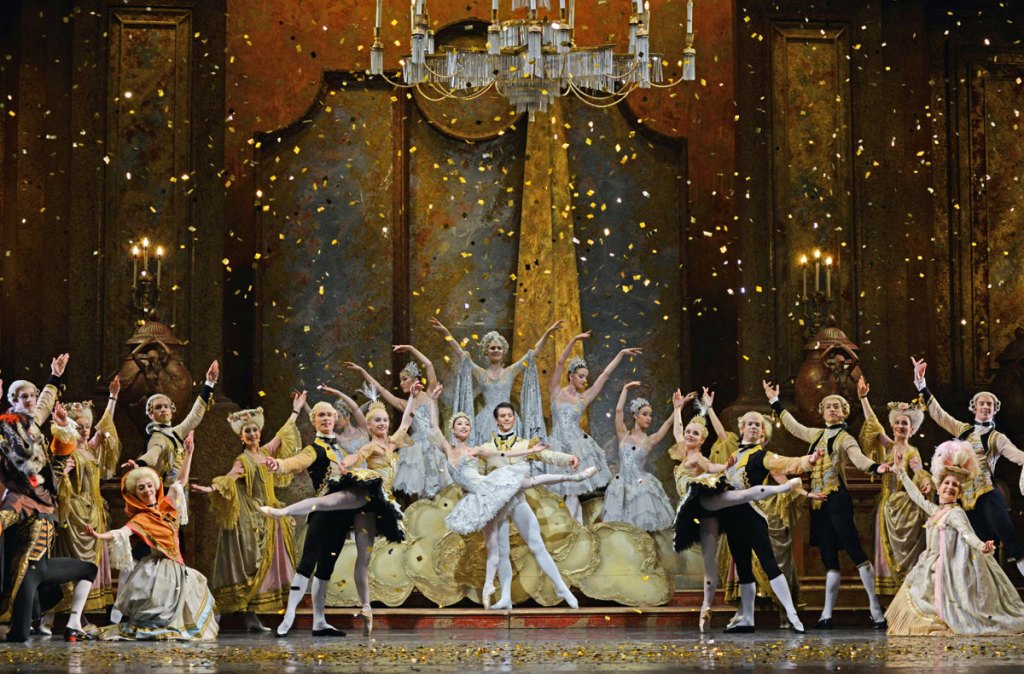
The stunning set (Philip Prowse) was filled to the brim with period pieces from candelabras to warmly coloured wallpaper and layers of dangling drapes. One look and you’re instantly transported to a different time period with lavish dresses, funny aristocratic wigs and pompous galas, but the costumes… they were to die for. Each opulent dress was embellished with layers of bedazzling jewels and flaunted by the graceful ballerinas, with the magnitude of costume changes making these details particularly impressive.
While ballet is a wordless art, the inclusion of traditional balletic mime clarifies the story, allowing you to be completely transported to this fantasy world and understand the conditions of the curse, and so on, even if you already know the story.
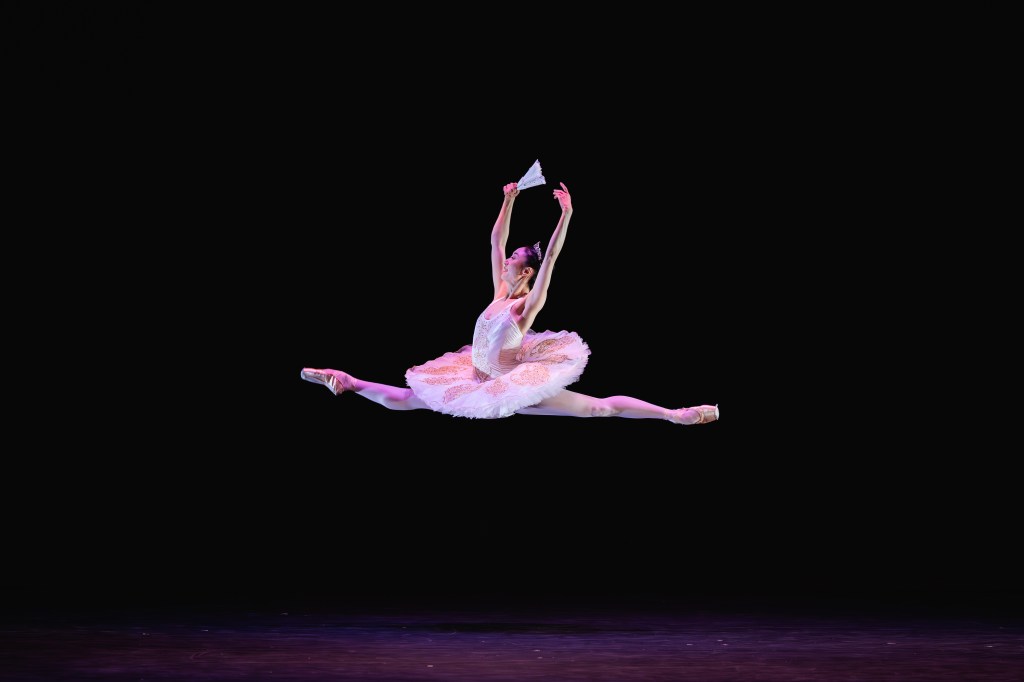
The choreography (Marius Petipa, Lev Ivanov and Peter Wright) was simply jaw-dropping, with graceful yet seemingly impossible lifts, incredible synchronisation, and in canon moments creating a pendulum of swinging legs, an air of elegance in each serene arm gesture and supply folding leg, and the pitter-patter of pointe shoes across the floor… all mesmerizingly beautiful and somehow perfectly matching the mood, tone and rhythm of every beat of the orchestra.
Dancers effortlessly recreated the mannerisms of animals, be it the Big Bad Aolf or Puss-in-Boots and even reflected the tittering playful score in the blue bird dances, Aurora’s innocence and naivety as she is given the spindle in Act 1, or the juxtaposing personas of the fairies as one elegantly protects the princess and the other spitefully curses her after cruising in on her raven-pulled chariot following a crack of lightning and dimming castle halls.
The Sleeping Beauty is truly a magical show that sends the audience soaring through evocative and elegant music, intricate ballet performances, astonishing costumes (which I’d love to own!), and great dramatic story telling.
Sir Peter Wright’s The Sleeping Beauty runs at the Lowry (Lyric Theatre) until March 9 and tours the UK until April 27.
Photo: © Dave Morgan
 JADAR
JADAR 