★★★★☆
Hir is an absurd queer play by Taylor Mac. This roaring revival stars Felicity Huffman (Desperate Housewives) on her post-prison comeback. But this is no star vehicle: the other actors hold their own against the award-winning actress, in an electrifying, uncomfortable play which lets everybody shine.
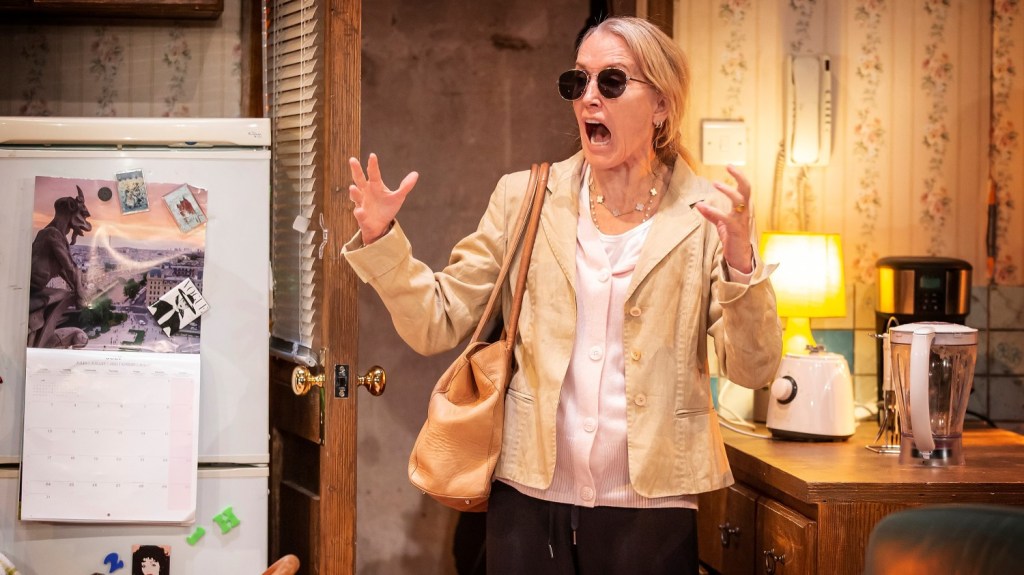
The audience enter the auditorium to see a man (Simon Startin’s Arnold) in clown make-up, wearing a wig and female nightgown. He sits silently, seemingly oblivious to his startling appearance or his intrigued spectators, in a cluttered kitchen, surrounded by laundry, surrounded by seats. It feels voyeuristic.
On the arched wall, above the set, sits a vast sign reading ‘LGBTTSQQIAA’, adorned with fairy lights. The back of the set has both the front and the back doors of the house. This illogicality prepares the audience for an evening of chaos, in which nothing is as it seems – and “home” is but another construct, much like gender.
Arndol’s wife, Paige (Huffman), enters the kitchen to welcome her son, Isaac (Hidden‘s Steffan Cennydd), who has been at war for the past three years, in which he was responsible for cleaning up body parts (and we soon learn that he possesses some form of trauma). Isaac cannot enter the front door because laundry is blocking it. Paige tells him to come through the back. After a humorous back-and-forth, Isaac finally relents and comes through the back, horrified by the state of the house and his vegetable-like father.
Whilst Isaac is the only “normal” person onstage, he, too, has his problems. Whilst the audience understand his opposition to his mother’s new, care-free lifestyle, some of his views (from his masculine bravado to his queerphobia) are as troubling as his mother’s.
Things only get worse when Isaac’s brother, Max (Thalía Dudek, who recently starred in the world premiere of Confessions at the National Theatre), who used to be his sister, makes an appearance. Max uses the pronouns “hir” (pronounced “here”) and “zi”.
Paige delivers a mind-boggling monologue in which she repeatedly refers to Max by their two preferred pronouns, capturing the real-life confusion of people in coming to grips with people’s pronouns – but it is made excessively confusing, which is, perhaps, a satirisation of those people choosing not to understand, and complicating, gender identity. Paige’s ability to always correctly refer to Max by their chosen pronouns tells the audience that it is possible to get the hang of changing gender identity – but you have to at least try.
Mac wonderfully lightens the weight of gender theory by placing it in a family home – a home belonging to a dysfunctional family.
Hir is an anti-domestic drama, so to speak: like a domestic drama, it takes real issues (it explores more than just gender politics) and applies them to a working-class family – but in opposition to the genre, it is not realistic. Rather, it is surreal, whimsical and melodramatic – a little like Desperate Housewives, except none of the characters are rich… or murderers.
However, Arnold is revealed to have been an abusive husband and father. A series of strokes have left him having to rely on the family he once abused. Paige and Max relish in the opportunity to tease and embarrass their abuser – literally stripping him of the masculinity which he used to terrorise them.
Paige’s treatment of Arnold is hilariously horrifying. One can understand the delight she takes in fighting back now that Arnold is defenceless but it is nonetheless uncomfortable to watch – especially because this is a complete role-reversal, in which Arnold, like Paige before him, cannot fight back.
“We will not rewrite his history with pity,” Paige tells Isaac, who cannot bear to see his father not only tormented but also emasculated (that distinction is important).
Paige represents the oppressed becoming the oppressor. It appears to be a critique of the idea that to be powerful in a patriarchal society, women must take on the characteristics of men – traits which have terrorised us since the dawn of mankind.
With the man rendered a vegetable, Paige is finally free – free to live her life however she wants and free to enact revenge on her abuser. But she frees herself not only from her patriarchal husband but patriarchal, capitalistic society as a whole – which sounds liberating but Paige and Max free themselves but have nowhere to go. They rebel against the status quo but they have no real purpose, which appears to be a critique of those who stand only in opposition to the establishment but offer no real alternatives. Paige tells Isaac that when Arnold dies, and the benefits stop, Max will support them – but, as Isaac, points out, Max does not know how to.
All the action is set in the messy house (hardly a home), which is literally placed on top of a landfill site (the play is full of clever metaphors). The play is like a modern, American version of kitchen sink drama/realism, with real-life sociopolitical issues tackled in a working-class setting, with an “angry young man”, disillusioned with society, as the protagonist. In this play, the “home” is microcosmic for society as a whole – a neoliberal, capitalist society literally falling apart, with populist, anti-establishment alternatives (whether left or right-wing) lacking substance.
Mac captures the zeitgeist of a nihilistic society, where the notion of the nuclear family has been destroyed. The characters are richly drawn; they are all kind-of unlikeable but nonetheless sympathetic – and one can understand their views, even if we do not agree with them.
The characters are cleverly contradictory, with the vegetable-like Arnold, who is terrified of his wife, occasionally attempting to assert his lost brutal masculinity.
Paige, a pseudo-anarchist, repeatedly corrects her son’s diction – and whilst she wants to live in a rule-free world, she enforces her own rules on the household, which she runs like a desperate dictator. Perhaps this is a nod to “anti-establishment” politicians gaining power and destroying one establishment, only to create another.
Max, who admirably wants to tear down the constrictive constructions of gender, has a troubling fascination with military machismo, perhaps compensating for their lack of a real penis, a physical representation of masculinity.
Director Steve Kunis has made the most of the Park Theatre’s small space, proving that it is possible to create theatrical magic even in a 200-seat, studio-like theatre. Ryan Joseph Stafford’s lighting and Roly Botha’s sound design and compositions work in tandem to create a weird, whacky, whimsical world which speaks to our own.
Ceci Calf’s set and costume designs are incredible, with great attention-to-detail. At the end of Act 1, the set closes in on itself, literally boxing itself into a house-shaped cardboard box – a physical representation of the repeatedly played ‘Little Boxes’ (Malvina Reynolds), a social satire about the development of suburbia, which mocks the associated conformist middle-class attitudes (casting a Desperate Housewife is poetic).
The Act 1 closer, though visually and emotionally striking – and a real technical accomplishment – perhaps overemphasises Isaac’s trauma, especially because the second act does not do as much with it as this dramatic scene suggests it might. Thus, the scene feels heavy-handed, especially in opposition to the play’s simple but impactful closing scene – a fitting end to a melodramatic, thought-provoking play which goes a mile-a-minute and throws everything but the kitchen sink (it does, however, throw things in and out of the sink).
This is a kitchen sink drama on steroids – or whatever drugs Isaac shoves up his ass (yes, really).
Hir runs at Park Theatre (Park200) until March 16.
Photo: Pamela Reith

 JADAR
JADAR 