★★★☆☆
Written by Jay Darcy, Katie Bray and Urussa Malik
The BFI ranked My Beautiful Laundrette as the 50th greatest British film of the 20th century. Bisexual mixed-race writer Hanif Kureishi has now turned his iconic film into a stage play, and we were so excited that we sent not one, not two but three writers to review it! Jay and Katie attended press night; the following night, Urussa attended a special performance, which included iftar (the fast-breaking evening meal of Muslims in Ramadan).
Jay Darcy
Set during the Thatcher years, the play follows Omar (Luca Chadwick-Patel) as he transforms a run-down laundrette owned by his ambitious uncle, Nasser (Kammy Darweish). Omar is assisted by his romantic interest, Johnny (Sa, Mitchell), a member of a fascist gang who terrorise the Pakistani characters. Omar’s uncle, who is cheating on his wife with a White woman, attempts to arrange a marriage between him and his Westernised daughter, Tania (Sharan Phull). Nasser’s ruthless right-hand man, Salim (Hareet Deol, whose performance earned him a WhatsOnStage Award nomination), enlists Omar to help with questionable activities. At home, Omar struggles with his drunken father (Gordon Warnecke, who played Omar in the film). Omar navigates these many plotlines better than the play does.
The play has both old and original music by the Pet Shop Boys, which encapsulates the queer 80s vibe whilst still feeling relevant, much like the themes.
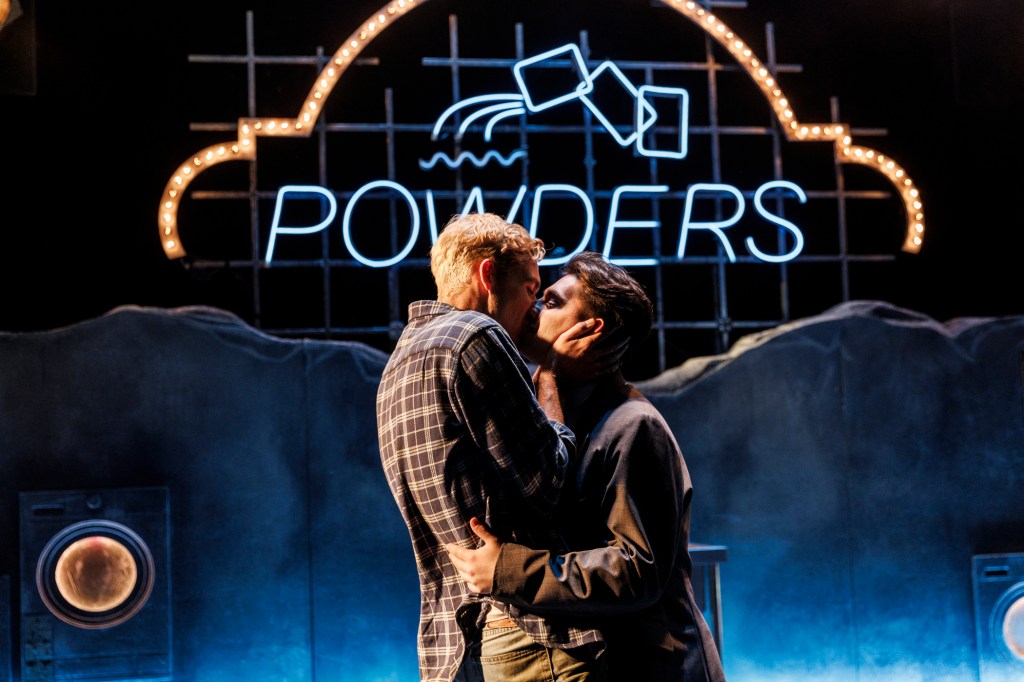
Grace Smart’s stunning set design easily transforms from a run-down laundrette to the titular beautiful laundrette, and even a nightclub. Ben Cracknell’s neon lighting design bringing the story and each scene to life, especially the nightclub scene, where bits of the set suddenly light up as the Pet Shop Boys’ ‘West End Girls’ plays. The costumes are period-appropriate, with great attention to detail (yes, the fascist gang leader wears docs with red laces).
Indeed, the design is dazzling – but you know that a play has problems when most of the praise is directed towards the design (“beautiful gowns,” to quote Aretha Franklin).
The writing can be pretty funny. A memorable line is said by Omar to Johnny: “I want you in a nice shirt – white and clingy, like you.” But, overall, the book leaves much to be desired. The script can be clunky, some of the characters are underdeveloped, and the performers occasionally overact.
Some of the characters need more backstory and development. Take gang leader Genghis, who is motivated purely by racial hatred. Paddy Daly does a great job of playing the monster but he is an archetype – to the point of caricature. I am sure that that is exactly how Kureishi remembers the fascist punks of his youth but better writing would explore how and why Genghis is the way that he is. We see this briefly when he criticises the Pakistani characters for “give[ing] their money to the Tories”.
Indeed, the dynamic between the middle-class Pakistani and underclass White characters is interesting, but this resentment could be better contextualised and explored – as could the idea that the working-class have been left behind.
Another issue is that the stakes never feel all that high, especially because the unconventional central relationship does not feel contextually taboo – whilst this might be progressive, it is not realistic. A Romeo and Juliet-style story, the play explores many themes, such as racism, classism, and sexism, but, strangely, not so much homophobia. It’s pretty poor to explore every ism and phobia except homophobia in a gay love story, especially given the prevalence of homophobia in this (my) community. In one scene, Pakistani characters walk in on the lovebirds, and the pair hardly even seem embarrassed, let alone worried.
Whilst the play has an interesting premise and an abundance of gritty themes and topics, it throws them all in for a quick rinse, without nourishing any of them. It does not separate the whites from the colours (so to speak), which results in the themes blurring into one, none of them receiving the attention they deserve. The script needs to be put back in the machine for a longer wash – then this play might be as beautiful as the titular laundrette.
Katie Bray
While I desperately wanted to love My Beautiful Laundrette, it sadly did not reach its full potential and fully explore the groundbreaking themes it aimed to. With themes of homophobia, acceptance, class differences, gangs, drugs racism, adultery and misogyny, the play overfaced its self, barely exploring them to an effective and emotional level.
The vulgar language does well in conveying the uncomfortable truths about British racism and classism, and yet it seems that classism in particular was thrown into the mix just to make Johnny even more of an outcast and “thug”, rather than adding additional depth.
From their initial meeting, I had hoped Johnny and Omar’s story would be an unlikely Romeo and Juliet tale… boys from separate classes and cultures facing their troubles head-on despite their differing worlds (Johnny especially in his fascist thug life). Instead, it became a myriad of mismatching puzzle pieces where the boys had met years ago and the audience were tasked with putting together what had happened and how they somehow jump from acquaintances to flirtation within seconds of reuniting with each other.
Indeed, I really struggled to see the chemistry between the characters who seemed to perform a full 360 from colleagues to lovers, to almost enemies at different points in the play. Their relationship seems to appear out of the blue, making it rather difficult to believe despite yearning to feel their connection. This particularly stemmed from the unlikability of these characters as Omar often double crosses his friends and family in search of his wealth or lashes out unfairly at Johnny, while Johnny himself is a full-fledged fascist that tries to change his ways but still somehow remains a little arrogant.
Then there are the cheating husbands, the controlling fathers… and so on. While it really had the pieces and themes to create a gorgeous masterpiece, I think some of the puzzle pieces were ultimately missing.
While I loved the Pet Shop Boys’ music, it appeared mainly in small synth transitions and as background music at parties, kind of limiting the impact of their music rather than using it to its full potential. Yet it did provide a nice 80s backdrop alongside some of the neon colours and the brief Thatcherian background context.
Indeed, the set was pretty inventive with rundown washing machines filled with colour-changing lights, posters of Freddie Mercury, a neon light for the laundrette, scaffolding to add levels, and chairs etc. to create living rooms or office spaces.
I think it was a great endeavour and that the story has real potential to blossom onstage with some pacing and script changes to help enhance both the romance and the weight of the themes the show aimed to tackle.
Urussa Malik
The day after press night, I attended a special showing of My Beautiful Laundrette, on invitation from Manchester-based cultural consultant Saminah Ali, who previously invited JaDar was another community event: a panel discussion for a South Asian reimagining of Charles Dickens’ Great Expectations at the Royal Exchange Theatre.
As such, this showing of My Beautiful Laundrette was for those marking Ramadan, a month of fasting and spiritual knowledge. The dates, beverages and food were provided by The Lowry, inviting participants to open their fast at their lovely building. A short welcome from Tim Manley, the Lowry’s Head of Marketing and Communications, and we were off to take our seats.
Three actors opened the play, walking on to a dimly-lit stage, the audience unsure so they carried on loudly settling down, which was unnerving. But then the disco ball glowed brighter and a pink-suited actor waltzed onstage. The transitions between scenes after this initial one felt clunky and unevenly paced, with the tone swinging almost erratically from comedic to dramatic. At one point, I laughed at what I initially thought was a comedic, but soon realised was actually a tense, dramatic moment.
The dialogue held strong, drawing lines from the original film. The story explores the cultural tension of 1980s Britain through two characters who seem to be on polar opposite ends of society.
The story is geared towards first and second generations migrants who came to the UK in the 1940/50/60s and have memories of this UK. We are now at fourth, fifth and even sixth generations, who may see this play like a time capsule, but it is hugely important to see it as cyclical. We still have forms of marginalisation in our own communities (e.g. where being queer in a South Asian community can be seen as being White/western and therefore invalid, even though South Asia has a rich queer history) and continued White privileges which undermine the British South Asian quality of life.
There is a time critique here because the play is trying to be relevant in the 2020s but I personally felt it would have been better to keep its 80s authenticity and let audience come to their own conclusions about what this play says about our societies and values now.
I admire the sentiment but feel it could have stayed closer to its original tone and style or committed better to a tone change, rather than this weird hybrid.
My Beautiful Laundrette runs at the Lowry (Quays Theatre) until March 23 and tours the UK until April 6.
Photo: © Ellie Kurttz
 JADAR
JADAR 