★★★★☆
Is Aishwarya dead? Or did she just exit stage right? “A meta dance comedy, full of the turbulence of life and death,” Rambert’s latest offering is a double bill of two pieces created by Ben Duke: Cerberus (2022) and Goat (2017). The former is a retelling of the Ancient Greek myth of Orpheus and Persephone; the latter is inspired by the music and spirit of Nina Simone.
Duke’s dancers retain their names, playing fictional versions of themselves, blurring the lines between fact and fiction. Goat is actually, partially, shaped by the stories and creativity of its original cast.
Spoilers ahead…
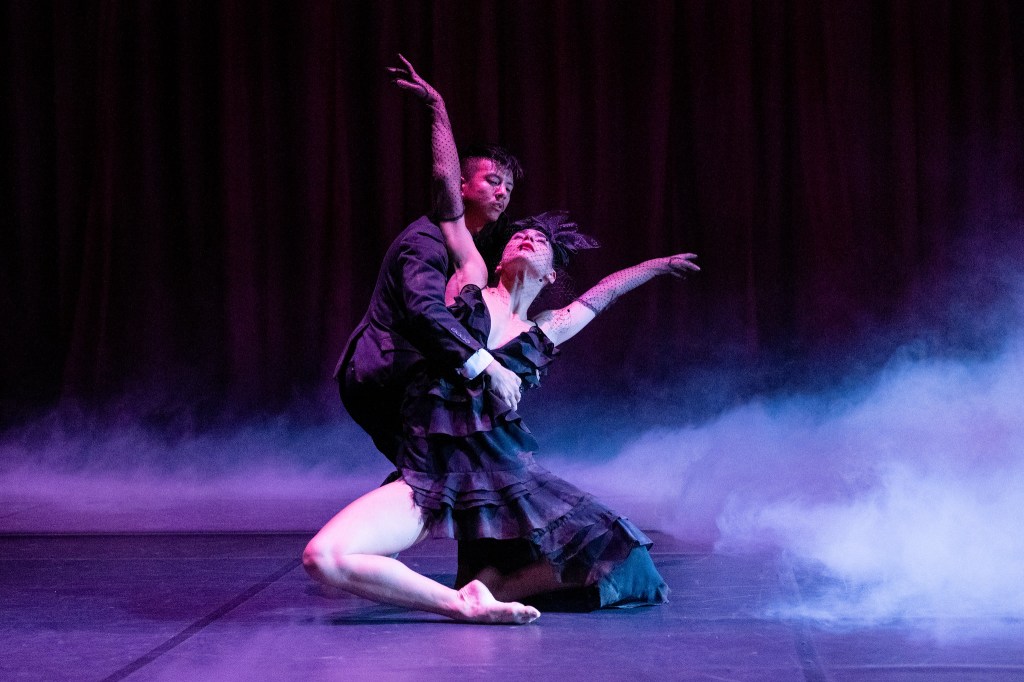
Cerberus, significantly shorter at just half an hour, is a sort-of play-within-a-play. Aishwarya Raut talks to the audience via voiceover as she prepares to take to the stage. She tells us that she will appear at the stage right, symbolising her birth, and exit stage right, symbolising her death. Attached to a rope, she frantically spirals across the stage, her movements capturing the intensity and diversity of life. As she exits, her boyfriend, stage hand Antonello Sangirardi, is pulled onstage, the rope dropping to the floor. He awkwardly addresses the audience.
It’s not long until the rest of the cast appear onstage in funeral couture, with Antonello made to eulogise his love. He finds himself playing along, even though he knows that Aishwarya is not dead; she’s just in the wings – or is she?
Antonello and Alex Soulliere – who plays himself playing a priest – are the only people not in a trance; the rest of the dancers are called to the stage left – and thus their deaths. Alex tells Antonello the story of Orpheus and Eurydice, and he travels to the Underworld to rescue his love – and the rest of the cast. Those of you familiar with the myth can guess how it ends…
The choreography is fierce, frantic, and formidable. The dancers repeatedly go from stage right to left, as if they are on some sort of revolve.
Some might take issue with all the talking – indeed, at first it feels a bit like a play with dance – but the slower start and transition into dance makes the latter part of the piece even more intense.

Goat, a 50-minute piece, is inspired by a village ritual from Duke’s childhood, where things the villagers longed to forget were written down and tied to a goat. It also has some similarities to Igor Stravinsky’s The Rite of Spring.
The action takes place in some sort of assembly hall or community centre, with broadcast journalist Angélique Blasco covering the ritual live. Angélique acknowledges the audience but also talks to the camera – to her viewers. The piece interrogates the tyrannical, exploitative nature of news media, with live camera and a screen used as a theatrical device – making the piece mega meta.
Goat begins rather deadpan and sardonic, with Angélique repeatedly invading the space of the dancers, interrupting their dances, interrogating them. She interviews a woman who appears to be the leader. The woman tells her that they can no longer sacrifice a goat because animal rights groups protested – so now they will sacrifice a human. Angélique appears unphased; to her, it’s just a story.
At one point, she asks a dancer what his dance represents; he gives some artistic answer, and she tells the audience that she never would have guessed that. The first dance number is to Nina Simone’s ‘Feeling Good’ (Sheree Dubois performs these mighty songs wonderfully) – though the dancers actually appear quite solemn. When it wraps, a confused Angélique states, seriously, “I think they are feeling good.”
There is, however, a brewing intensity, a growing darkness, as we descend into chaos. Britain’s Got Talent‘s Musa Motha, a cancer survivor and amputee, channels a spirit. Musa is the most mesmerising performer in the double bill; the way he moves, crutch in hand, is unbelievable. He explores a few people before eventually choosing Jonathan Wade. The dancers depart before an excited, smiling Angélique slowly approaches him to ask him how he is feeling about being sacrificed. She dismisses his remark about not wanting to talk. She asks how long it will take to dance himself to death. He responds, “I don’t know; I’ve never done it before,” humouring the audience.
In Goat, Duke creates a topsy-turvy world that repeatedly flips its emotional tempo. Things that should be serious, such as the interviews with the dancers, are preposterous, whilst things that should be preposterous, like a man covered in post-its dancing himself to death, are serious.
A desensitised Angélique appeared quite excited at the prospect of a sacrifice, but the death of Jonathan, who is only 25 years old, breaks her. She demands that the camerawoman, who she had previously enslaved and forced to capture every intimate moment, stop recording.
In the emotional finale, Jonathan is resurrected by his boyfriend; the pair perform a number that is intimate but difficult, embodying the complexity of life and love. They leave the stage before a guilt-ridden Angélique takes his place, covering herself in the pristine sheet.
This piece feels even more like a play with dance, but also a play with music, with many of the music/dance numbers broken up with speech.
Death Trap is not your average dance piece. The lack of dancing and meta aspect risk alienating regular viewers, but those more selective with the dance they see – like yours truly – will be spellbound by its ambition and artistry. It is meticulously meta, marvellously manic, and a little bit mad. The two pieces, different as they may be, are paralleled wonderfully. At the top of Act 2, Angélique acknowledges the previous piece and even exits the stage left to show us that “the portal” has closed. The self-awareness is as awkward and uncomfortable as it is considered and tantalising.
Rambert – Death Trap runs at the Lowry (Lyric Theatre) until April 20, before wrapping up its UK tour at Newcastle Theatre Royal, where it plays on April 24 and 25.
Cerberus. Photo: Camilla Greenwell
 JADAR
JADAR 