
★★★★☆
The Bell Curves: a play about genetics, its research, its impact, and its very difficult nature of discussion.
Performed at Ascension Church, Hulme, the setting of the church created another abstract connection to genetic editing. Exploring genetics and gene-editing in a play mired with the setting of a church can make both of those things seem unusual, even abstract.
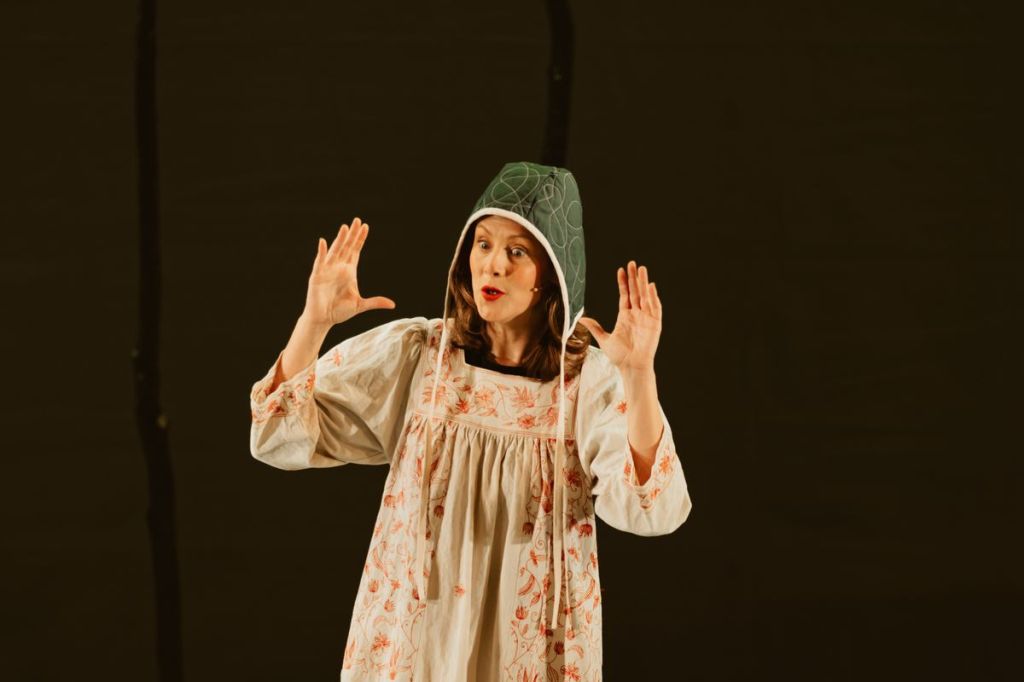
The themes are explored through the characters of Nana, Lulu, Rosa, Henry, and the on-off character of Keisha, the writer of the play. The names Lulu and Nana refer to the He Jiankui affair, a scientific and bioethical controversy concerning the use of genome editing, following its first use on humans by Chinese scientist He Jiankui, who edited the genomes of human embryos in 2018.
Written by Keisha Thompson, Artistic Director of Contact, with support from Contact and the In Manchester DNA Project among others. Keisha has been working on this since 2018, where many remarkable feats, including jail-time for a scientist, and the UK’s first three-parent baby. This play directly focuses on the science of CRISPR-Cas9, a genome editing tool.
The play was script-in-hand, which denoted to me that it was still in the research phase. Indeed, it is billed as a work-in-progress presentation. The performers remarked that they had four days to learn the lines. But a post-show discussion also revealed that it may be an aesthetic and structural point: reading a script which changed as fast as the science necessarily forced both the world of the play and the world of the play being written (ours!) to keep reading and changing the script.
Speaking of the world of the play and our world, this was an intrinsic focus, theme perhaps, of the play. Keisha utilised this meta quality of becoming part of the play, though potentially not by her choice, and having to consult with one of her characters who says what, reminding me of the writer-dramaturg relationship, where the play tests different scenes, different tones.
Another way to look at it: Keisha, the character and an actual person in real-life, is like a doctor/writer finding and replacing words in the play, and Rosa, the character who breaks the wall and talks to Keisha, is the CRISPR tool, being tasked with different lines and appearances in the play.
The actual narrative of the play was this: Nana, rehearsing for her public engagement PhD part with a colleague; Rosa is rehearsing in a Church ran by her partner’s (Henry) parents. In this same church, Nana’s sister, Lulu, is excitedly and amazingly rehearsing songs and making fun of Rosa’s intrepid observations. A sub-plot or just-as-main-plot is Keisha and Rosa discussing to include testimonials, who in the play should say what, and what impact testimonials have on the one who created them.
In the play-plot, Nana is worried about Lulu overhearing her PhD work as it relates to her nephew, Lulu’s son, who has a degenerative illness of DMD which shortens lifespans exponentially. As Nana’s work suggests we can, as was discovered in CRISPR, have the technology to edit genes and avoid this fate. Lulu’s defiance is never noted but is alluded to be against Nana’s work, for religious reasons, or at least I was gleaning.
It was definitely one of the harder plays to watch and understand. I am interested in how it further develops and how much the real world influences the script.
Audiences are invited to a further workshop based on songwriting, script-writing, and the science of the CRISPR-Cas9, which I’ve signed up to. I am interested in how interestingly public engagement is being weaved into the world of the play and into the real world too (ours!). I want to see what changes are made, should it be put on again.
The Bell Curves is a bold play that not only makes you question gene-editing – it also makes you question plays.
This work-in-progress presentation of The Bell Curves has now wrapped its current run at Ascension Church – it also played a read-through at Contact, for those uncomfortable in a religious setting – but keep your eyes out on Contact‘s website for news of a full production.
Photo: Drew Forsyth
 JADAR
JADAR 