
★★★★☆
Atri Banerjee’s stripped-back adaptation of Tennessee Williams’ The Glass Menagerie, which premiered in Manchester, has been remade for London.
“Yes I have tricks in my pocket, I have things up my sleeve. But I am the opposite of a stage magician. He gives you illusion that has the appearance of truth. I give you truth in the pleasant disguise of illusion.”
These are the words which open Tennessee Williams’ The Glass Menagerie, now playing at the Kingston Rose Theatre, and which hang over the audience for the rest of the play. Although there are no stage magicians featured in Williams’ semi-autobiographical drama, the audience are invited into a shared illusion – or, more aptly, a delusion – in an effective yet minimalist take on the memory play which has taken on new meaning in this modern age.
Directed by Atri Banerjee and first staged at Manchester’s Royal Exchange in 2022, this production of The Glass Menagerie is a stripped-back, minimalistic interpretation which succinctly gets to the simple, ugly truth at the heart of Williams’ universal family drama.
As per the opening monologue, we’re told the play takes place in St Louis, during “that quaint period” of 1930s America, a time when the middle class were “matriculating in a school for the blind” and revolution floundered at home whilst flourishing abroad. Williams representatives for this unremarkable interwar era are the Wingfields, a family whose three members are all trapped in their own illusions. The mother, Amanda, (an electric performance by Geraldine Somerville), is a former Southern belle obsessed with finding a suitor for her shy daughter Laura (Natalie Kimmerling). Her son, and Laura’s slightly younger brother, Tom (Kasper Hilton-Hille) is our narrator; a bored factory worker suffocated by domestic life who dreams of escaping his mundane job for greater adventures.
As the play goes on, these characters and their neuroses are put under the spotlight, revealing darker truths about themselves and providing an insight into family life under mental duress from all angles.
Williams’ works are primarily driven by character rather than plot, so to list out the script’s general story-beats would do a disservice to both the play, this production and a potential audience member’s enjoyment. However the general thrust is as follows:
Tom is a poet at heart but factory worker by trade who dreams of life beyond the confines of their apartment walls whilst his Mother, Amanda, harbours hopes for the family beyond their unremarkable existence in St Louis, obsessing over finding a suitor for her shy, withdrawn daughter Laura who is more comfortable with her record collection and glass animals than entertaining the prospect of marriage. Tom eventually brings home a gentleman caller but not all is as it seems. As the play goes on, each character withdraws more and more into their own illusions, revealing a darker truth within them and providing a window into the tragedy of a quintessentially American family.
First staged in December 1944, The Glass Menagerie has long been an audience favourite with its dynamic characters and universal themes. Ideas like memory, ambition, and finding purpose in a constantly adrift world are at the forefront of its characters’ minds. The relatable struggles of the Wingfields, with the loving-but-domineering mother, and the illusory dreams of her children, who yearn to escape yet can never quite make something of themselves, are something any audience member can identify with, either from personal experience or just being kindred spirits. Banerjee’s production realises this, and its stripped back approach allows the actors to control the stage, giving them space to breathe and inviting the audience into this world where truth is in flux as memory shapes the re-telling of stories we are never quite sure are entirely accurate.
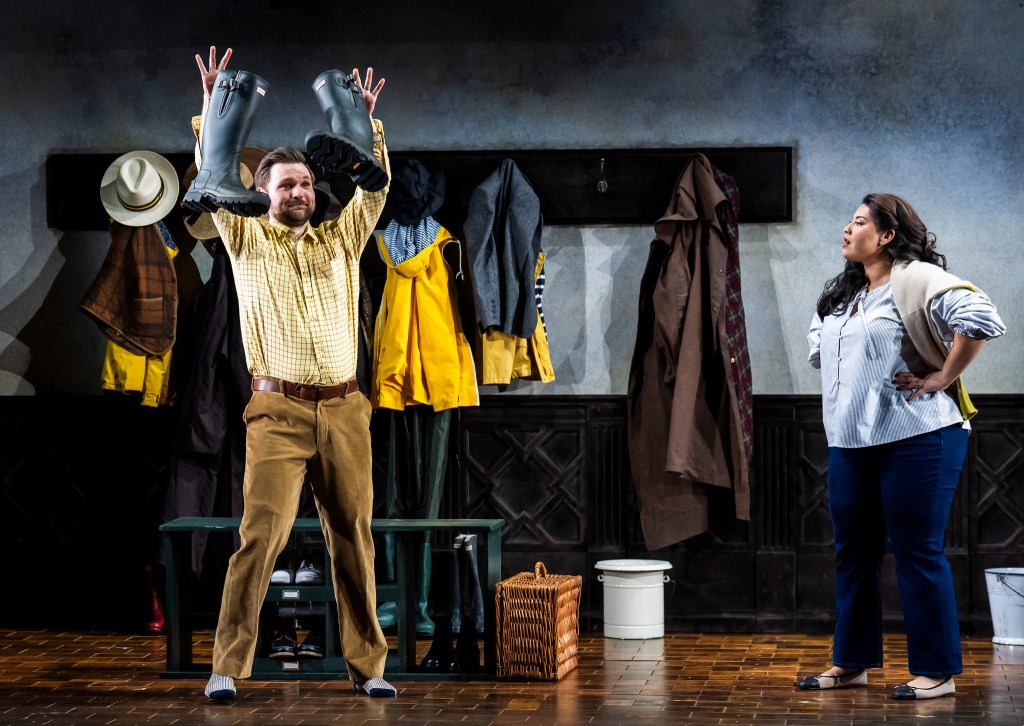
Featuring a minimalist set design, the production does away with furniture and instead simply opts for four chairs and a ring of glass animals circling the stage. Of course, all this is offset by the giant rotating sign reading “paradise” centre stage, constantly reminding the audience every character would rather be anywhere but here, escaping to the constructed realities in their minds. Although the sign is at times distracting, the staging is thankfully effective. Such a simple play does not require lavish props or elaborate set dressings; indeed a table is not even present. Designer Rosanna Vize understands this, and the beauty of this simple set design is the way it lets the actors inhabit their characters, filling the space through performance rather than props.
This clever approach to design pays off particularly in the second part where Jim O’Connor (Zacchaeus Kayode) pays the Wingfields a visit. All four characters occupy different parts of the stage, constructing boundaries in the audience’s minds like the ones they construct between themselves. As Amanda Wingfield, a character equal parts sympathetic as pitiful, Geraldine Somerville benefits the most from the designer’s sparing use of space. Her persona fills the theatre, dominating the space even when she is barely at its edge. Although all four performers are strong, Somerville is unsurprisingly the most dynamic. Her pitch-perfect southern accent changes with every word, communicating one idea to the audience through her deliberately strained pronunciation of certain words whilst the dialogue suggests another.
However, as Tom and Laura, Hilton-Hille and Kimmerling more than hold their own. Both are clearly stars in the making and manage to embody the complexity of Williams’ characterisation without projecting pretence or artifice. As brother and sister, their interactions feel authentic; they imbue a sense of warmth and fragility into their performances that is much harder to convey on stage than it is on screen, casting two tragic figures without resorting to melodrama. Although given much less to do, Kayode still shines as gentleman caller Jim O’Connor. His easy charisma and commanding voice gives him immediate affability, endearing him to an audience which might have good reason to be suspicious of him. His duologues with Kimmerling are especially notable for their subdued passion and it’s easy to envision him being cast as a romantic lead in the near future.
Deserving of as much praise as the cast are the play’s technical elements which were undoubtedly its strongest element. As The Glass Menagerie is a memory play, that is a story told as a loose collection of memories rather than a linear telling of events, its undefined setting lends a certain freedom to the creatives – particularly designers – because the source material declines to stipulate how exactly events should be presented. Here, lighting designer Lee Curran bends this to his advantage, bathing the stage in warm, hazy colours which add to the confusion and sense of illusion present in the play’s trappings. Giles Thomas’ music was also a highlight, aiding the drama instead of overriding it. His subtle score bubbled underneath the surface to the point where it was constantly in the back of the audience’s heads but not at the forefront of their minds, creating a sense of foreboding without ever dominating the soundscape.
However, as well performed and designed the play was, it was not without its faults, particularly when it came to context. The last Williams play I saw, Roy Alexander Weise’s Cat on a Hot Tin Roof (which, like this play, premiered at the Royal Exchange Theatre) was staged in a contextual vacuum that was both 1950s America and 21st Century Britain. As I wrote in my review, it took big swings but, more often than not, completely missed its mark, resulting in an apolitical endeavour which deprived the play of its power and poignancy, serving only to undermine its talented cast and creative crew. Thankfully, Banerjee’s Glass Menagerie transgressions are nowhere near as blatant or artistically neglectful as Weise’s Cat, however, it is not exactly above reproach.
Despite fantastic staging and a talented cast, the costumes leave a lot to be desired. Amanda Wingfield wears a plain housewife’s dress, a solid enough choice to contrast with her history as a southern belle. However the two children and Jim O’Connor are dressed as if they exist in an entirely different century altogether. Tom wears an oversized corduroy shirt, complete with a plain white t-shirt and dark jeans. A simple enough choice but combined with his “indie boy hairstyle” he resembles a Liam Gallagher superfan more than a young man living in 1930s St Louis.
Unfortunately, the costuming choices for Laura are even more baffling. Whilst Tom could pass for a 1930s teenager if the audience’s imagination went into overdrive, Laura is dressed exactly like an anxious teen in 2024 before switching to a small dress seemingly designed to emphasise her fragility which only adds to the contextual confusion.
These design choices could be ignored if it weren’t for the walkman and headphones Laura uses in place of records and the Whitney Houston songs emanating from them. If the play was a conscious reimagining then these transgressions could be forgiven; however, the opening monologue directly states it takes place in the 1930s! Context gives a story meaning and geography lends it power. Although themes and ideas are universal, history is not, and Williams’ writing is unique to a certain period in mid-century America where the play’s themes of illusion, truth, love and family were all designed to communicate a specific idea about a particular point in time.
Of course, dramas should be reimagined, and a text like The Glass Menagerie has the potential to cross boundaries and take on new meanings when staged in a different context. Indeed, Laura’s shyness could easily be translated into a polemic about today’s skyrocketing rates of teenage anxiety whilst Tom’s dreams beyond the factory could be an allegory for a worker in the gig economy; but these ideas are unique in and of themselves, they should be fully developed, not teased at or left to the audience’s imagination for no apparent purpose. Modernisations have their place, but something should be said for staging a play the way it was written – something all other elements of this production succeeds brilliantly at.
All in all, though, this latest production of The Glass Menagerie is a very good, sometimes great, staging of a fantastic (but not transformational) play. The cast all bring their A-game, and the creative design team manage to craft an exceptionally enjoyable experience which manages to both entertain and provoke thought in the audience. Whilst some unnecessary contextual choices are questionable, thankfully they are not abundant enough to distract from what is ultimately a refreshing update of a modern classic.
The Glass Menagerie runs at the Rose Theatre until May 4 and tours the UK until June 1.
Photo: Marc Brenner
 JADAR
JADAR 