
★★★★☆
Nick Winston’s production of Bonnie & Clyde invites audiences to delve into the complicated and controversial lives of Depression-era outlaws Bonnie Parker and Clyde Barrow. The story of these infamous criminals is told in a fresh and compelling way, as the narrative unfolds backwards through the eyes of Sheriff Ted (Daniel Reid-Walters). Beginning with their capture, the story rewinds to reveal the duo’s turbulent journey from ambitious dreamers to ruthless fugitives.
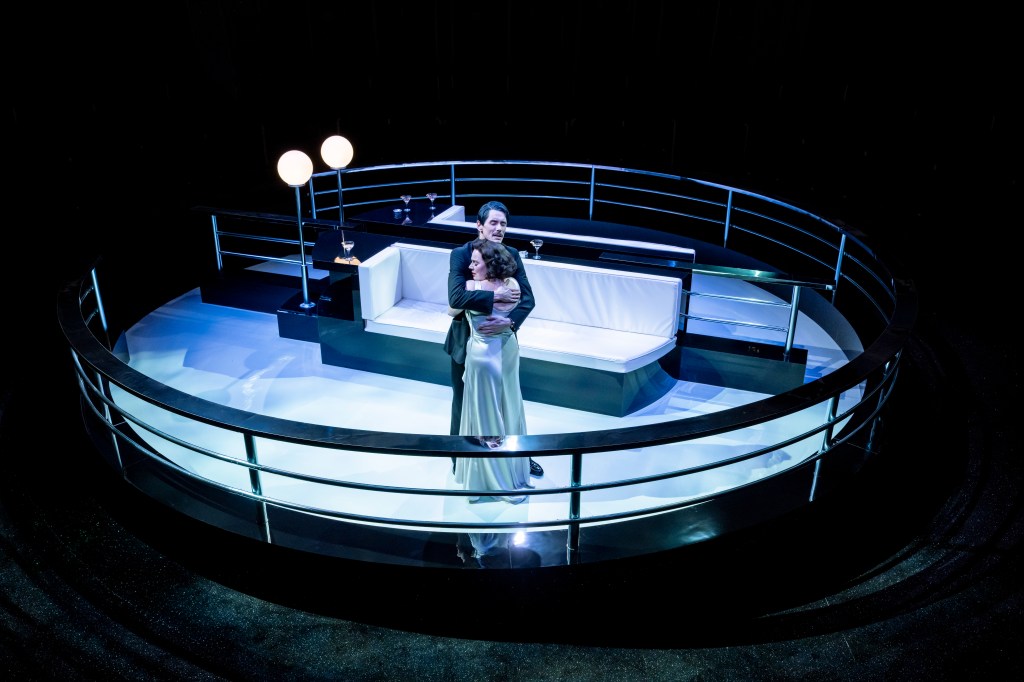
The musical seamlessly weaves a fabric of romance, danger, humour, and ambition, underscored by a captivating cast and evocative stage design.
Alex James-Hatton as Clyde and Katie Tonkinson as Bonnie excel in their roles, with convincing chemistry that captures the essence of their passionate and ultimately tragic relationship. Not only do they shine vocally on their own, but together, their harmonies blend seamlessly in the romantic duets, embodying the couple’s passionate connection while highlighting their individual vocal strengths. Their voices, full of emotion and storytelling prowess, anchor the production with passion and professionalism.
Coronation Street’s Catherine Tyldesley makes her musical theatre debut as Blanche, Clyde’s sister-in-law, delivering a standout performance that is both powerful and nuanced. As Blanche, she is caught between loyalty to her husband, Buck (Sam Ferriday), and her moral compass, which urges him to abandon his brother’s criminal path… at least for a while. Tyldesley’s stirring vocals shine particularly in her touching ballad ‘Now That’s What You Call a Dream,’ in which she expresses her internal struggle and hopes for a life untainted by crime.
Ferriday’s Buck, Clyde’s brother and partner-in-crime, provides a layered portrayal of a man torn between familial loyalty, adrenaline-fuelled ambitions, and the desire to protect his wife from harm. Together, Ferriday and Tyldesley craft a narrative of a couple entangled in the chaos of Clyde and Bonnie’s reckless ambition.
The show’s narrative leans heavily into romanticising Bonnie and Clyde’s story, depicting them as a Depression-era Romeo and Juliet who dare to dream big while trying to escape their poverty-stricken, hopeless circumstances. This romantic lens is balanced with moments of dark humour and sobering reality, as seen in the salon girls’ number ‘You’re Going Back to Jail,’ and Ted and Clyde’s ‘You Can Do Better Than Him,’ which provides a stark perspective on their doomed trajectory. Ted, ever the voice of reason, argues that no desperate circumstances can justify crime, while Blanche urges those around her to strive for integrity despite the odds.
Throughout the production, violence is merely suggested rather than explicitly depicted, softening the impact of Bonnie and Clyde’s ruthless criminality. While the story attempts to paint them as misunderstood dreamers, this sympathetic portrayal overshadows the grim truth of their actions, leaving the narrative less grounded and more sanitised than it should be.
Despite the missed opportunity to delve deeper into their darker actions, the production is bolstered by Winston’s direction and choreography, which elevates the romantic elements of the story. The clever use of projections (Nina Dunn) brings a vivid sense of realism to the narrative, offering glimpses of historical photographs and handwritten poetry from Bonnie herself.
However, the frequent reliance on these projections sometimes detracts from the overall immersion, and the use of more physical props could have elevated the production to West End quality. This is not to say that there were none, but their presence sometimes felt sparse, and additional physical elements could have further enriched the immersive quality of the scenes, giving the production a stronger sense of realism and depth.
The score, created by British lyricist Don Black and American composer Frank Wildhorn, is firmly rooted in American folk, gospel, and blues traditions, complementing the story’s setting. The accents and musical nuances are carefully handled by the cast, who bring a lively authenticity to the show. Songs like Clyde’s ‘Raise a Little Hell,’ the duets ‘When I Drive’ and ‘You Love Who You Love,’ and Bonnie’s ballad ‘Dyin’ Ain’t So Bad’ create an emotional landscape that brings out the unique stories of each character.
Unfortunately, the musical struggles with an anticlimactic ending because we don’t see how Bonnie and Clyde are captured and killed by the police. Their violent demise, famously marked by a hail of over 150 bullets in just under 20 seconds, is conveyed solely through storytelling, leaving the audience with a sanitised, softened version of their fate rather than a visceral depiction of the brutal reality. This lack of direct portrayal diminishes the intensity of the final moments, making their notorious story feel less impactful and failing to capture the high-stakes drama expected from their violent end.
Ultimately, Bonnie and Clyde is a compelling exploration of love, crime, and ambition, skilfully intertwining humour, music, and romance to create a memorable theatrical experience. While its sympathetic portrayal of Bonnie and Clyde might not sit well with those seeking a more hard-hitting depiction, the musical offers a fascinating lens on their lives, both through the eyes of their allies and adversaries. The show’s strong performances and engaging score make it an enjoyable evening of dreams and destruction.
Bonnie and Clyde runs at Palace Theatre Manchester until May 11 and tours the UK until October 26.
Photo: Richard Davenport
 JADAR
JADAR 