Based on the 1970s cult classic TV play Robin Redbreast, Robin/Red/Breast is the latest collaboration by Maxine Peake, Sarah Frankcom and Imogen Knight (the founders of Music, Art, Activism and Theatre – MAAT) for Factory International.
Robin/Red/Breast is performed in the North Warehouse – literally the northern part of Aviva Studio’s Warehouse – an incredibly versatile space which is entirely unrecognisable every single time you visit it. The Warehouse first hosted Yayoi Kusama’s You, Me and the Balloons, then the second act of Danny Boyle’s Free Your Mind, and has since hosted everything from a Johnny Marr gig to Joe Wicks’ gym classes.
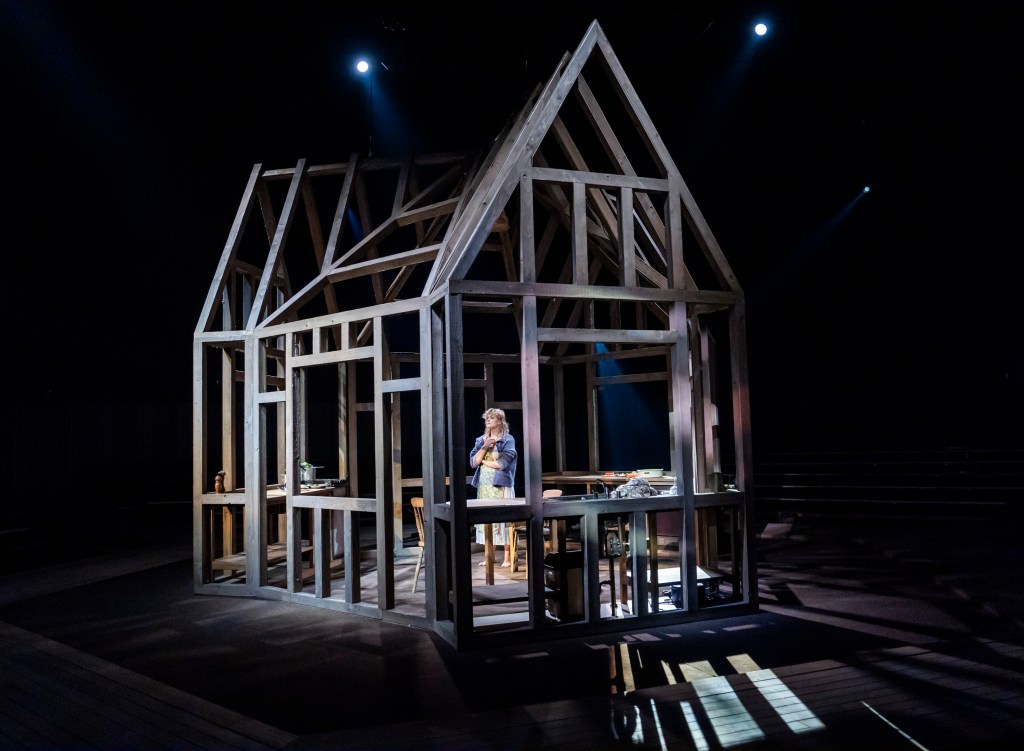
Robin/Red/Breast is performed in the round, with uncomfortable bench style seating (fortunately the play is only 55-minutes-long – though the press performance started considerably late), evoking the feeling of being in some sort of community space, a church, a school, or something similar. There is even floor seating for those that want to feel fully immersed. The stage has a series of pathways that run through the audience, running into the darkness, the abyss. In the centre of the stage sits a wooden frame of a house, with panels running all across it, turning the house into a prison cell.
When you enter the auditorium, you are handed a pair of headphones. You are told to put them on during the first blackout and take them off during the second (the blackouts might reference the strike-induced power cuts that occurred during the TV play’s broadcast). It’s a one-act play but it feels like a two or even three act play, with each act being aesthetically and tonally distinct.
The play opens with an all-female brass band dressed in red. The play manages to make the brass band creepy and sinister – I’m not sure I’ll ever be able to watch one the same again.
The first act consists of Maxine Peake’s Nora (a name that evokes the transgressive female lead of Henrik Ibsen’s A Doll’s House, who rebels against partiarchal values – and perhaps just societal and moral expectations of parents) moving around the house as she talks to us via prerecorded voiceover.
Peake’s ability to perform in silence and act out the words in our (and, presumably, her) ears is testament to her sheer skill as an actor. The words in our heads are the thoughts in Nora’s; it’s an odd feeling, watching Nora’s paranoia whilst experiencing it in our own heads. Whilst some might have preferred the voiceover to have been played via speakers, the headsets create an intense, uncomfortable immersion (luckily, the headsets themselves are rather comfortable).
The first act does seem to last quite awhile. Peake has a fantastic voice but it becomes a lot listening to Nora talk at us (not as bad as listening to Winnie drone on in Happy Days, though – as astounding as Peake was, not even she could make that play engaging).
Eventually, Tyler Cameron – the only other actor in the play – makes an appearance. Nora takes a liking to this mysterious young man. Cameron does well to play a character who never speaks.
There are other characters but they are nameless and/or never seen. The brass band sometimes double as characters. Nora refers to characters, sometimes telling us that they are with her, but we do not see them. One of them – “the woman cleans my house” – is heard a couple times, but it’s not clear if that is actually her talking or just Nora mimicking her voice. If the latter, is Nora mimicking the voice in her head, as a memory, or is she deluding herself into seeing and hearing somebody that does not exist?
It’s an interesting choice not letting the audience see (or even hear) the baddies. It heightens the paranoia and suspense. Is this actually happening, or is it all in Nora’s head? Are the townsfolk evil or just odd? Is Nora just a fearsome urbanite? Or is this none of this really real?
In the second act, Peake finally speaks – live. It’s a welcome change. The tension grows and grows, with the band making several appearances, sometimes as the band and other times as other mysterious folk. Strange things happen – some of them predictable, some of them so unclear and strange that I’m still not quite sure what happened. Nora seems to be – or at least think that she is – an unwilling participant in a small-town cult’s historic ritual. This speaks to the fears that urbanites can have of small-town folk – dismissing them as superstitious whilst being suspicious of them.
This modern reimagining attempts to do something feminist, tackling issues around fertility and autonomy – what with rituals often involving fertility – but the messaging is not always so clear. It is interested specifically in what folk traditions say about women and motherhood – but I’m not entirely sure what the play itself is trying to say.
Whilst the play begins slowly, the momentum picks up in the second act, as we witness Nora’s descent into paranoia. Our headsets now removed, we are no longer experiencing Nora’s madness and fear but watching it. The audience are sat all around Nora, entrapping her. She sees our shapes, shadows and eyes in the darkness.
Does this represent society’s cold treatment of women who are genuinely concerned, perhaps about male predators – how we dismiss such women as paranoid until it is too late?
The third blackout, which ends with a flash of light and a loud noise, is genuinely frightening.
However, the narrative and momentum are shuddered by a scene towards the end where Nora appears to be in a self-help group – though she is the only one that speaks. However, this play seems to be doing something very different, going against the conventions (and restrictions) of Western fiction, from not showing us the “baddies” to offering a disjointed narrative that disorients the audience – creating a liminality in which we are both in and out of the action.
The writing (Daisy Johnson) is interesting but can lack clarity – though perhaps confusion is the point. Frankcom’s direction and Knight’s movement evoke the feeling of classic horror, especially folk horror, but it is made modern with the use of headsets and Lizzia Clachan’s exhilarating set design, which does things and goes places nobody will expect. The rain is especially exciting, though the open space of the Warehouse means that one can clearly see the rain machine up above, which removes us from the action a bit – but, again, this works; there is a blurring of the lines between fact and fiction, reality and fantasy.
Gazelle Twin’s compositions, Pete Malkin’s sound design, and Lizzie Powell’s lighting design all compliment the play’s aesthetic and themes, enhancing the eery experience of this live horror. The book will divide people but the design is undeniably exhilarating.
Perhaps the biggest problem with the play is its presumption that the audience are familiar with the original text. This adaptation is billed as “An intimate, immersive and voyeuristic take on a folk horror classic,” and whilst Robin Redbreast is a groundbreaking TV play that is widely considered a precursor to The Wickerman, the vast majority of people are entirely unfamiliar with it. This play has reimagined a film that hardly anybody knows. On the one hand, this makes it easier to take the text in whatever direction the creatives want. However, most people cannot appreciate the ways in which the original text has been reimagined for today, which I’m sure are wonderful – or would be if there was more clarity in the text.
I studied Politics and then Gender, Sexuality and Culture at university, with a focus on popular culture, yet the political and feminist themes and ideas of this play did not always come through to or land for me. The play can feel a bit vague and lacking in cohesion. Sometimes gripping; other times, confusing; and occasionally uninteresting – again, is that the point, or am I giving it too much credit? Is the play too smart for me, or is it not as smart as it thinks it is?
Regardless, nobody can deny Robin/Red/Breast‘s artistry and ambition. It’s a bold, unique play that immerses the audience into a world of paranoia; a world – or, rather, village – that is simultaneously intimate and immense. The entertainment comes in the form of design whilst the writing and direction (and those bloody benches) aim to discomfort.
Robin/Red/Breast runs at Aviva Studios (North Warehouse) until May 26.
Photo: ©Tristram Kenton
 JADAR
JADAR 