★★★★☆
City of Floating Sounds is a unique and immersive orchestral experience composed by Huang Ruo and performed by the BBC Philharmonic Orchestra. It takes classical music and its associations before flipping it on its head and giving the audience an interactive concert right in their hand. Its experimental yet entertaining approach is an orchestral experience unlike any other, which has you listening to every note and instrument as it makes its grand musical build.
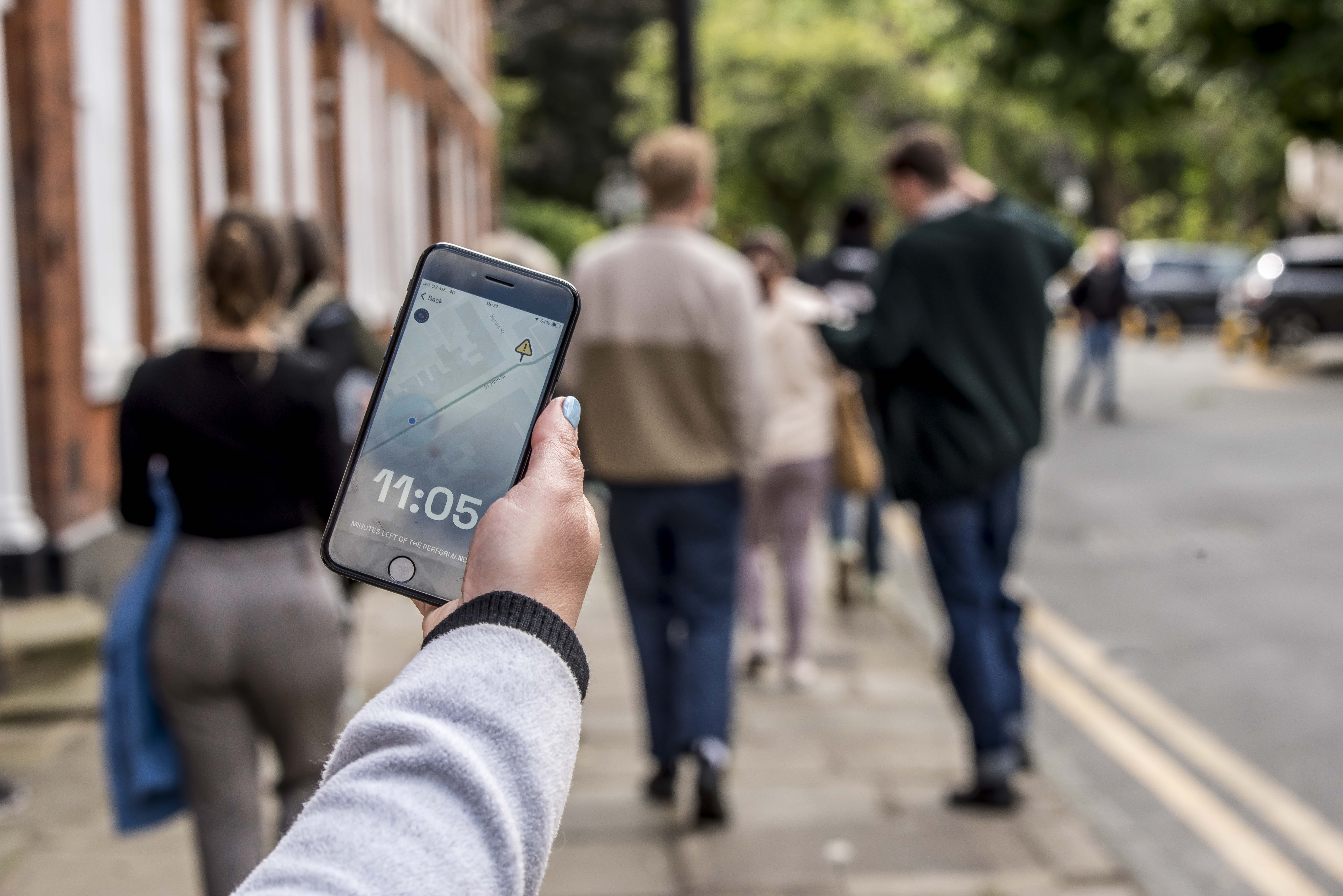
The first part of the show involves a creatively executed half-hour stroll through the streets of Manchester and finally meeting in the AVIVA Studios. Groups choose where they wish to walk from, whether it be one of the four options with guides, or trekking it alone, while an orchestra slowly starts to build on the navigation app as you make your way through the hustle and bustle.
My journey started in Sackville Gardens next to the Alan Turing memorial statue before going through St. Peter’s Square and making our way through the winding streets to our final destination.
As the journey began, one continuous string note is played, almost reminiscent of a car horn ironically. Gradually, more and more instruments and melodies are added to the note with different users having unique strands of the ‘City of Floating Clouds’ arrangement. As a result, each user gets a different experience… if you hang back further in the group, you may get a brassier sound than the light strings in the front, and so on.
Additionally, the more people, the more the music interacts, repeats, weaves in and out, and creates more complex musical patterns. In this way, the whole experience becomes more enriching as the people, and the music they play, mingle together, along with the steady chugs of the trams, beeping car horns, and other typical city sounds.
By the time we had reached another set of gardens, our orchestra had fully kicked in as we surrounded the circular monument (oddly it felt as though we were all playing the song as a tribute to the pompous pigeon sat in the centre). The music creates a sense of meditative wonder, encouraging you to open up all of your senses to the bold world of culture around us and perhaps even the music of the mundane – that everyday city life sound.
While the experience was a unique and innovative way of experiencing segments of the piece before the formal show, I did have a bit of trouble with my app, and after trying two pairs of earphones, I resigned myself to listening through my phone speaker, bringing it closer to my ear like many other participants. I think the experience worked best with the Bluetooth speakers that the representatives carried, and I often tried to stay near the reps to grasp the whole experience.
Despite this, I admire the originality of the app and composition, and felt it created a sense of wonder and curiosity, from passers-by as they heard the humming slowly creep towards them, and by participants as they commented on the different tracks, people-watched and admired nature in a friendly communal walk.
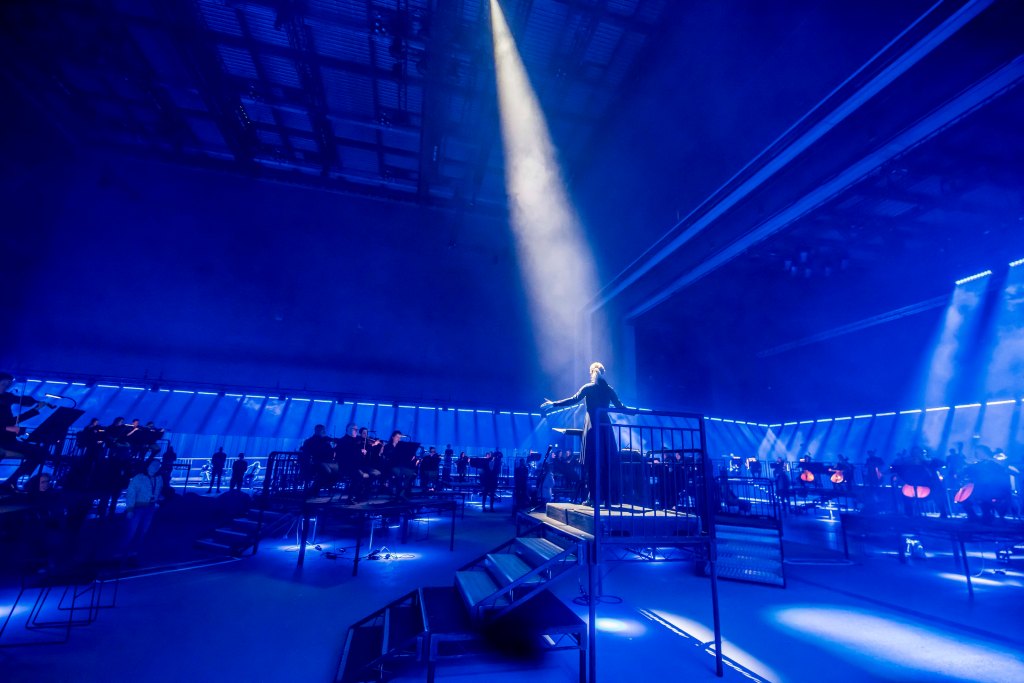
Part two brings us to AVIVA Studios in a world premiere of the full version of City of Floating Sounds played by the BBC Philharmonic. Having been to the studios several times, I was aware how adaptable the staging could be, but never in a million years would I have guessed the layout for such a prestigious orchestra would be so unique and creative.
Rather than sticking with traditional staging, the entire orchestra were spread across the room, lit by colour-changing lights dimmed dramatically by a thin layer of fog. On one end, the conductor stood alone on the podium with the most serene aura as she swished the baton, casting spells on the audience which all seemed enchanted by her movements and clear passion. Around her were many string instruments, and further away, the brass, the woodwind, more strings and so on, all played by a myriad of talented musicians also sat on little platforms above, yet surrounded by the audience.
Much like the app, walking around the sections meant you could hand pick which instruments you wanted to hear the loudest, thus making what at times feels a repetitive tune (with several returning cyclical motifs as the music builds and builds) into your own composition. It’s as if you become the conductor and choose the dynamics.
Along with this, the bean bags and seating meant listeners could end their stroll and fully listen to the swirling musical patterns – something I saw many people get lost in as they closed their eyes to appreciate it, or stared with awe at the many musicians. At the end, the gradual movement and noise of the audience had ceased, and all eyes drew towards the conductor as the orchestra played their final bars.
The orchestra and Ruo received a much-deserved grand applause for their efforts, and I was left stunned by how unique the whole idea was… an app that plays segments to familiarise yourself with the music and encourages chatter and thought about our urban environment… a concert where the audience surrounds platformed musical enclosures… an experience that allows you to truly listen to the complexities and arrangements of different instruments that would likely have been left unnoticed if not for the ability to move them.
Despite a few hiccups with the app, both the walking segment and the orchestral concert were performed astoundingly. The creativity behind many of the decisions was jaw-dropping. In fact, more shows should take note from the orchestra’s move to shake things up and try something that links to either today’s technology or creates a more intimate or innovative way of experiencing a traditional show. Put simply, it was a superb and touching experience performed with the most unexpected but creative decisions I’ve seen since another Factory International show: Dark Noon.
City of Floating Sounds runs at Aviva Studios, Manchester until June 8 before transferring to Lincoln Center, New York City for its international premiere from July 23 to 24.
Photo: Chris Payne
 JADAR
JADAR 