★★★☆☆
Few British plays are as iconic as Oscar Wilde’s The Importance of Being Earnest. The play, which premiered in 1895, marked the climax of Wilde’s career – but also his downfall. Despite its early success, Wilde’s notoriety caused it to close after just 86 performances. It was soon revived, then again and again and again – and 130 years later, it continues to be revived, most recently at Manchester’s Royal Exchange Theatre, whose programming largely consists of modernised classics.
A farcical comedy, the protagonists maintain fictitious personae to escape burdensome social obligations. Working within the social conventions of late Victorian London, the play’s major themes are the triviality with which it treats institutions as serious as marriage and the resulting satire of Victorian conformity.
Essentially, the play is about sheltered, rich folk whose boredom causes them to do ridiculous things – like all in love.Two men, friends, take on double identities to seduce women.
Algernon (Parth Thakerar – hilariously insufferable) discovers that the friend he has always known as Ernest (Robin Morrissey – marvellous) is, in fact, Jack; he is a country boy with a city alter-ego.
Back in the country, Jack is a reputable man and a guardian for the 18-year-old Cecily (Rumi Sutton, who succeeds at modernising the youngster). In the city, Ernest falls for Algernon’s cousin, Gwendolen (Phoebe Pryce, who does an excellent job playing a woman who is bold except when her mother is around) – much to the disapproval of her elitist, aristocratic mother, Lady Bracknell (Abigail Cruttenden, who steals the spotlight the few times she is onstage).
This deception inspires Algernon to do the same: he, too, adopts the Ernest persona to seduce Cecily. The men are both surprised to learn that their romantic partners both always dreamt of being with men called Ernest – but would they want to be with them if they were not called Ernest?
4 x Olivier Award-nominee Ian Bartholomew (Chasuble) and James Quinn (Lane/Merriman) portray their characters wonderfully and make the most of their limited stage time.

The play is often praised for its comedy – farcical comedy often ages quite well – but there has also been a little rewriting to suit today. Highlights include Lady Bracknell asking Jack, “What are your politics?” “I’m afraid I have none,” says Jack. “I’m a liberal democrat.” This language has, no doubt, been modernised to suit today. Later, in act 2, the more grounded, Northern Cecily says, “When I see a spade, I call it a spade,” prompting the snobbish, Southern Gwendolen to respond, “I’m glad to see that I have never seen a spade!”
However, the play has been criticised for its lack of social messages, though there are certainly some important themes. The play is largely about triviality: Wilde told Robert Ross that the play’s theme was “That we should treat all trivial things in life very seriously, and all serious things of life with a sincere and studied triviality.” While much theatre of the time tackled serious social and political issues, Earnest is superficially about nothing at all – and that’s exactly the point. It is a rebellion, of sorts – an artistic representation of its transgressive writer.
The play superbly satirises society – more broadly, society as a whole; more specifically, “society” as in “high society”. It repeatedly mocks Victorian traditions and social customs, marriage, and the pursuit of love, in particular. In Victorian times, earnestness was considered to be the overriding societal value; originating in religious attempts to reform the lower classes, it spread to the upper ones too throughout the century. The play’s very title, with its mocking paradox (serious people are so because they do not see trivial comedies), introduces the theme; it continues in the drawing room discussion, “Yes, but you must be serious about it. I hate people who are not serious about meals. It is so shallow of them,” says Algernon in Act I.
This can prove tricky for modern adaptations, which are generally expected to add something new or make the themes relevant for now. We are often told, “The themes remain relevant,” but that cannot be an excuse for not doing anything with the themes.
Director Josh Roche, like countless directors before him, had to think about what this play, which is essentially about nothing, means for today – and he had to differentiate it from previous productions.
But this is where this production struggles. The play’s relationships are deliberately ridiculous; Algernon is undeniably in love but he’s just a bored, wealthy man trying to fill the emptiness of his privileged life. But in this production, the relationships are straight and serious, with Alergnon’s declaration of love said with sincerity, accompanied by ambient music. There seems to be an expectations that the modern, Northern audience gets behind these shallow (arguably exploitative) relationships – and be delighted by the “happy ending”, rather than laugh at it.
The first act drags and lacks the heightened comedy that this production requires. Things get going in the second act, especially when the two women, blissfully unaware of the whole Ernest deception, battle it out over who is Ernest’s rightful fiancée – the one who had him first, or the one who had him last? Here, the play descends into melodrama and finally feels like a farce.

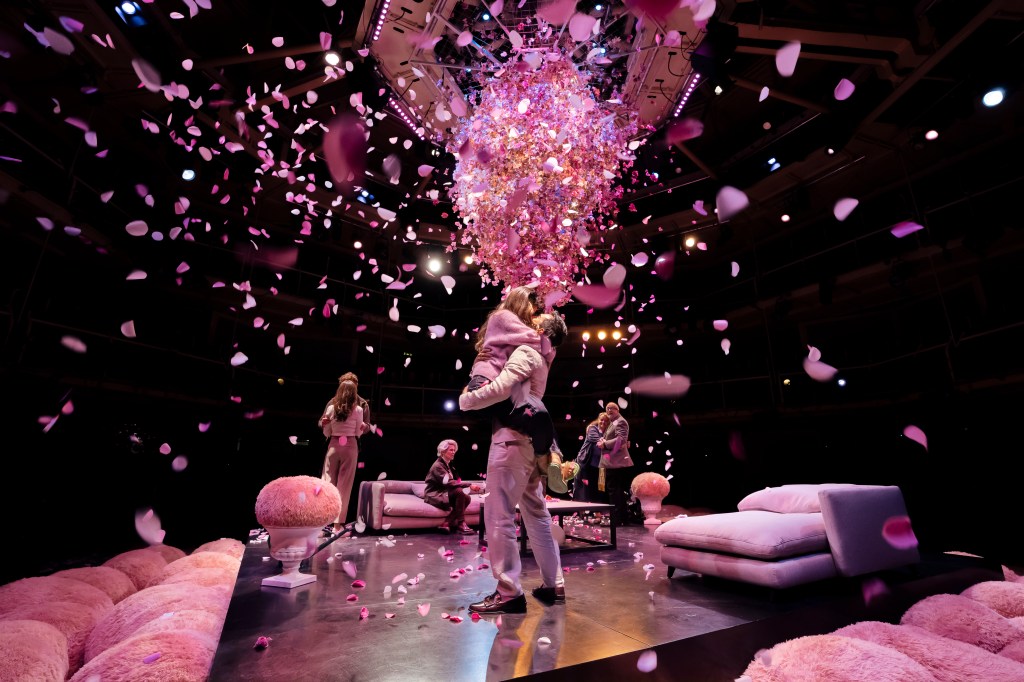
The most memorable part of the play is its set – a beautiful representation of artificiality. The high, black, squared stage is contrastingly layered with pristine, pastel-coloured, cosy furniture and surrounded by cloud-like, pink pouffes – a sort-of playground for the rich, though one which causes a little difficulty for them when they are trying to rush on or off stage. This seems to signify that their problems are all caused by themselves.
A mass of flowers hangs from above, though the flowers appear scrunched and dried, perhaps a representation of the rich soon tiring of exciting things. The stage is brought to life with Johanna Town’s luscious lighting and Sam Glossop’s sublime sound design.
The play is cleverly modernised with relatable references and phones serving as the modern-day diary, and Bull’s costumes are certainly appropriate for the modern rich, along with discarded takeaway boxes and Talking Heads’ ‘Road to Nowhere’ (fitting).
Whilst the play deliberately lacks meaning, it is found in the wonderful set design – but the ironically earnest direction reduces it to “beautiful gowns.”
The Importance of Being Earnest runs at the Royal Exchange Theatre until July 20.


 JADAR
JADAR 