★★☆☆☆
Following its predecessor, Murder Show Tonight (2023), this sequel of sorts, aptly named Murder Show Tonight II, focuses on an entirely new case with no prior knowledge of the previous show required.
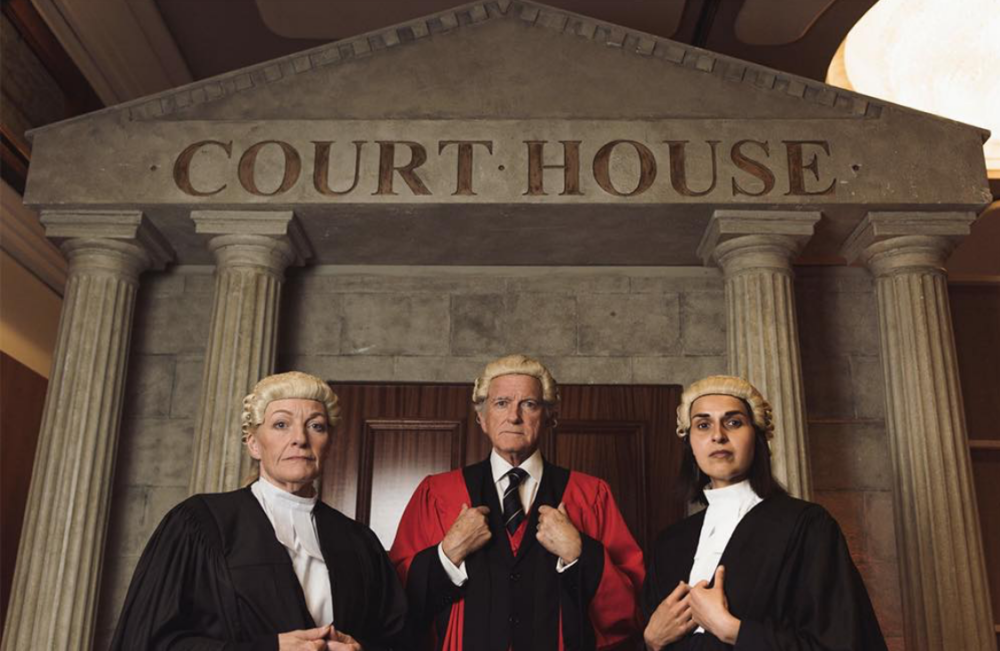
The “jury” is asked to listen to the evidence and deliver a verdict in the trial of Heather Banks (Lauren Moakes) as she is accused of murdering her husband (Greg Patmore). Karren Winchester and Alex Kapila return from the original production, with Kapila ironically taking Winchester’s role as prosecutor and Winchester becoming the judge.
The trial begins with a rather blinding array of lights mixed with an emotive string music before introducing the audience to the concept of the courtroom, and challenging us to correctly assess Heather, since “30% of murder trials deliver the wrong verdict”.
The court setting, with its wooden panels and podiums, works strangely well with the backdrop of the grand organ at the Bridgewater Hall.
We’re then introduced to the events in question through a dramatic video of the night, in which an anniversary dinner precedes the brutal murder of Mr. Banks and a large-scale man-hunt for the murderer after Heather’s E-FIT was released to the media. The murder scene is skipped, before we see Heather, having witnessed the murder, running for help from a passing car. Then begins the trial…
Ironically mirroring the pompous procedures of the courtroom, the audience/jury are asked to stand before court commences (although the repetition of this later does become a little irksome).
After a lengthy description of court procedures and opening statements from the prosecution and defence, a rather frustrated-looking Heather is brought into the courtroom before the prosecution brings out their three character witnesses, later cross-examined by the defence.
The deceased’s daughter gives a plight about Heather being a “sl*t” and a “golddigger” only interested in her father’s money, while her ex-husband accounts an event of domestic violence, and a police officer accounts for the investigation and a few pieces of evidence they found that night, as well as later enquiries.
Before court is adjourned for the interval, the defence effectively pulls all of this into question, blurring the lines between hapless victim and potential murder suspect, largely attributed to the talented and charismatic delivery from the actor playing the defence lawyer and the reasonable doubt he casts on what feels like rather flimsy evidence by itself.
Next the defence character witnesses were pulled in, including a friend of the couple, and a young man Heather had helped. Some dramatic revelations are unveiled – by which side I won’t reveal, but arguments are later wrapped up in a closing speech, and the jury are warned to dismiss all media attention which supposedly surrounded the case (although was never actively shown in the performance), and disregard any misconceptions and prejudices about Heather.
This is where the show takes an interesting break, asking audience members to cast their vote using the on-screen bar-code. There’s time for a short discussion but did Heather truly kill her husband, was it the man from the road rage incident just minutes before her husband’s death, or was it another party we hadn’t considered?
The show’s conclusion brings a specially chosen audience member to speak for the jury and reveal the results of the ballot. In our show, the verdict was “Not-Guilty”, with Heather cheering in relief as she is exonerated by the court… but wait… were the audience correct?
As court wraps up and the gavel comes down, the screen finally shows what happened that night in a startling and cinematic flashback to that fateful night. While Patmore’s performance as Mr. Banks was short, it certainly didn’t lack emotion, and the audience were left gasping and cheering as each piece of evidence fell into place.
While the drama of the some of the court case was interesting and the cinematic clips were extremely engaging, I couldn’t help but notice a real tonal disparity throughout the show. While some of the audience seemed quite content with the humour, I often felt it undercut the seriousness of the immersive courtroom experience.
As someone that has attended jury service, I can attest to just how strict the courtroom environment is, and rightly so, yet it almost felt like the show parodied this at times, despite claiming to be recreating this environment.
While the show recreated the standing for the court, the long speeches, the endless rules, the funny wigs, the lengthy structure of a court case, and the foreperson speech, this was constantly juxtaposed by bits of tonally jarring humour from the judge who wouldn’t have felt amiss drinking a swig of whiskey as she watched her courtroom erupt into intense arguments and general buffoonery. While it felt necessary to add a little something to many of these long interrogation pieces, the humour felt at odds with what the show set out to do.
Particularly awkward moments of humour included the prosecution’s patronising attitude when reading out flirtatious messages, and the cringy suggestion that the defence was “mansplaining” an emoji and being reprimanded for this after the prosecution had literally done the same thing when describing how the “wink emoji” was “lascivious”.
As a result, I couldn’t help but feel that the show needed to decide between being parodic and trivial, allowing audiences to become as rowdy as they did in these comedy bits, or being a strict theatrical representation of the courtroom. If it was to be fun and unserious, perhaps some of the longwinded accounts and the occasional flat-line delivery could have been cut down to become more cinematic, animated, punchy or dramatic segments, thus becoming more memorable, or have Heather react to some of the accusations more frequently.
Alternatively, lean into more of the audience participation bits to get members to question statements, etc. If not, then I feel the rowdiness that some of the interactive and comedy segments, caused within the crowds only work against the show as the constant chatter, shouting interjections and people being allowed in and out for drinks did undercut the immersion.
As a watcher of true crime and crime thrillers from time to time, it also felt like there wasn’t a substantial amount of evidence given in the case. While we were treated to a map of the route from the restaurant to the road Mr Banks died on, a crime scene pic, footage of a car altercation, tyre marks, and some text messages, there was very little to go on.
To ask a jury to give a guilty verdict, there has to be no reasonable doubt – concrete and undeniable proof in a trial. Instead, many of the accounts merely dipped their toes into whether or not they felt Heather was a good person – inconsequential chatter ultimately.
The evidence of blood spattering and tyre marks suggested one story but could ultimately chalk up to another as the defence attested, giving reasonable doubt. At times, it felt like lots of chattering with little to assert from these statements, and very little evidence, which perhaps was true for the real case, but felt rather stark and left the screen, visual aids and physical evidence under-utilised, and the remaining lacklustre forensic evidence feeling like the only thing that justifies questioning her guilt/innocence.
Despite this, the show makes up for a certain amount of lack of evidence, with the amount of debate and discussion it encourages. Like in The Mousetrap, there is an air of curiosity and anticipation to see whether their theories are correct, yet it ultimately feels a little pointless, as me and my guest both felt there was not enough evidence for a conclusive result.
Ultimately, it feels like the show needed more time in the drawing room to refine its long script, interactive elements, and tone. Despite the great video clips and the dramatic string introduction, the drama itself remains a little tame while the courtroom vibe is constantly used then undercut. While it’s a great idea with capable actors, and I ardently hope it succeeds in future iterations, I’m left a little bewildered by the experience as it is… a pompous yet repetitive trial reconstruction, or a parodic courtroom drama?
Murder Trial Tonight II tours the UK and Ireland until July 13.
Photo: Alan McDermott
 JADAR
JADAR 