★★★★☆
This new production of Murder on the Orient Express, adapted by Ken Ludwig and directed by Lucy Bailey, is Christie extraordinaire with its enchanting cast of mysterious characters, array of confounding clues, whimsical humour, and its integrally haunting moral message. It is a true sleuth tale that leaves you guessing until the last moments in true Christie fashion, and despite the limitations of the train setting, this production did a phenomenal job of pulling the audience into each carriage to investigate alongside Poirot as the mystery unfolds.
Christie was inspired by her own journey on the Orient Express,, writing her novel in 1934 before several movies, a 2006 video game, and obviously a few plays.
The story follows a slightly weary Poirot (Michael Maloney) in the height of his career. Having just solved a case with tragic consequences, he retires to the Orient Express for some much-needed respite before one of the string of bizarre characters, the aggressive Ratchett (Simon Cotton), is murdered right under his nose, forcing him to investigate for the sake of his friend and train owner Monsieur Bouc (Bob Barrett), and the safety of his fellow passengers.
With incredible deduction and a rather cheesy amount of dad jokes and eccentricities, Maloney plays one of the best iterations of Poirot I’ve seen to date. His jovial demeanour perfectly matches the sprinkle of Christie humour, while also implicating the haunting morals entwined in this tale of justice, revenge and murder. He plays Poirot with a spark of sporadic excitement yet adds weight to the most dramatic and unsettling segments of the play, alongside the equally emotive Barrett.
Like The Mousetrap, Christie’s creative crew of cunning characters all hold their own mysteries and come from a vast range of cultures. We have the hilariously short-tempered Hungarian princess (Debbie Chazen) and her zealously religious helper Greta (Rebecca Charles), and the Belgian Countess Elena Adreyni (Mila Carter), whose affinity to speak French, her medical skills, and her strength become passionately adored by Hercules.
Then there’s the helpful train conductor (Jean-Baptiste Fillon), Ratchett’s assistant, Hector (Paul Keating), a strange American woman travelling without her husband (Christine Kavanagh), and a young couple anxiously holding a strange secret (Rishi Rian and Iniki Mariano).
Before entering the theatre, the atmosphere was phenomenal, with a jazz duo playing at the side of the restaurant, bar staff wearing conductor’s hats, and a train frame photo opportunity for the audience to interact with. Inside the auditorium, the stage itself poured out bellows of ominous smoke – all immersive touches that I relished!
Poirot opens on this smoky scene, narrating under a haunting spotlight alongside our cast, posing melancholically before the tale begins… a scene we return to during the finale.
Now the train… the train is both the biggest limitation and the grandest spectacle of the show. Smoke bellows again from the unseen locomotive, but we don’t see it until a strangely oversized projection with Poirot and company stood to half the size of the train’s wheels. While it effectively recreates the aesthetic of the era, it felt rather unrealistic and jarring, especially when Helena comments that the Orient Express isn’t that impressive, despite it being sized for one of the giants climbing down Jack’s beanstalk.
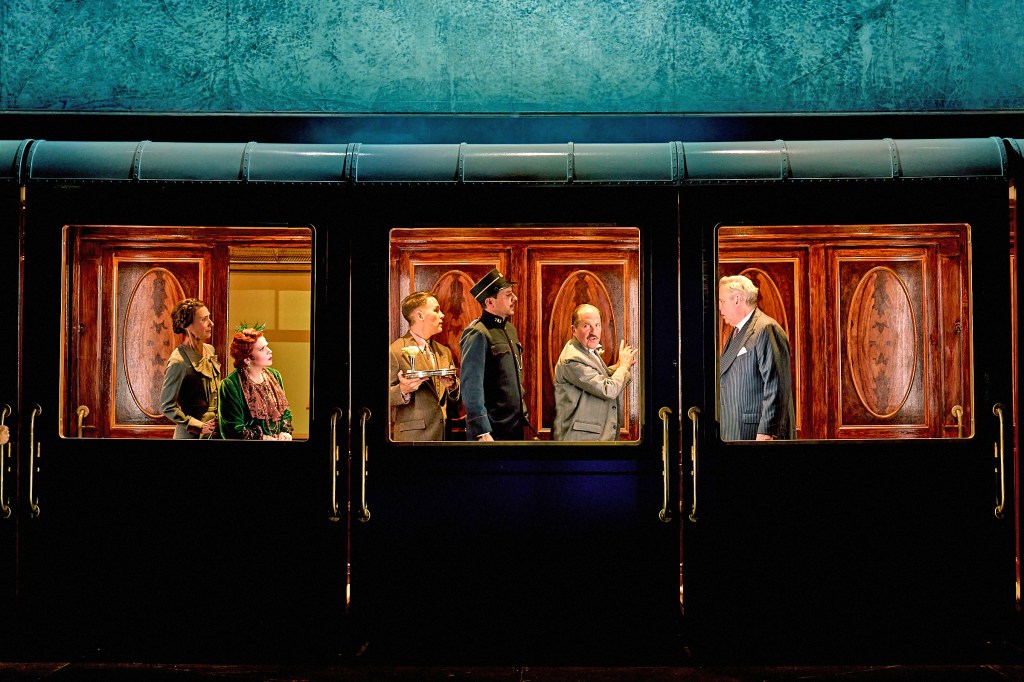
However, the real reveal of the train is a gorgeously intricate set of carriages that rotate (as does the cast in some scenes), deconstruct and attach in numerous ways. The carriages, with their period décor and opening doorways, first create a horizontal tunnel, making the audience outsiders looking in, before the front section is detached and we see the adjoining bedrooms of Poirot, Helena, and our murder victim.
Other times, the train carriages were pulled apart to create miniature suites with added chairs and tables pulled to the side, or it highlighted the fast pace of the action, rotating to show us a kissing couple at the rear of the train, before showing us Poirot and a confrontation, or the conductor panicking about the snow in the front carriage.
This fast-paced set transition was phenomenally done, especially with the dramatic music accompaniment, but I did wish that the projection scene matched the set a little better.
All in all, it was inventive, but the illusion was constantly disturbed when we saw the deconstruction of the train right in front of us – the darkly-cladded ensemble lying their backs against the carriages and waiting for the queue to push, or rotate the pieces into place. While it was a fabulous set piece, it felt like it needed a little more revision to keep that magical illusion in place.
With this in mind, it is probably the trickiest Christie novel to adapt. While Mousetrap uses a simple mansion with hidden doors, Orient Express has everything on show and needs to constantly change for the audience to see each detail up close.
Designer Mike Britton, Lighting Designer Oliver Fenwick, and Video Designer Ian William Galloway have worked in tandem to bring this iconic novel to life.
Aside from the train, one of my favourite features of the performance was the use of flashbacks in Act 2 as Poirot pulls the pieces together. As someone who has seen the film and knew who the murderer was, even I appreciated the methodical way Poirot goes through evidence – but the reenactments of previous conversations and eventually the murder itself was a nice touch.
Despite this, the reenactment of the murder did feel a little tonally disjunct. After being told the victim had been drugged, we see him flitting around he is stabbed from awkward positions, standing up from the bed, then flailing about, then crawling back onto the bed in the strangest sequence of the show. It just felt like a strange almost comedic choice in the moment of what should be focusing on the gruelling murder and shocking reveal.
Speaking of which, I was a little shocked that the audience didn’t have a more audible reaction when the murderer was revealed – as with Mousetrap, the whole audience seemed to whisper in amazement, however, I think the mainstream nature of the tale (with three movies telling the tale) its likely that many people already knew the ending.
The only technical issues that occurred were a few muddled accents (one seemed to transition between French, English and American), and an audio cut out or two – things that ultimately didn’t detracted from the show but should be acknowledged.
Ultimately, the show was an incredible adaptation with an astonishing amount of talent put into the acting, costumes and the intricate set. While some moments felt a little jarring and juxtaposed tonally, I cannot fault what was ultimately one of the trickiest and most endearing stage adaptations I’ve ever seen.
Murder on the Orient Express runs at the Lowry (Lyric Theatre) until September 14 and tours the UK until May 3.
Photo: Manuel Harlan
 JADAR
JADAR 