★★★☆☆
The Book of Mormon has arrived at the Palace Theatre Manchester saying “Hello!” to fans old and new of this classic musical, yet having watched it I’m left slightly baffled at how its garnered such a varied fan base, continued for so many years, and ultimately how the ‘humour’ is so generally accepted. Don’t get me wrong, the musical score is flawless, the enthusiasm and choreography is enchanting, and the cast are incredibly endearing, but somehow the show leaves a slightly bitter taste with its strange mishmash of culturally insensitive jokes, homophobia and racist, colonial undertones.
The Book of Mormon follows the story of Mormon missionaries Elder Price (Adam Bailey) and Elder Cunningham (Sam Glen) as they are sent to a Ugandan village to help their fellow Mormons to get more baptisms. Together, they have to overcome the general’s grip on the villagers and attempt to preach to the God-hating and oppressed inhabitants of Uganda.
The show premiered on Broadway in 2011, with Andrew Rannells and Josh Gad as the leading elders. It won nine Tony Awards and four Oliviers, making its way to the West end in 2013 and having two UK tours since then. With a script penned by South Park’s Trey Parker and Matt Stone, its no wonder the show is controversial.
I went into The Book of Mormon completely blind and purely excited to experience a show which I knew very little about, despite its worldwide success. Ironically, most of the show’s marketing seems to keep the audience blind to what is to come. I always presumed from promotional material that it was just a plucky show about Mormons getting up to shenanigans in a family friendly show, but boy? was I wrong! It’s explicit and sexual, with many moments of clunky “comedy” writing.
Personally, I’ve never been bothered by parodies of Christianity, whether it be the odd but gritty tone of Jesus Christ Superstar, which pairs gorgeous rock ballads with a practically twerking King Herod, or joke segments on TV. With TBOM, there’s an air of expectation that the show will push the boundaries of comedy and obviously mock the black-tied, door-bell ringing Mormon recruiters, but aside from that, nothing can truly prepare you for the rollercoaster to come. Do be warned that some of the sensitive subjects are dealt with rather brashly at times, often to be outlandish and provoke reactions. While there are some funny moments, there are some extremely clunky ones too.
A gorgeously celestial white frame comes into view with this golden spotlight highlighting a golden messenger, surrounded by tartan-like stained-glass panelling and a heavenly sky backdrop, before we are introduced to the past of Mormonism… the scene of Jesus, glowing robes and all, telling Mormon that the Nephites were disappearing, and in a comedically bad ADR voiceover, to bury the golden plates containing their faith’s teachings.
The scene ends and we are transported to the modern USA as the quirky Mormon group slowly assembles at each imaginary doorstep, book in hand and words recited as an almost militaristic march plays and they interrupt each other’s introductions during ‘Hello!’, which comes full circle with ‘Tomorrow’s A Latter Day’ in the finale with “The Book of Arnold”. Elder Cunningham stands out straight away with his ungelled hair, unconvincing sales pitches, and lovably, silly outbursts.
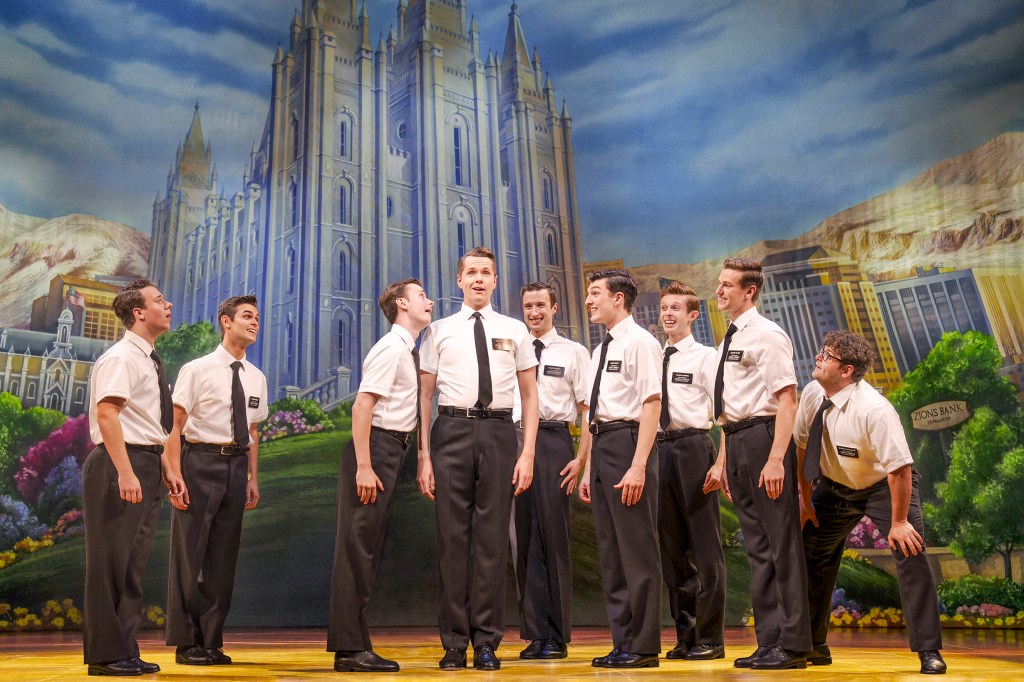
It nails the eccentricsm and cheery disposition of religious recruiters and interestingly reveals the indoctrination of several of the Mormon missionaries in ‘Turn It Off’ and ‘Spooky Mormon Hell Dream’ as many of them ignore their feelings to create this sunny, frolicking, God-loving persona – all of them devoid of their own personalities, referring to each other as “elders”, and using the same costumes and lines during each recruitment pitch.
The Mormons endear themselves to the audience with their passion and absurdly cheery nature, with Price and Cunningham being complete opposites. While Price is beloved by the Mormons, Cunningham has a vivid imagination, is rather clingy, and ironically lacks that rigid faith valued by the others.
‘Two by Two’ captures some combination of a barber-quartet, army rolecall, and the classic optimism of musical theatre, with a sprinkle of silly monologues from Price. ‘You and Me (But Mostly Me)’ develops what would usually be a great friendship in any other musical, but for a narcissist, its all about him.
I did particularly love the pastiche of musical theatre’s usually optimistic views and friendships (even capturing an essence of ‘Wicked’ and other shows in their musical variety), the awkwardness of bursting into and reprising songs like ‘I am Africa’ or the incredible ‘I believe’, and the cute building harmonies and interruptions from the over-eager Cunningham who gets left in the darkness or cut out behind the curtains during Price’s big moments.
Casey Nicholaw’s choreography is truly awe-inspiring in capturing the Mormons’ enigmatic excitement and in later more parodical numbers, such as the fabulously funny ‘Spooky Mormon Hell Dream’, where red and black striped devils with pitchforks, coffee, and glazed donuts danced around the hellscape, while a guitar-playing, winged Satan stands overhead… bizarre and amazing.
Coming into the next segment, my main issue lies with the colonial, White saviour undertones and the problematic depiction of Uganda as a hellish, disease-ridden, and sex-obsessed place. While it satirises America’s exaggerative perception of Africa, it doesn’t do anything to resolve their perspectives. I’ve seen many people that defend the show calling people “woke” or a “Karen”, but ultimately the show does propagate racial stereotypes despite its attempts to remain humorous.
Price is immediately appalled at the idea of visiting Africa, especially as he wanted to go to Orlando and see Disney World again, but our first taste of the show’s view of Africa comes in the airport… a woman who admittedly has never been to Africa comes out with face paint and Lion King-like make-up, chanting and dancing.
Indeed, The Lion King becomes a reoccurring parallel that is sure to make theatre lovers giggle, but also feels a little shoe-horned in to show the contrast between their idyllic Africa, and the one they got.
The trick highlights America’s hypocrisy and cultural appropriation yet it never really tackles these issues or alters our expectations, further perpetuating stereotypes and myths in rather obscene ways – it’s like Africa becomes the butt of the joke for the majority of the show with often unsettling colonial undertones that make me wonder how the show has continued to garnish support for so long without questions or adapted material… I suppose that it’s for those “less sensitive” audiences is usually the argument.
Our first introduction to Africa moves us away from the gorgeous blue skies and the commercial landscapes of America to a grungy, rundown village where one man drags a surprisingly realistic looking dead donkey across the ground (another of which can be seen built into the muddy backdrop).
Another man bizarrely cradles a chicken while the General (AKA General-Butt-F***ing-Naked) steals the elders’ luggage as soon as they arrive. Immediately, we find out the general is both a cannibal and a misogynist who circumcises women, yet this plot point is often undermined by the Mormons’ recruitment focus, and belittled by the show’s obsession with jaw-droppingly awkward moments.
As soon as they arrive in Africa, the audience are introduced to the villager’s concept of ‘Hasa Diga Eebowai’, their own ‘Hakuna Matata’ of sorts that quickly derails from this moment of choral chanting to what is initially jawdropping (when you don’t know its about to happen that is)… this musical has swearing! While the swearing was mostly comedic it sometimes did feel like it was there for shock value over all else as it sometimes took things too far, for instance when explaining what the phrase means we descend into villagers chanting “when God f***s you in the butt, f*** him right back in his c***”. Then comes the line: “80% of us have AIDS… many young girls here get circumcised, their clits get cut right off”, or “he got caught last week trying to rape a baby… to cure their AIDS”. Oh, and don’t forget the guy that constantly reminds us about the “maggots” in his “scrotum”. Surely, I don’t need to point out the inaccuracy, insensitivity and awkwardness of these subjects.
Then there’s the mainly comedic ‘Turn it Off’, which mocks the way Mormon’s bottle up their “feelings like a light switch”. It’s a weird song that undercuts the seriousness of domestic abuse, death and the homophobia around one of the elders with comments like “Turn it off!” and “my hetero side just won”. It’s a shame because the tunes are so catchy and the dance number is incredible, with their claps turning off the lights before they are miraculously dressed in a glamorous pink bejewelled blazer, a classy old broadyway style harmony, and an A Chorus Line esque dance routine.
Despite this, sprinkled in there were many moments of genuine humour, especially in the cute relationship between Cunningham and Price, with Cunningham trying desperately to be his friend, bond over star wars, sing him nursery rhymes and bring up his self-esteem. I desperately wanted to like Price, especially with the endearingly stellar performance from Adam Bailey, but he’s written so stubborn and unlikable that even towards the end where he’s rather quickly redeemed, he doesn’t feel genuine. His pampered and self-loving exterior never really comes down, even after he learns how to find happiness. Honestly, Cunningham was probably the most likeable character of the show (alongside Nabulungi) with his desire to please everyone, even lying to the villagers to give them hope. Glen’s excitable nature and clingy physicality give him such a cute personality (much like the energy of Josh Gad’s performances), despite his later lying and problematic manipulation of the villagers- although they seem to forgive him within a heartbeat in one of the quickest plot resolutions in history.
Cunningham’s teachings culminate in Nabulingi’s gorgeously dreamy ‘Sal Tlay Ka Siti’ as she yearns for a safe home and trusts the Mormons to help her. Nyah Nish’s performance during this song was incredible and in any other musical would bring tears to the audience’s eyes. She was endearing, raw, and realistic despite the musicals mocking moments (and how she kept her face straight with Cunningham inappropriately degrading her name from “Nutella” and “Nikki Minaj” to “Nigel Farage” and “Neutragena” or throwing out a million innuendos in ‘Baptize Me’, I’ll never know).
TBOM has so many redeeming moments regardless of its tongue-in-cheek humour, whether it’s the acting, the choreography or its relationship between religion and the musical genre. For instance, “All American Prophet” reminded me of Jesus Christ Superstar but made light of the mysterious ways of God, parodied the reenactment of Joseph’s life behind Price, and had Joseph dramatically die. This scene was also parodied by ‘Joeseph Smith American Moses’ when the villagers recite the Cunningham’s version of The Book of Mormon, with frog f***ing, humping, and diarrhea. ‘Man Up’ had Glen throwing aside his cute friendly demeanour to channel Meatloaf in a rock concert like setting, the other elders with their chain-linked jeans, scruffy hair and bedazzled uniforms dancing like they were in Grease. ‘Making things up again’ brought in Darth Vader and the hobbits in a spectacular parody of all things nerdy. The show even paralleled itself with the villagers making their own theatre structure mirroring the heavenly herald on stage above our heads.
The show concludes with its core message… happiness. The Mormons and villagers unite in spreading the words of Arnold (Cunningham), highlighting that they have all learnt to love and accept each other, including the Chief who is accepted into their ranks after being convinced to change in fear of spooky Mormon retaliation, Joseph Smith missiles, Death stars, and other vaguely nerdy threats.
Ultimately, TBOM is one of them divisive shows that audiences will either love or hate. Its lack of subtlety and awkward risqué moments of insensitivity plague many moments of the show, yet its incredible score, interesting set design, swift transitions, talented cast and intricate choreography make it a masterclass in musical theatre. Even certain comedy elements are hilarious with the whole audience erupting with laughter during musical pastiche or religious parody moments, while other segments feel entirely like watching South Park in all its crassness- comedy that feels too problematic. I was surprised so many people were laughing and didn’t see the issues! Its one of the most bizarre and rude shows I’ve ever seen, and yet it has its charms if you know where to look, even if the majority of the ‘humour’ feels too crude.
It follows the story of Mormon missionaries Elder Price (Adam Bailey) and Elder Cunningham (Sam Glen) as they are sent to a Ugandan village to help their fellow Mormons to get more baptisms. Together they have to overcome the general’s grip on the villagers and attempt to preach to the God-hating and oppressed inhabitants of Uganda.
The show premiered in Broadway in 2011 with Andrew Rannells and Josh Gad as the leading elders. It won 9 Tony Awards and four Oliviers, making its way to the West end in 2013 and having two UK tours since then. With a script written by South Park’s Trey Parker and Matt Stone, its no wonder the show has become rather controversial.
I went into The Book of Mormon completely blind and purely excited to experience a show which I knew very little about despite its worldwide success. Ironically, most of the show’s marketing seems to keep the audience blind to what is to come. I always presumed from promotional material that it was just a plucky show about Mormons getting up to shenanigans in a family friendly show, but boy was I wrong! It’s explicit, sexual and many moments of clunky ‘comedy’ writing.
Personally, I’ve never been bothered by parodies of Christianity whether it be the odd but gritty tone of Jesus Christ Superstar which pairs gorgeous rock ballads with a practically twerking King Herod, or joke segments on TV. With TBOM there’s an air of expectation that the show will push the boundaries of comedy and obviously mock the black tied, door-bell ringing Mormon recruiters, but aside from that nothing can truly prepare you for the rollercoaster to come. Do be warned that some of the sensitive subjects are dealt with in rather brashly at times, often to be outlandish and provoke reactions. While there are some funny moments mixed in, its safe to say there are some extremely clunky ones too.
A gorgeously celestial white frame comes into view with this golden spotlight highlighting a golden messenger, surrounded by tartan-like stained-glass panelling and a heavenly sky backdrop, before we are introduced to the past of Mormonism… the scene of Jesus, glowing robes and all, telling Mormon that the Nephites’ were disappearing, and in a comedically bad ADR voice over, to bury the golden plates containing their faith’s teachings. The scene ends and we are transported to the modern USA as the quirky Mormon group slowly assembles at each imaginary doorstep, book in hand and words recited as an almost militaristic march plays and they interrupt each other’s introductions during ‘Hello!’, which comes full circle with ‘Tomorrow’s A Latter Day’ in the finale with “The Book of Arnold”. Elder Cunningham stands out straight away with his ungelled hair, unconvincing sales pitches and lovably silly outbursts.
It nails the eccentricsm and cheery disposition of religious recruiters and interestingly reveals the indoctrination of several of the Mormon missionaries in ‘Turn It Off’ and ‘Spooky Mormon Hell Dream’ as many of them ignore their feelings to create this sunny, frolicking, God-loving persona- all of them devoid of their own personalities, referring to each other as “elders”, and using the same costumes and lines during each recruitment pitch. The Mormons endear themselves to the audience with their passion and absurdly cheery nature, with Price and Cunningham being complete opposites. While Price is beloved by the Mormons, Cunningham has a vivid imagination, is rather clingy, and ironically lacks that rigid faith valued by the others. ‘Two by Two’ captures some combination of a barber-quartet, army rolecall, and the classic optimism of musical theatre, with a sprinkle of silly monologues from Price. ‘You and Me (But Mostly Me)’ develops what would usually be a great friendship in any other musical, but for a narcissist, its all about him. I did particularly love the pastiche of musical theatre’s usually optimistic views and friendships (even capturing an essence of ‘Wicked’ and other shows in their musical variety), the awkwardness of bursting into and reprising songs like ‘I am Africa’ or the incredible ‘I believe’, and the cute building harmonies and interruptions from the over-eager Cunningham who gets left in the darkness or cut out behind the curtains during Price’s big moments.
Casey Nicholaw’s choreography is truly awe-inspiring in capturing the Mormon’s enigmatic excitement and in later more parodical numbers in the fabulously funny ‘Spooky Mormon Hell Dream’ where red and black striped devils with pitchforks, coffee, and glazed donuts danced around the hellscape, while a guitar-playing, winged Satan stands overhead… bizarre and amazing.
Coming into the next segment, my main issue lies with the colonial saviour undertones and the problematic depiction of Uganda as a hellish, disease ridden, and sex-obsessed place. While it satirises America’s exaggerative perception of Africa, it doesn’t do anything to resolve their perspectives. I’ve seen many people that defend the show calling people “woke” or a “Karen”, but ultimately the show does propagate racial stereotypes despite its attempts to remain humorous.
Price is immediately appalled at the idea of visiting Africa, especially as he wanted to go to Orlando and see Disney World again, but our first taste of the show’s view of Africa comes in the airport… a woman who admittedly has never been to Africa comes out with face paint and Lion King like make-up, chanting and dancing. Indeed, The Lion King becomes a reoccurring parallel that is sure to make theatre lovers giggle, but also feels a little shoe-horned in to show the contrast between their idyllic Africa, and the one they got. The trick highlights America’s hypocrisy and cultural appropriation yet it never really tackles these issues or alters our expectations, further perpetuating stereotypes and myths in rather obscene ways- it’s like Africa becomes the butt of the joke for the majority of the show with often unsettling colonial undertones that make me wonder how the show has continued to garnish support for so long without questions or adapted material… I suppose that it’s for those “less sensitive” audiences is usually the argument. Our first introduction to Africa moves us away from the gorgeous blue skies and the commercial landscapes of America to a grungy, rundown village where one man drags a surprisingly realistic looking dead donkey across the ground (another of which be seen built into the muddy backdrop). Another man bizarrely cradles a chicken while the General (AKA General-Butt-F***ing-Naked) steals the elders’ luggage as soon as they arrive. Immediately we find out the general is both a cannibal and a misogynist who circumcises women, yet this plot point is often undermined by the Mormons’ recruitment focus, and belittled by the show’s obsession with jaw-droppingly awkward moments.
As soon as they arrive in Africa, the audience are introduced to the villager’s concept of ‘Hasa Diga Eebowai’, their own ‘Hakuna Matata’ of sorts that quickly derails from this moment of choral chanting to what is initially jawdropping (when you don’t know its about to happen that is)… this musical has swearing!
While the swearing was mostly comedic, it sometimes felt like it was there for shock value over all else as it sometimes took things too far, for instance when explaining what the phrase means, we descend into villagers chanting “when God f***s you in the butt, f*** him right back in his c***”.
Then comes the line: “80% of us have AIDS… many young girls here get circumcised, their clits get cut right off”, or “he got caught last week trying to rape a baby… to cure their AIDS”. Oh, and don’t forget the guy that constantly reminds us about the “maggots” in his “scrotum”. Surely, I don’t need to point out the inaccuracy, insensitivity and awkwardness of these subjects.
Then there’s the mainly comedic ‘Turn it Off’, which mocks the way Mormons bottle up their “feelings like a light switch”. It’s a weird song that undercuts the seriousness of domestic abuse, death and the homophobia around one of the elders with comments like “Turn it off!” and “My hetero side just won”. It’s a shame because the tunes are so catchy and the dance number is incredible, with their claps turning off the lights before they are miraculously dressed in a glamorous pink bejewelled blazer, a classy old broadyway style harmony, and an A Chorus Line-esque dance routine.
Despite this, sprinkled in there were many moments of genuine humour, especially in the cute relationship between Cunningham and Price, with Cunningham trying desperately to be his friend, bond over Star Wars, sing him nursery rhymes, and bring up his self-esteem.
I desperately wanted to like Price, especially with the endearingly stellar performance from Adam Bailey, but he’s written so stubborn and unlikable that even towards the end, where he’s rather quickly redeemed, he doesn’t feel genuine. His pampered and self-loving exterior never really comes down, even after he learns how to find happiness.
Honestly, Cunningham was probably the most likeable character of the show (alongside Nabulungi), with his desire to please everyone, even lying to the villagers to give them hope. Glen’s excitable nature and clingy physicality give him such a cute personality (much like the energy of Josh Gad’s performances), despite his later lying and problematic manipulation of the villagers – although they seem to forgive him within a heartbeat in one of the quickest plot resolutions in history.
Cunningham’s teachings culminate in Nabulingi’s gorgeously dreamy ‘Sal Tlay Ka Siti’ as she yearns for a safe home and trusts the Mormons to help her. Nyah Nish’s performance during this song was incredible, and in any other musical would bring tears to the audience’s eyes. She was endearing, raw, and realistic, despite the musical’s mocking moments (and how she kept her face straight with Cunningham inappropriately degrading her name from “Nutella” and “Nikki Minaj” to “Nigel Farage” and “Neutragena”, or throwing out a million innuendos in ‘Baptize Me’, I’ll never know).
TBOM has so many redeeming moments regardless of its tongue-in-cheek humour, whether it’s the acting, the choreography, or its relationship between religion and the musical genre. For instance, ‘All American Prophet’ reminded me of Jesus Christ Superstar but made light of the mysterious ways of God, parodied the reenactment of Joseph’s life behind Price, and had Joseph dramatically die. This scene was also parodied by ‘Joeseph Smith American Moses’ when the villagers recite the Cunningham’s version of The Book of Mormon, with frog f***ing, humping, and diarrhea. ‘Man Up’ had Glen throwing aside his cute friendly demeanour to channel Meatloaf in a rock concert-like setting, the other elders with their chain-linked jeans, scruffy hair and bedazzled uniforms dancing like they were in Grease. ‘Making things up again’ brought in Darth Vader and the hobbits in a spectacular parody of all things nerdy. The show even paralleled itself with the villagers making their own theatre structure mirroring the heavenly herald on stage above our heads.
The show concludes with its core message… happiness. The Mormons and villagers unite in spreading the words of Arnold (Cunningham), highlighting that they have all learnt to love and accept each other, including the Chief who is accepted into their ranks after being convinced to change in fear of spooky Mormon retaliation, Joseph Smith missiles, Death Stars, and other vaguely nerdy threats.
Ultimately, TBOM is one of them divisive shows that audiences will either love or hate. Its lack of subtlety and awkward risqué moments of insensitivity plague many moments of the show, yet its incredible score, interesting set design, swift transitions, talented cast and intricate choreography make it a masterclass in musical theatre.
Even certain comedy elements are hilarious with the whole audience erupting with laughter during musical pastiche or religious parody moments, while other segments feel entirely like watching South Park in all its crassness- comedy that feels too problematic. I was surprised so many people were laughing and didn’t see the issues. Its one of the most bizarre and rude shows I’ve ever seen, and yet it has its charms if you know where to look, even if the majority of the “humour” feels too crude.
Photo: Paul Coltas
 JADAR
JADAR 