★★★☆☆
Written by Devi Joshi
The Gentlemen’s Club marks the international premiere and British debut of the Patchworks Ensemble, with a new version of their hit show presented by The National Centre for the Performing Arts, India.
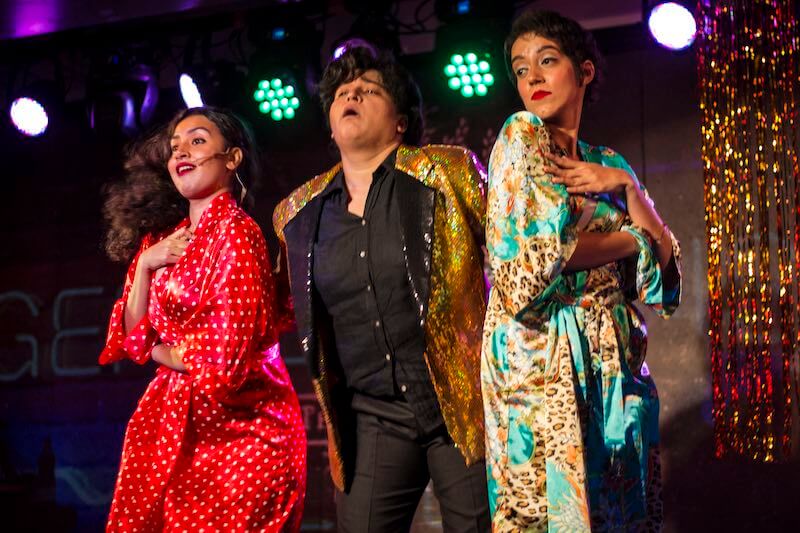
Stepping into the basement of the Soho Theatre, the audience sits four to a table, transported to Mumbai’s pulsating underground club scene and stepping into the lives of the city’s electrifying drag kings. A mix between cabaret and Bollywood performances and skits, with an interwoven story of belonging, tradition and what it means to perform, the show celebrates Indian women and their explorations of masculinity.
The show begins with the headline act, a drag king channelling legendary ’60s Indian actor, Shammi Kapoor. The hair, the make up, the facial expressions, (the golden sequined blazer), brings the audience straight into a classic Bollywood movie.
Puja Sarup, playing Rocky (playing Shammi) captures his mannerisms perfectly while singing Aaja Aaja from the film Teesri Manzil.
Growing up in a South Asian family but only speaking English, I know first-hand that one of the best things about classic Bollywood movies is that even if you can’t understand the language – which, to varying degrees, the audience may not – the unbridled physicality and showmanship of Bollywood actors brings you into the emotion of the songs. You don’t need to understand the lyrics to understand the story.
The next act up was another drag king called JT – younger and in a slim-fit suit, he danced on stage to a different kind of classic: ‘SexyBack’, a tribute to US pop legend Justin Timberlake.
The relationship between JT and Rocky is central to the show, with Rocky being a veteran drag king who is content with the status quo, and the younger JT longing to update the set, bring in new performers, and feel more part of the wider drag community.
One drag king finding comfort and nostalgia in classic Bollywood, one drag king looking to the future of drag and the endless possibilities of self expression. One drag king who has already found their way, one drag king still on a journey of self discovery. Add in a journalist who is interviewing drag performers on the Mumbai club circuit, and there’s lots of interesting conversations to be had.
The themes of drag as a calling, drag as a form of revolution, and drag and artistic integrity are also often picked up and dissected by characters. The next act up, a drag king called 55 (Pachapan) sings ‘My Ding a Ling’, a novelty song made famous by Chuck Berry, about a little boy discovering his, well, you can guess what. It’s one thing to hear a whole audience singing along to a chorus of “My ding a ling, my ding a ling, I want you to play with my ding a ling”, another to hear quite a compelling case made for this being a revolutionary act of self expression. As Pachapan says, “No matter what the government wants to shove down my throat, I want you to play with my ding a ling”.
Among the other skits and performances – a stunning slam poem sequence by two women about the nature of men, a dream sequence channelling the melodrama of Indian TV dramas, a cabaret style mash up performance of James Bond and ‘Toxic’ – one really stood out to me.
It was a flashback scene of Rocky choosing Shammi Kapoor as their drag muse. They were struggling to get booked as a drag king, and got some advice from a seasoned drag queen. They had pitched their original idea for their act: get on stage, down a beer, smash the glass, do some push ups over it, and if budget allows, have a car descend from the ceiling. You know, manly stuff. But the drag queen said that Rocky had “soft, feminine eyes”, eyes they couldn’t hide, which reminded them of Shammi Kapoor.
Shammi Kapoor broke the mould of what it meant to be a leading man in Bollywood, redefining what masculinity can look like, and bringing a softness and eccentricity to his roles. It’s fitting then that by channelling Shammi Kapoor, Rocky also learnt what masculinity can look and feel like, and channelling Shammi felt natural because it wasn’t so distant a version of who they already were.
Later on in the play, Rocky takes on another persona – a stand-up comedian relying on tired jokes full of sexist tropes and distasteful jabs at women. While the sketch was meant to highlight the sexism which is still rife in South Asian communities with a “laughing at, not with”, judging by the audience’s sparse and nervous laughter, it was a jarring inclusion among the other performances and lacked their playfulness and satirical touch. But this was an outlier in what was a show packed with hilarious and exciting performances.
While the majority of the play is in English, many of the skits moved between English and other South Asian languages. Unashamedly, the play welcomes everyone in but remains distinctly South Asian, no pandering, no watering down.
The day after the show, I watched videos of Shammi Kapoor performing ‘Badan Pe Sitare Lapete Huye’ in the movie Prince, and am in awe of the way he was brought to life in the show.
The Gentlemen’s Club is a celebration of South Asian culture, South Asian artistry, and the South Asian queer communities who create spaces for belonging and exploration. I hope the audience leaves with an appetite for more.
The Gentlemen’s Club runs at Soho Theatre until October 12.
Photo: (c) Jazeela Basheer


 JADAR
JADAR 