★★★★☆
WRESTLELADSWRESTLE is a brand-new piece of live performance that that centres Judo as a space of physical and emotional self-defence, community and empowerment. It is currently having its world premiere at HOME, ahead of a UK tour next Spring.
The piece of theatre was devised and written by Jennifer Jackson and Simon Carroll Jones – who also star in it – with dramaturgy by Sarah Dickenson.
Jackson is an acclaimed movement director, artist and choreographer who is no stranger to staging sports spectacle. Her last piece of work, Endurance, was highly acclaimed, so I was excited to see this new fusion of art, dance and sport, with design cultancy by Katie Scott, lighting design by Sarah Readman, sound design and composition by Jose Guillermo Pollo, and video design by idontloveyouanymore.
In WRESTLELADSWRESTLE, Jenni (Jackson) oscillates between teaching Judo to the audience (and a “Girl Gang” of Manchester Locals) and more intimate personal stories about witnessing a racist incident towards her Bolivian mother, a drunk woman at a taxi rank, and her teenage Judo career.
The performance began with Jenni’s assistant – Simon (Jones – who, it is important to note, was the only man in the piece) – walking onstage, asking the tech desk to lower the music, and explaining the rules of the “Judo Club”. He told the audience the rules – listing a multitude of things that were “not permitted” in Judo. I wasn’t immediately certain if this was part of the performance but I think this ultimately served to involve us audience members in the action as if this was a real Judo match.
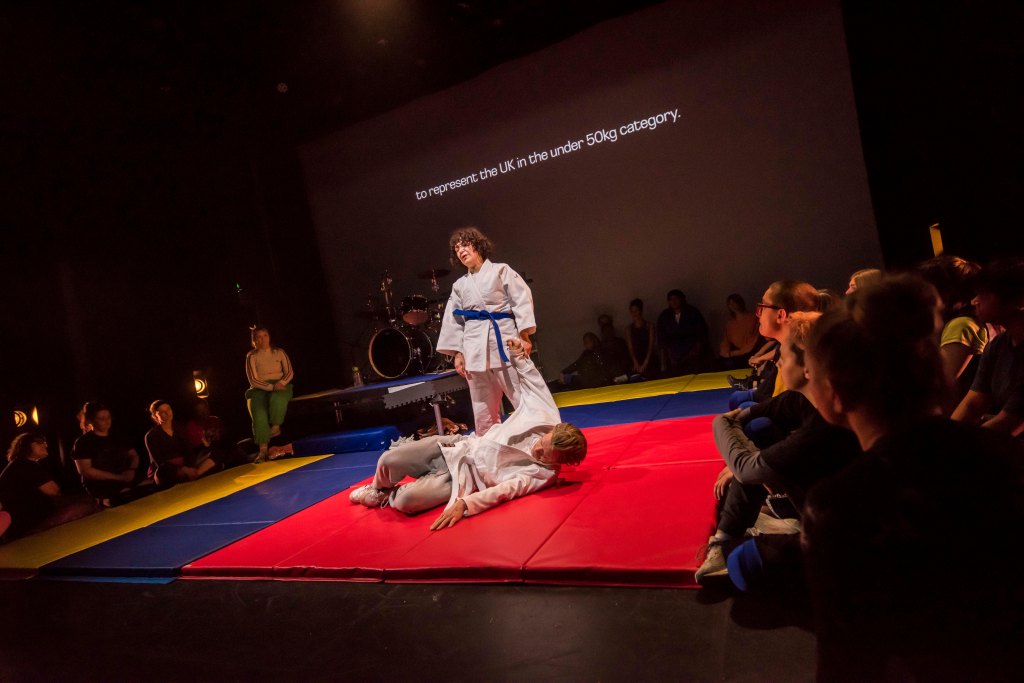
The set also echoed that of a Judo Club, with red, blue and yellow mats piled vertically on a raised platform – with a large screen behind this. I want to commend this production on their use of creative captioning (by Sarah Readman – also lighting designer). Although they were sometimes out of time with the actual performance, the captions often increased the audience’s enjoyment and understanding of certain passages.
Early on, it was very evident that this play was about more than Judo and Wrestling. When Jenni entered and told her first story – about a racist man in C&A shouting at her mother to “Go back to your country you…”, she was silent and the captions simply said “[insert racial slur here]” – which felt universal. Conversely, When Jenni mentioned C&A, the C&A logo appeared amongst the captions, causing audible giggles throughout the audience. Both of these uses of captioning added to the storytelling element, and made the performance both accessible and enjoyable.
The sports-spectacle element of the piece truly began in a surprise reveal after this story when Jenni and Simon began their play-fighting, removing the gym mats from the platform and revealing a live drummer (Isobel Odelola), who had been hidden from view! This immediately shifted the space, creating an electric, almost rock and roll-esque atmosphere – which felt paramount to the spectacle of live wrestling.
As the drumming and fighting continued, Jenni introduced the first member of her “girl gang”, Annie (Annie Rogers), and live camera footage blasted up on the screen. As each member of this girl gang entered, videography played of them entering the stage, followed by a comic book-esque title card (with a personal Wrestler pseudonym and aesthetic as they barrelled and leapt onstage). It is important to note that this girl gang was not composed of professional wrestlers or actors, but a multicultural and intergenerational collective of Manchester locals.
Throughout the piece, Jenni had been teaching the audience and girl gang Judo moves – sometimes with reference to the opponent being a “drunk uncle” – and always displaying these moves on her assistant, Simon. The girl gang served as a Judo Class – who practised these moves through play-fighting with each other.
A specific moment that felt very empowering was when Jenni taught us her favourite throw, and each member of the girl gang went up one by one to throw Simon on the mat. The only noises were that of him hitting the mat, and Jenni’s words of encouragement to each woman. The stage truly felt like a Judo class, in which there was no judgement, and an atmosphere of support, vulnerability and strength.
The pacing and balance of WRESTLELADSWRESTLE was masterful – with Jackson balancing these moments of empowerment with truthful accounts of racism and misogyny. Jenni returned to stories of the racist incident with her mother, later admitting that the racist was a woman – and admitting how nobody did or said anything. In these repeated retellings, there was a white spotlight and high pitched droning – displaying the isolating nature of these incidents, and perhaps illuminating Judo as an opportunity to display strength that was not able to be expressed in these moments of injustice.
There were extremely long segments in which Jenni displayed these moves alone. First, an intense fight with a blow-up doll – in which ‘G.L.O.S.S. (We’re from the Future’), by by trans-feminist hardcore punk band G.L.O.S.S. (Girls Living Outside Society’s Shit), blared: “THE FUTURE: FAGGOTS, FEMMES AND GIRLS”. Then it cut out as she was shouted at to “deflate him” in comparative silence.
Once the blow-up man was deflated, Jenni sank to the floor, instead hitting the mat in silence. This instinctive self-defence, even without the presence of a threat, felt almost like a prayer as she raised and lowered her hands – continuing well after the “GONG”.
This need to continue fighting without a present threat was reminiscent of cycles of perfectionism in the sports world and victim-blaming culture – and felt extremely emotionally resonant as both the girl gang and audience alike watched her pain in silence.
This solo fight/prayer then became a reclaimed dance, and Jenni stepped up onto the platform, grabbing a mic that lowered from the ceiling as she introduced the final members of the girl gang. Thus commenced the final bout of play-fighting… Red lights flashed, handheld live footage played on the screen, blow-up dolls were thrown into the mix as the girl gang ascended into a state of joyful explosive rage.
Jenni became both host and commentator – commandeering the stage into a live wrestling match in which even Odelola (the live drummer) got involved. It was an anarchic reclamation of violence that felt beautifully chaotic and empowering.
However, it was one of the final moments of the play that stuck with me the most. After this anarchic play fight, Jenni ruminated on her loss at the national Judo competition in Holland – saying she was “trying to figure out how [she] could’ve fought better”. She then replayed all the moves she had taught us in another silent solo fight, as a droning sound played. The previous joyful rage was now met with an atmosphere of helplessness and disappointment. Her solo dances were very evocative of the toxic nature of perfectionism in sports, but also of cycles of trauma, and how you can hurt yourself in the attempt to harden and protect yourself from pain.
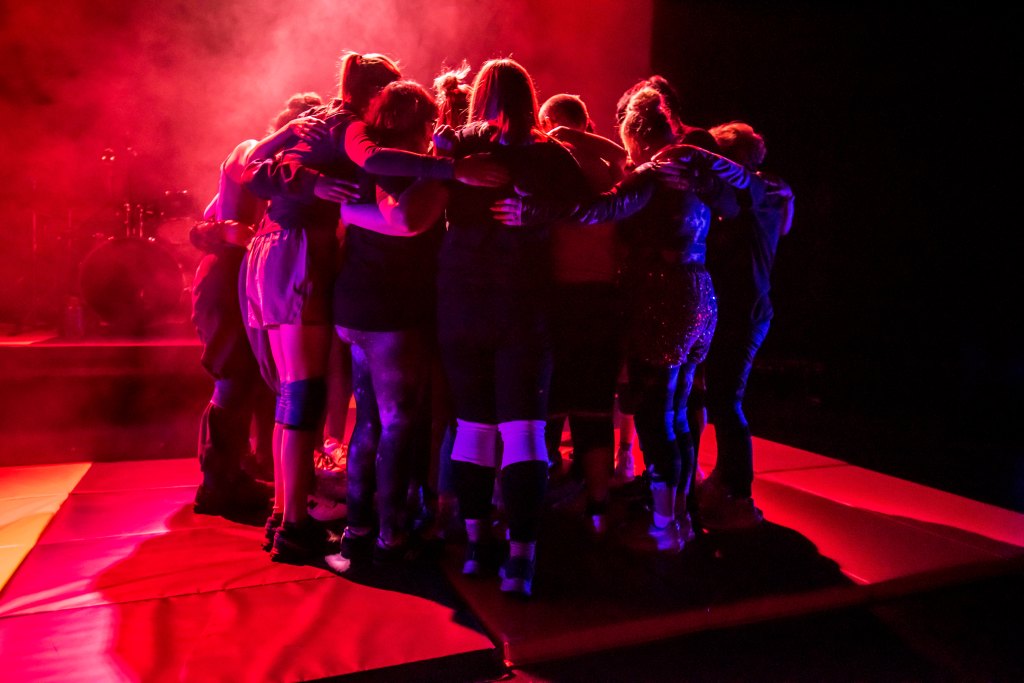
However, in the most heartfelt moment of the show, the girl gang surrounded her in a 30-person-strong embrace. The droning faded out and was replaced with birdsong. The solidarity and support displayed in this moment is a testament to Jackson’s use of a community ensemble, and the solidarity and supportive nature of feminine spaces. The interplay between strength and vulnerability is fully realised at this moment – in something as simple and familiar as a hug. The piece ends with the collective sitting on the mats, stretching, chatting and handing out snacks – returning to the natural atmosphere of a Judo class.
WRESTLELADSWRESTLE is a true triumph of feminine empowerment. The criticism of perfectionism in the sports world carries remnants of victim culture and highlights how women are made to feel powerless. Jackson’s reclamation of Judo as a space of physical and emotional self-defence presents the joy and empowerment of collective feminine rage. Jackson’s thoughtful balance of emotional resonance and anarchic play fighting allows the piece to shine not only as a thrilling sports spectacle, but as an ode to strength, community and empowerment.
WRESTLELADSWRESTLE runs at HOME (Theatre 2) until October 12 2024, The Playhouse (Sheffield Theatres) from February 12 to 15, and tours the UK from Spring 2025, with dates to be announced.
 JADAR
JADAR 