★★★★☆
Lizzie has returned to Hope Mill Theatre, swinging and ready for action – but it’s not for the faint of heart!
Lizzie is a gritty, gruelling, yet bloody brilliant rock-feminist show exploring the story of the infamous Lizzie Borden murder mystery in the whackiest four-woman show I’ve ever seen. The musical ambitiously breaks free of the small cast and space, unshackling Lizzie’s darkest desires alongside a collection of heavy rock anthems.
The “true crime rock musical” focuses on the mysterious life of Lizzie Borden (Kayleigh McKnight), the daughter of a respectable Massachusetts family, whose father and step-mother are found brutally murdered in their family home in 1892.
As the prime suspect, Lizzie is put on trial for their murders but proclaims her innocence with her sister, Emma (Emilie Louise Israel) and maid, Beatrice (Jennifer Caldwell), by her side, whilst her friend Alice (Katie Tonkinson) is uncertain of her guilt.
Fascination with the case has remained fresh with books, retellings, movies, shows, nursery rhymes, and this hit musical all peeking into what potentially happened that fateful day. While Lizzie takes a morally questionable route in glamorising the murders with the promise of female emancipation, it weaves an enthralling and complex web of the potential horrors Lizzie may have faced.
When you first walk into the venue (newly adorned with pumpkins for spooky season), there’s an air of excitement from new-timers and old fans alike. A variety of merchandise, a sweet-filled coffin, axe-decorated muffins, and special cocktails all add to this immersive feeling, which I hope will be replicated at more venues for shows.
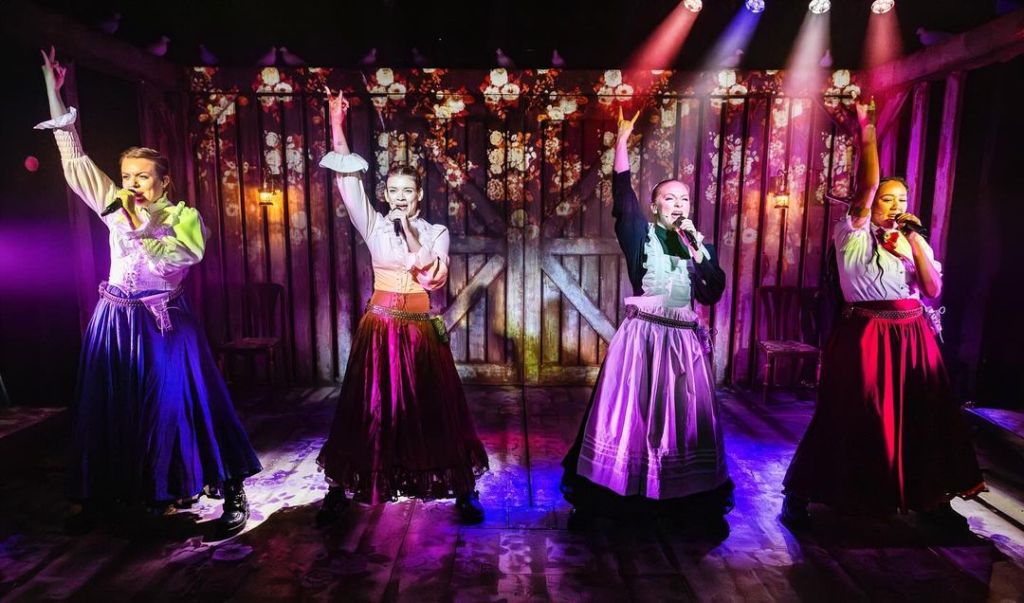
While quaint, the set, executed by Andrew Exeter (also lighting), is largely effective. Audience members are greeted in a dark room with a solitary spotlight on the rotating axe music box at the centre of the slightly ajar barn doors, while pigeons glance down from the roof. The barn doors are our courthouse (where we begin before the flashback), the infamous manor, and the barn itself, with projected ornate floral wallpaper or other furnishings added for authenticity (gorgeous video design by Dan Light).
Certain numbers allow you to see through the cracks of the wood, reflecting Alice’s longing as she looks at Lizzie from afar, or adding to the spookiness as our backing chorus sing ever-presently through the cracks.
Most of the time, the set works perfectly, the barn doors ominous closing bangs still ringing in my ears, although for bigger dance numbers or Lizzie’s panic in ‘I Gotta Get Out of Here’, it did feel a little limiting, despite mirroring her claustrophobia.
In her manic state, the set often lights with flashing images or moments where her father’s eyes (real photographs) seem to loom on her, adding to the sense of foreboding – an inventive and panic-inducing choice by Dan Light.
While I’m not a fan of every song in the show, the score by Steven Cheslik-deMeyer, Tim Maner and Alan Stevens Hewitt is annoyingly catchy and begins to grow on you after your first listen. One element I loved, was how the music perfectly encapsulates the brewing storm of Lizzie’s emotions and the show’s dark fairytale nature undertone.
Like Grimm fairytales, the prosperous and well-to-do family harbour dark secrets as reflected during the rocky nursery rhyme-like ‘Forty Whacks’ and ‘House of Borden’. Their catchy and whimsical nature seem innocent enough on the surface, but the gritty rock style and enchantingly eerie harmonies point to something more sinister, as everyone in the house is “a prisoner of a long silent war”.
Lizzie’s biggest problem is the restriction she faces under her father’s rule. His vile sexuality towards his own daughter is revealed in ‘This is Not Love’, where she describes his “selfish” touch and her voicelessness in the situation. McKnight’s performance in this part is stomach-churning and poignant, dressed in her child-like white and blue floral dress while sat in a chair representative of her father’s looming oppression, trembling and bubbling into repressed anger.
The show interestingly never shows the father or stepmother in these moments (perhaps for the better, being based on an actual murder), focusing primarily on the girls and their feelings and struggles for empowerment and fear of being disinherited by stepmother Abby. Therefore, the show’s convincing creation of hatred for a character that we never see is rather impressive, as is the murder, presented behind blood-spattered plastic sheets covering the set’s barn doors.
Despite initial plans to poison Abby in the spell-like ‘Shattercane and Velvet Grass’, the plan doesn’t come into fruition, and instead her cruel father murders the pigeons she so enviously admired – her only escape from their oppression destroyed (until her own symbolic freedom when acquitted and given wings during ‘Into your Wildest Dreams’).
While moments of heavy metal creep into the show in numbers, like ‘I Gotta Get Out of Here’, after the pigeons die, the music turns to forebording to unhinged continuously mirroring her insanity in ‘Why Are All These Heads Off’ and the murder tune ‘Somebody Will Do Something’.
In contrast, the second act uses more ballads and softer melodies, alongside a less climatic rocky songs. Its more in-depth approach to the characters, their responses to the murders, and the increasing amount of comedic moments with the nonchalant maid, made the second act far more enticing than the more chaotic first act.
Speaking of the Bridget the maid, Caldwell’s character was ironically my favourite, with her fourth-wall breaking dead-pan stares, winks to the audience, hilariously intentional and dramatically dark jabs, occasional swears, and acceptance of bribes becoming the show’s much-needed comic relief. Yet simultaneously, she was warm, caring, and had this gorgeous motherly folk tone to her voice in the calmer songs.
McKnight’s transformation from a meek, helpless girl into a fearless young woman after the murders is also reflected in her change in fashion, burning her girlish blood-soaked florals to adorn a more womanly light blue gown, and later a gorgeous white dress. Her attitude and vocals perfectly adapt from soft and longing to confident and empowered, only softening around Alice, who expresses her love for Lizzie in ‘Will You Stay’ during Act One but becomes increasingly withdrawn with her concerns that Lizzie was the murderer.
Tonkinson’s voice is so angelic yet powerful in these moments, like a song-bird in flight, providing the perfect counter to the powerhouse vocals of McKnight. Her harmonies are to die for, and her chemistry is so raw and authentic, although it comes with no surprise since I last saw her as the enigmatic and charmingly rocky Bonnie in Bonnie and Clyde. I look forward to hearing more from her in the future.
Emilie Louise Israel’s vocals are equally stunning, and she performs perfectly as the caring but frustrated older sister.
While the show does a great job of exploring themes of (alleged) abuse, empowerment (to the detriment of her parents), and sexual oppression, it does neglect the class factor a little. While gowns, inheritance talks, and their supposed mansion hint at their wealth, the idea that a young noble woman was incapable of such crimes was integral to the original case, and goes largely unmentioned in the slightly rushed court case segment of act 2.
Additionally, it would have been beneficial to have explored Alice’s feelings towards Lizzie after the trial and whether her testimonies against Lizzie impacted her love as her acquittal only garners celebration and brushes off Alice’s previous internal conflict. Their chemistry was well created but it felt like a little more time together would have solidified it.
After her release, the exciting finale takes us through the biggest songs of the show, the performers excitedly bursting onstage in their rocky fishnets and crop tops for a refreshingly modern take on these moments, reflecting the timelesness of the themes.
With the guitarists centre-stage and the barn doors open to reveal the other musicians, this segment feels like an authentic rock concert, akin to the energy of the similarly empowering Six. My only gripe with this part was that I ardently wanted more of the show to match these thrilling moments. The chemistry between the performers, the fun, and the excitement from the audience was so infatuating.
Costumes (Rachel Tansey) before this are historically accurate, unlike in the original production, but with the modern twist of a bejewelled microphone holster that feels a little unnecessary, ginmicky and strange. While Jesus Christ Superstar works perfectly with the microphones and grungy rock set, it feels a little shoe-horned at times here. Whilst it does add to that chaotic modern reimagining, there’s something off about it – like the show can’t decide how modern and camp or accurate and authentic it wants to be.
While its small set provides certain challenges and some themes and conflicts remain unexplored, the inventive plot, empowering (although a little morally ambiguous and factually shaky) gritty feminist perspective, emotive storylines, and gripping rock tunes truly set this show apart. It’s perfect for true crime fans, musical lovers, and even psychological horror fans, with the amount of intense breakdowns and musical mirroring we experience.
While I craved more of the modern rock goddess vibe from the show’s finale, the performances were truly authentic. At its best, it’s a bloody axe-citing show with darkness, intrigue, and rock at its core. At its worst, it’s a little chaotic, feeling simultaneously modern and antiquated, inventive yet lacking in-depth at times.
But who doesn’t like a bit of chaos when it comes to rock n’ roll?! It’s simply unlike anything I’ve ever seen or heard, and I can’t fault its ingenuity.
Lizzie runs at Hope Mill Theatre until November 17.
 JADAR
JADAR 