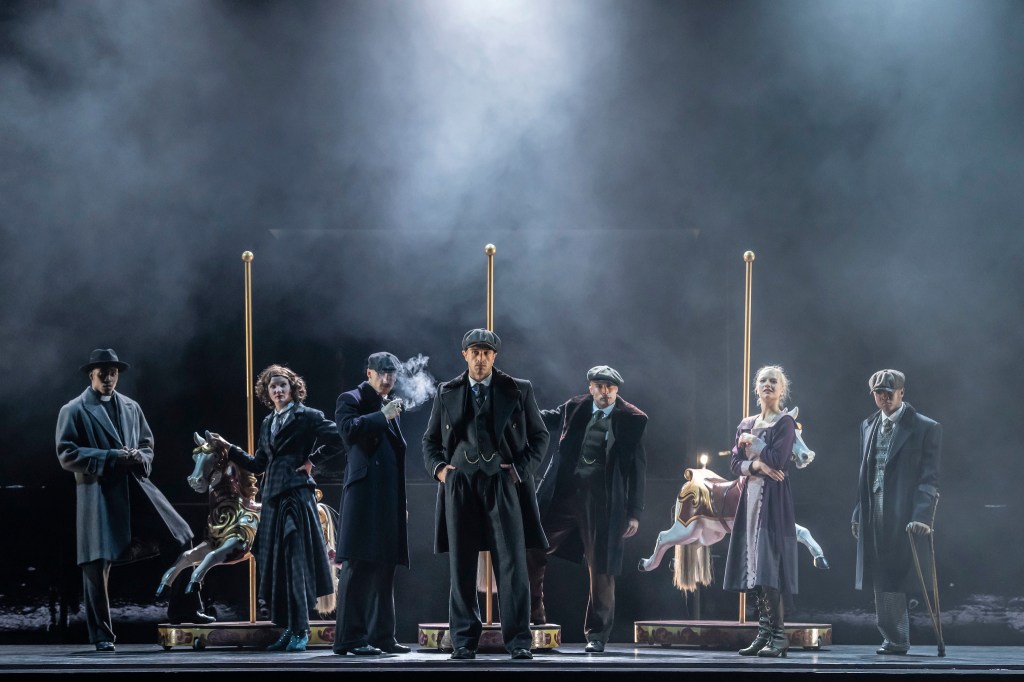
Peaky Blinders has become one of those rare television shows to get a taste of international renown. Over six series Thomas Shelby and his brutal gang gained thousands of fans fascinated by the world of warring Brummie gangsters and Rambert Dance’s The Redemption of Thomas Shelby (fairly effectively) summarises moments from four seasons of writer Steven Knight drama in two hours of contemporary and interpretive dance. We see Shelby move from the army to a gang, fall in love, and lose his way… but will he redeem himself? Will he continue living the Peaky Blinders legacy?
The versatile set by Moi Tran constantly transforms into each setting with added backdrops and props. One moment, it’s covered by industrial chains and sparky pyrotechnics for a factory, next carousel horses are paraded around the set surprisingly realistically (with momentary dancing mixed in). Another time, we see a building on fire, or a glitzy club with dazzling costumes by Richard Gellar.
At its bear bones, the set consists of a box platform (aiding illusions but sometimes blocking their legs from view), one set of bright lights, an ominously dark and smoky space, and a grungy rock band peaking mysteriously out from behind the fog.
Having the band barely visible was a unique touch for a show whose music is so integral to the world it’s creating, and I loved watching the band at work in some of the grittier action-packed dance sequences.
As Britain’s oldest dance company (celebrating its 100th anniversary in 2026), Rambert’s innovation and skill is irreputable. While one may question the concept of dancing gangsters and television-to-dance adaptations, the show works surprisingly well. The mixture of contemporary dance and grungy industrial rock creates a delectable swagger and confidence that feels at place in the ever-bleak world they take advantage of.
‘Red Right Hand’ (the TV show’s intro) is the perfect song to encapsulate the trauma, brutality, and suave of Shelby and his thugs, as well as see his character development since its played here and in the finale.
The range of dance styles was a rather impressive touch from director and choreographer Benoit Swan Pouffer. Sometimes dancing was used metaphorically, to represent pain and addiction (more on this later), or show the characters’ personality, but the most entertaining sequences were the dance fights. Rival gangs would square up, reminiscent of some twisted West Side Story rivalry. There were classic Newsies-esque leaps, synchronised fist fights, flips, lifts and slams as the gang closed in on their enemies.
Granted, some of these larger scenes lost their pacing a little, or perhaps the sheer amount of events on stage become too hard to follow, but these dance fights were incredibly well-crafted and felt authentic to the show’s grittier side (although a touch less gruesome).
Another incredible moment was the dog chase routine. While I did giggle at the slightly kinky leathery dog masks, chain leads, and hilariously animate human hound hybrids, the number genuinely created a sense of urgency and desperation as Shelby narrowly avoids the police.
However, due to the sheer amount of content the show crams into its short performance, there are several pacing issues. It rushes through several story beats in the first twenty minutes, making it incredibly difficult for me (new to the story) and my dad (a seasoned Peaky fan) alike to follow.
We move from the bleak and traumatic war, are quickly introduced to our damned protagonists, are whisked away to the dismal factory and a disgusting creep who rapes his employees before the gang take over, then we meet their female relatives, then they take over a betting shop, then they go to a night club and so on. This first section is so hard to follow!
Just as we’re trying to remember who plays each character, we’re expected to remember every new setting, subtle or undescribed story beat, and character thrown our way.
The edgy narrated recordings by the late Benjamin Zephaniah are integral to helping a newbie understand these moments and provide some rather poetic takes on the Shelby story. Additionally, I much preferred these little tid bits of information to the echoey and hard-to-understand audio recorded clips of lines from the show. I loved that melancholic story-telling.
Admittedly, after the club scene, the pace evens out as Tommy (Conor Kerrigan) develops feelings for Grace (Naya Lovell), goes through the motions, and the gang action picks up. Sadly, it never feels quite as dramatic, emotive or choreographically impressive as I’d like because of the shortness of these moments – we don’t get time to understand and bond with these characters before something else happens, undercutting gravitas.
Indeed, with (spoiler!) Grace’s sudden and dramatic death after being shot at her and Tommy’s wedding, a new version of her death that was shocking but not really heartbreaking.
Despite this, it certainly left me excited for part two, yet I was rather baffled when the curtains opened only to show the incredibly slow-paced aftermath of her death through Tommy’s addiction to opium. He reaches for the hand of a weird wirey-headed being, neglecting his family in his drugridden state, and becoming lost in waves of hallucinatory people, standing under a rain of poppy petals, and convulsing against the barrier between sanity and insanity, life and death.
The sequence is stunning… in any other show. Here, it feels a little too profound and becomes tedious to the often-action-packed source material. It’s impressively rich in symbolism and rather beautiful to watch but creates a jarring halt to the plot after such a shocking shooting happened moments before.
These pacing issues also impact Tommy’s importance to the story. Despite being our central protagonist, it doesn’t feel like we are seeing the world through his eyes. We see a bit of the heartbreak, a bit of the post-war trauma, and increase in his compassion, but I never felt emotionally connected to him.
Kerrigan did a phenomenal job at capturing the suave exterior fighting with his inner turmoil and grief alongside Benoit Swan Pouffer’s rich choreography. And yet, as a character, Tommy feels less significant, collected and impactful. Tere’s so much happening on stage and so many people to follow (sometimes I even got him mixed up with other characters) that he becomes lost in the story.
It also doesn’t feel like there is a redemption despite him realising war leads to death (and the show’s title). All those impressive moments are still there. The story just needs a touch more time and care to match the weight of the show’s delivery.
Ultimately, The Redemption of Thomas Shelby is an innovative and intriguing adaptation of the series but falls short of the television show’s legacy and emotional gravitas. Its dedicated ensemble of dancers, the variety of contemporary dance styles, the toe-tapping rocky score, and the transformative set all create intrigue, but the show’s equally rocky pacing and characterisations undermine its unique potential.
It has piqued my interest in the Peaky Blinders series with its effective world-building yet simultaneously fails to recreate multi-dimensional characters, nor the full Shelby mystique, despite the cast’s flawless performances.
Peaky Blinders: The Redemption of Thomas Shelby runs at The Lowry (Lyric Theatre) until October 26 2024 and tours the UK and Europe until June 21 2025.
Photo: Johan Persson
 JADAR
JADAR 