★★★★☆
Walking into the delightful Marylebone Theatre, still a fairly new space that opened in 2022, adorned with a beautiful café and a quirky bookshop, I didn’t know what to expect from What We Talk About When We Talk About Anne Frank. My knowledge started and ended with it being a play about Judaism starring Joshua Malina from The West Wing. It’s fair to say that 2 hours later, What We Talk About When We Talk About Anne Frank has left me with A LOT to think about.
What We Talk About When We Talk About Anne Frank or WWTA for short is based on the Pulitzer-finalist short story by Nathan Englander and first premiered at San Diego’s Old Globe Theatre in 2019 before its international premiere production at Marylebone Theatre this Autumn.
After reading Aviva Dautch’s interview with Englander, director Patrick Marber and star Joshua Malina, it seems the creative minds behind WWTA had a hard time finding space to stage the play for venues’ fear of pro-Palestine protests. A decision no doubt a lot of theatres will come to regret after watching this phenomenal show.
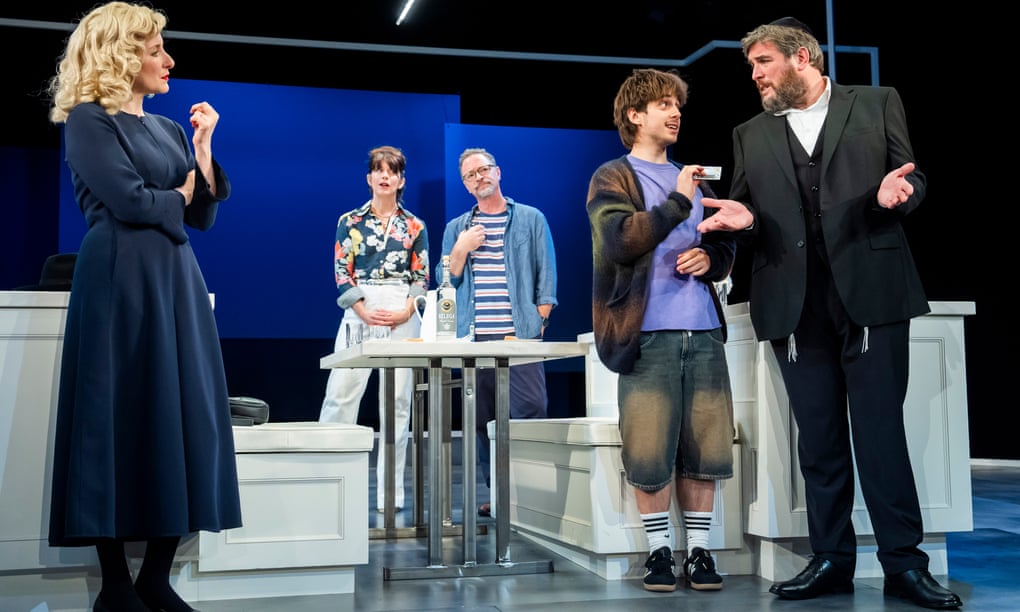
WWTA follows two Jewish couples who have reunited for a dinner date. One couple, Shoshana and Yerucham, are Orthodox jews, living in Israel with their 8 children. The other, Phil and Debbie, are secular, and reside in a luxury apartment in Florida with their son, Trevor. With very different takes on marriage, religion, and politics, an innocent reunion inevitably turns into one of tense debate.
The contrast in these two couples is made apparent from the very start: the play opens with Phil dressed in bright pink shorts welcoming Shoshana and Yerucham, both in traditional Jewish attire. Yerucham prays before every drink he takes, and Shoshana refuses to hug any man that is not her husband, adorning a Marilyn Monroe-esque wig in custom with traditional notions of propriety.
But the differences only escalate from there. WWTA’s 2 hour-run time is split into 6 acts, each loosely taking a different topic of debate as its focus. From marriage, parenting and education to Jewish anxieties, the Holocaust and the Israel-Gaza war, WWTA does not shy away from offering opposing takes on the current political climate, overtly addressing topics of genocide and oppression. This is primarily delivered through dialogue as the four sit around a kitchen table, each putting forward their opinions on such topics. It is raw. It is authentic. It is deeply uncomfortable.
Yet, what really makes this show commendable is that it roots these difficult themes in humour. While debating very serious ideologies, the cast have the audience in roars of laughter throughout, with the most memorable moment being when the couples get high, discussing the role of God in their lives. This play is a comedy, and while this may make you question the morality of combining humour with discussions of the Holocast, you’ll have to trust me when I say it works.
WWTA consists of a small cast of 5. Our Florida couple is comprised of Joshua Malina as Phil (The West Wing, Scandal, The Big Bang Theory, Inventing Anna) and Caroline Catz as Debbie (Doc Martin, DCI Banks). On the other side of the kitchen table, we have Dorothea Myer-Bennett (EastEnders, Holby City) as Shoshana and Simon Yadoo as Yerucham. Trevor is played by Gabriel Howell (Bodies, Nightsleeper).
A star-studded cast that are the true highlight of the show, the chemistry between the 4 leads is palpable. Each with a distinct personality: the sarcastic Phil, the guilt-ridden Debbie and the united Shoshana and Yerucham, grounded in their Jewish morals, each actor brings a magnetism that captivates the audience.
It is Trevor, though, that steals the show. While his primary purpose is in moving the scenes along by breaking the fourth wall, his rage-filled speech just before the interval is phenomenal. He brings a new perspective to the ongoing debates: one of generation, with a focus on environment and climate change. His shout of “You’re arguing!” followed by his mother’s repute, “We’re debating!” had me chuckling. WWTA underuses Trevor, and I would’ve loved to have seen more from him.
While the juxtaposition of the serious and the comic is remarkable, WWTA’s script does feel stilted. This may be due to the constant rewriting of the speech by Englander to reflect the ongoing developments in the Israel-Palestine conflict, as the script includes references to the events of October 7th. WWTA is rooted in the present.
Equally, the play’s pacing falls short. This is primarily due to the set being a static kitchen, beautifully designed by Anna Fleischle and wonderfully lit by Sally Ferguson, but lending it victim to audience’s minds wandering elsewhere.
Something that consists entirely of discussion becomes a detriment as I found myself questioning how it would end. How does a play conclude when there isn’t a “correct” opinion or an easy solution to any of the arguments the couples are having? So, how does it end, I hear you ask? With a dance number that was unnecessary and jarring in tone to the rest of the play.
At the core of What We Talk About When We Talk About Anne Frank is what it means to be Jewish. It is a show that inspires conversation and debate, forcing audiences to think about guilt, responsibility and action, long after they have left the theatre. People will go home and introduce the Anne Frank game to their partners, questioning who in their life they would trust to keep them alive. What We Talk About When We Talk About Anne Frank forces us to sit with our feelings and is a crucial watch for all.
What We Talk About When We Talk About Anne Frank is runs at Marylebone Theatre until November 23.
Photo: Tristram Kenton
 JADAR
JADAR 