★★★★☆
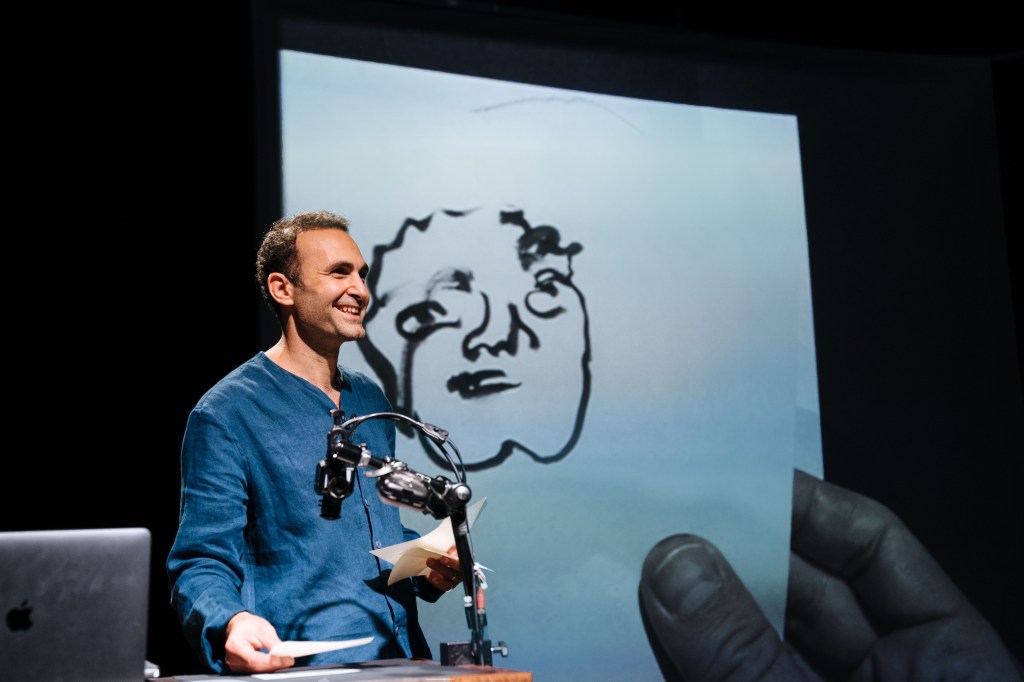
Khalid Abdalla is one of all too few actors from an Arab and/or Muslim background who has gone beyond playing terrorists, tyrants and taxi drivers. He got his breakthrough playing the lead hijacker in United 93 – which he referred to a few times in this piece – but has since played the protagonist in the film adaptation of The Kite Runner and, more recently, Dodi Fayed in The Crown, which earned him a bunch of major award nominations. His latest project, a one-man play called Nowhere, is “an anti-biography” that combines the personal and the political in a 95-minute journey through nowhere.
The piece – it’s hard to call it a play – lacks a linear narrative, though we are still taken on a journey, and segments are weaved together with a story of an Egyptian friend with terminal cancer, which Khalid repeatedly goes back to.
Khalid arrives onstage and speaks directly to the audience, immediately breaking down the fourth wall. It feels like a pre-show announcement. It sets Nowhere up not only as an anti-biography but also anti-theatre.
The piece explores countless topics and ideas, including the liminality of being both British and Arab. Born in the UK – later revealed to be, specifically, Scotland, in the tender piece’s most hilarious scene – to Egyptian parents, Khalid asks where you belong when the country you were born and raised in no longer wants you or has become too dangerous for you. As a British Muslim of foreign descent, I relate – especially after this summer’s racist riots.
Whilst a lot of similarly themed art is intended for (to enlighten) White audiences – “it was great but it was not made for me,” I often remark – Nowhere has universal appeal but proudly speaks directly to marginalised peoples, who come from, or whose family come from, the Global South.
Images often speak louder than words. In one of the most chilling moments, a video shows a line of clothes laid out on a beach, representing murdered Gazan children, which goes on for miles and miles, never reaching an end, not even when the speed picks up or the camera zooms out.
The multimedia piece also uses projections, videos, voiceovers, stories, song and dance, and even audience interaction, such as a Q&A in which Khalid asks audiences to stomp their feet and, another time, to draw themselves looking only at the provided mirrors, not the paper.
The simple set includes a desk, a laptop, a large screen, a small screen, and a clear curtain that covers the stage, creating a lininality between seen and unseen – and a feeling of voyeurism that evokes Edward Said’s Orientalism, especially when Khalid dances to a Middle-Eastern remix of ‘I Put a Spell on You’
Ti Green (set and costume designer) kept the set simple – allowing Jackie Shemesh’s lighting design and Sarah Readman’s video design to truly shine – but the set has enough going on for Khalid to play around with that it never feels empty, except when he wants it to (nowhere, indeed).
The unique piece, with its lack of form, can feel a bit disjointed and undisciplined – and the story of Khalid’s friend isn’t quite the spine that the piece wants it to be – but its rebellion against the expected is refreshing. By doing away with conventions, Khalid rebels against the status quo and frees himself from Western hegemony. It is in this abyss that he has the freedom to create without censorship.
The piece has similarities to the scattershot storytelling and theatre-making of British-Iranian creative Javaad Alipoor – one of only two theatre-makers whose work I will never miss – but also feels fresh, unique, and specific to Khalid.
Nowhere is an ambitious, avant-garde piece of art that could have failed, but Fuel Theatre hired all the right people to bring Khalid’s words (with dramaturgy by Ruth Little and writing mentoring by Chris Thorpe) to life. Whilst the piece is, essentially, a 95-minute monologue, Khalid’s passionate delivery – and Omar Elerian’s inventive direction and Omar Rajeh’s stunning choreography, which make great use of the space – will have you utterly transfixed from beginning to end.
The Space of Freedom: Here and Now Post-Show Discussion
I could not make press night, as I was flying back from Dublin, but HOME kindly let me attend the performance the following night, which was followed by a post-show discussion (The Space of Freedom: Here and Now Post-Show Discussion).
Curated by Khalid and hosted by a Dani Abulhawa, a British-Palestinian performance maker and academic, the panel also featured Nasima Begum, a British-Bangladeshi performance poet, playwright, producer, actor and creative practitioner, and Nikki Mailer, a playwright/poet and applied theatre maker, who is Co-director of Outside the Frame Arts (and a notable member of Jewish Action for Palestine – indeed, she proudly wore a “Freedom for Palestine” t-shirt).
The talk was an exploration of the opportunities for dialogue and the unique challenges Arab artists currently face, and how we can collectively overcome them.
Dani asked the panelists a series of questions, before opening up questions to the audience, and the three all spoke openly and passionately about their experiences in the arts and activism.
Dani referenced the recent controversy surrounding the Royal Exchange Theatre cancelling their production of A Midsummer Night’s Dream because of references to transgender rights and Palestine, with Nikki unashamedly reminding audiences that this very venue had cancelled a Gaza fundraiser – which it later reinstated and is now, of course, hosting a pro-Palestine piece of theatre by a British-Arab artist.
Khalid, whilst acknowledging censorship, said that here in the UK, we have more freedom to tackle difficult subjects – and tension can lead to creativity – but if this piece was performed in Egypt, there would be guards at the door to shut it down and arrest them.
Nasima spoke openly about the politicisation of her identity as a Muslim woman – especially one who wears a headscarf – and even referenced the trauma of being ethnically Bangladeshi, what with the country and its inhabitants living through British colonialism (as India), partition (becoming East Pakistan), and its own war of independence with (West) Pakistan, finally becoming its own country (but currently in a state of crisis).
Bangladesh is seldom spoken about in relation to partition, and as someone of part Pakistani descent, I know that Pakistanis often choose not to think about Bangladesh at all, rather than acknowledge what Pakistanis did to it.
There was only time to take one question from the audience, but after Dani took the first question, Khalid kindly suggested taking a couple more and allowing the panelists to answer them all together. This led to a 6-minute response from Khalid but he is so eloquent and imaginative that nobody lost interest.
“Frankly… I would rather live in the sanctuary of my hope… with the possibility that it succeeds than I would by sticking my hands up and saying, ‘F*ck it – it’s never gonna happen,’” he told us.
“In relation to Arab identity and the activists and the code-switching… I just eventually come to a point where, I don’t feel like I have a choice; I feel like the other choice is much harder. And I spent part of my life trying to do that, and frankly, it broke me; it was constantly encouraging me to be someone who I wanna push against.”
This post-show talk was a safe space where stimulated audience members could could linger a little longer and engage in meaningful conversations. It was a comforting epilogue, of sorts, that calmed us down after Nowhere ended so powerfully, provocatively, and passionately.
Nowhere runs at HOME (Theatre 1) until October 26.
Photo: Helen Murray (copyright)
 JADAR
JADAR 