★★★★☆
Classic ballet has an air of elegance and gravitas that few other forms of theatre can replicate. The gorgeously detailed sets, the precise patter of pointe shoes, the flexibility and poise of the cast, and the spectacularly choreographed swirling numbers compare to naught. To mark their 75th anniversary, English National Ballet’s rendition of Giselle (directed by Mary Skeaping) promises a night of that enigmatic grandeur and elegance.
First performed in 1841, Giselle has received numerous adaptations and additions over the years, some elements of which are retained or reshaped in Mary Skeaping’s production. Alterations occurred to the structure and imagery, the amount of classical ballet mime (although chunks remain intact), including a rather religiously fuelled edition of the Wilis confrontation, and a more cathartic tragic ending, despite remaining true to the original’s core romanticism.
Giselle follows our titular heroine (Erina Takahashi), as she falls head over heels with a mysterious stranger (Francesco Gabriele Frola), despite the attestation of the jealous Hilarion (Henry Dowden). Duke Albrecht (the stranger) disguises himself to keep up the rouse but tragedy strikes when his identity is revealed, alongside a prior engagement to the wealthy Bathilde. Giselle goes insane and dies of heartbreak upon the news.
Meanwhile, the ever-looming threat of the ghoulish and vengeful Wilis lies just beyond the village, enticing men to join their never-ending dance. [Spoiler:] Despite his misdoings (which are a little easily forgiven), when Giselle is resurrected as a Wilis, she displays her unwavering devotion to the mournful Albrecht, protecting him from dancing to his death at the hands of the Wilis Queen.
David Walker’s set and costume designs are truly exquisite here. The intricately painted and homely woodland backdrop, the multiple layers of trees in the borders, and the cosy cottages create this vibrant and inviting fairytale village.
In contrast, the remarkably darker and supernatural act two is marked by a solitary gravestone, ominous, all-consuming smoke, hidden screens veiling lurking Wilis and spooky lighting effects.
His costume designs similarly match this juxtaposing tone. Act one’s bland medieval colour palette is spruced up with splashes of colour, flowers and ribbons to mirror the excitement, romance, and festivity.
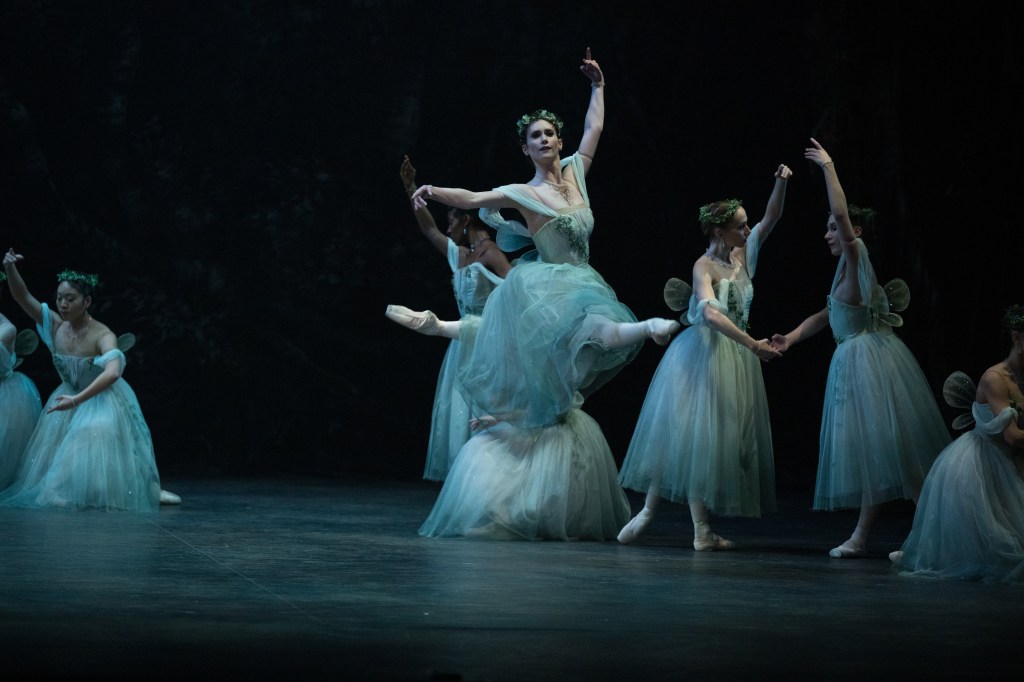
Meanwhile, act two’s Wilis costumes are elegant yet haunting with their (initially) veiled faces looming ominously behind the gamesmen in the flashes of lightning. Their draping sleeves, floral accented bodice, and puffy sweeping skirts bobbing melodically to their ghostly and clockwork reminiscent dance. They’re accented with floral tiaras and glimmering wings but certainly aren’t the angelic fairies they appear to be.
Siren-like, they captivate the gamekeepers, spiralling menacingly around their prey, hunched and moving ferociously with their arms draped across their face. They have a ferocity reflected in the dread-inducing musical score and their fast-footed yet statuesque poses, dynamically toeing across the stage with precise pointe-work and this floaty ethereality.
Many dance in canon or unison under the instruction of the queen (Julia Conway), slyly confident and effortlessly poised as their sinister puppet master. Similarly, the mime for Wilis has this sense of elegance and composure, with the motif repeating throughout the choreography; hands splayed delicately in front of the chest.
Takahashi’s performance as Giselle is enchanting, from her delicate pointe patter and supply stretching arms to her delicately coiling fingertips… she emanates elegance. Her initial performance is filled with an adorable pinch of girlish love, picking daisy petals and playfully teasing Albrecht alongside equally jovial woodwind melodies.
After her death, that melancholic and haunting intangibility is ever apparent in her performance, her solemn expressions, extended pirouettes, and slower pace, matching the sombre of her tragic death and twisted resurrection. She dithers and sways longingly, floats fleetingly above her grave, and paces mysteriously across the woodland set.
Frola’s dynamic leaps and powerful acrobatics are matched by an equally lofty tune. His boundless energy and the effortlessness and height of each pounce was jaw-dropping, as was his acting in moments of desperation and exhaustion. Each muscle and subtle leg movement felt bold and intentional, sometimes moving beyond what I thought was humanly possible.
His gorgeous shapes and poses next to Takahashi and the graceful lifts, spins and quickly paced leg clicks… such rich choreography performed with indescribable accuracy. The ensemble also performed phenomenally with the big dance numbers being the highlights of the evening, whether it be the festival dance with its spinning line of dancers or the terrifying Wilis.
Additionally, the peasant pas de deux with Ivana Bueno and Lorenzo Trossello was another particularly stand-out performance in the first act.
However, the show did have a few flaws, especially in relation to Giselle complex story and its pacing. Despite being a fairly short tale, there are several moments where it feels like certain dance segments last a little past their welcome. While beautifully varied, sometimes the sheer multitude of dance numbers in between story beats stalls the show’s progression.
Other times, because of the strange otherworldly nature of the show, it becomes hard to follow, with some audience members conferring with one another in the interval to figure out what happened.
Personally, I managed to read between the lines but greatly appreciated a re-read of the synopsis going into the second half. The miming does help explain some moments, yet it feels a little hard for a modern audience to grasp the story on that and the dancing alone (I missed an entire foreshadowed plot in one miming sequence).
Ultimately, despite moments of unclarity, the show’s mixture of frolicking fun and dark romanticism won me over. The cast’s effortless performance of intricate routines, the stunning set, and the spine-tingling Wilis; all poignantly spun together into one lavishly artistic piece.
A modern audience may struggle with a few elements due to the adaptation’s reconstructions of moments from the 183-year-old original, but the sheer versatility and dedication of the cast and creatives, the serene yet sinister score, the evocative imagery, and the variety of ballet styles make up for these minor pitfalls. It’s a tale of tragedy and heartbreak that captivates us with the chemistry of the doomed dynamic duo and supernatural wonders.
Mary Skeaping’s Giselle runs at Palace Theatre Manchester until November 2 2024. After a little break, it wraps its UK tour with a West End run at the London Coliseum from January 15 to 18 2025.
Photo: © Laurent Liotardo
 JADAR
JADAR 