Written by Jenifer Hosking and Madi French
★★★★☆
Cock, written by Mike Bartlett, first premiered on the West End 15 years ago in 2009, starring Andrew Scott and Ben Whishaw, receiving mixed reviews. A provocative exploration of how we identify ourselves and those around us, a wry look at our dependency on labels tied to expression. The Northern premiere is produced by HER Productions and directed by Rupert Hill, with lighting design by Grace Bastyan and sound design by Alec Waters.
The drama follows a short time period in the life of John, a gay man who falls in love with a woman. Delightfully witty and emotionally thrilling, Rupert Hill took the production to Manchester at the The 53two Theatre. The Northern premiere stars John O’Neill (Emmerdale, Boat Story), Joe Gill (Brassic, Emmerdale), Hannah Ellis Ryan (Coronation Street, Boiling Point) and Colin Connor (Peaky Blinders).
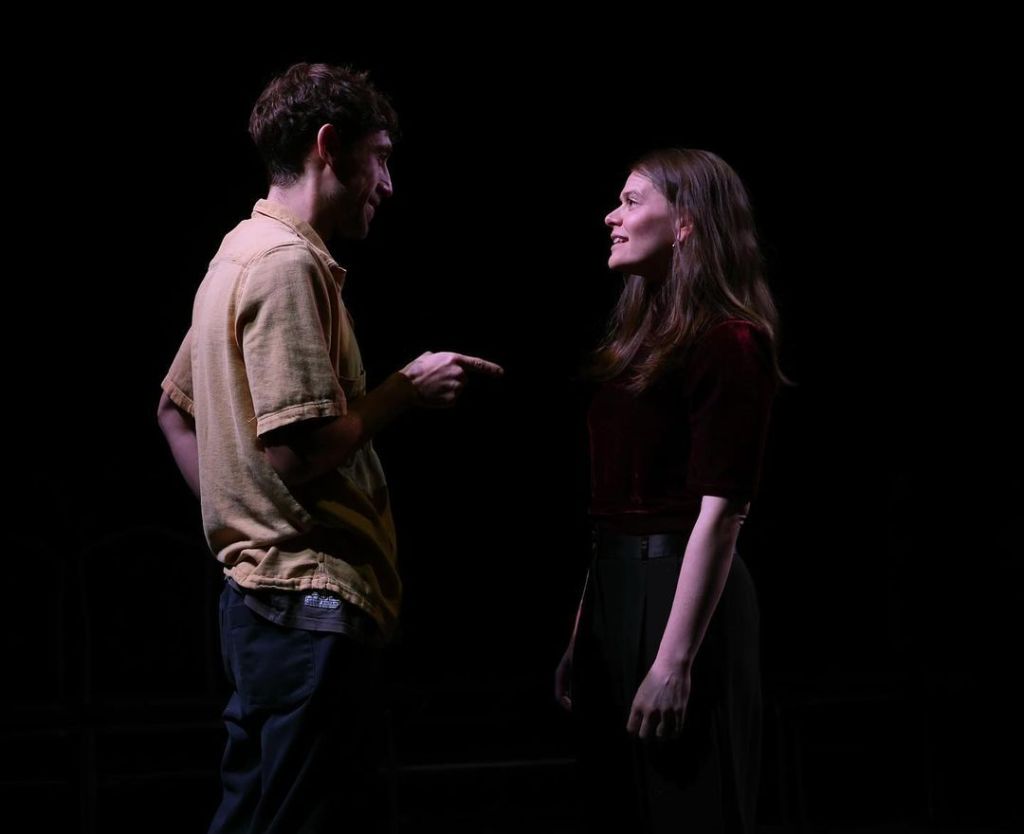
The opening scene of any play, particularly this one, opens on emotional vulnerability. Though it took a few minutes for the two performers to find their rhythm with a live audience, once they did, the actors were unstoppable, even managing to deliver a heartbreaking duologue through the piercing ringtone of an audience member.
The overall design of the show was stripped back, bringing theatre back to its roots, relying solely on character expression and raw emotional performances. Hill brought audiences into a traverse space with a clear chalk outline representing the acting space. He took an intricately intimate script that demanded for touch and yet did not provide it. He had audience members on the edge of their seats when characters got within inches of each other. The emotional performances were all the audiences could respond to, and this production took on the challenge exceptionally well.
Hill makes the decision to have the actors be themselves outside of the stage boundaries, sat alongside us on the front row. It was delightful to see their faces light up in the background, watching the production during offstage moments. It’s clear that a lot of love surrounds the production, and the actors appreciate what they have created. We saw a particularly sweet moment where actor John comforted a woman in the audience, who was quite upset after her phone went off mid-show. It was breathtaking seeing the performers rise up from their seats with such purpose and immediacy.
The story revolves around John, exposing a rich history of mistakes made, and the two love interests that he hurts. The script allowed little sympathy for the character as we watched M and W respond to his actions, but Gill brought a complex embodiment of the character to life. There was an inherent sadness to John that was noticeable from the first scene, drawing audience members into Gill’s inner monologue. The character is frustrating–since coming out at University, he’s always identified as gay, and after spending years with his boyfriend M, he’s questioning both the validity of his sexuality, and his relationship.
Though this has relevance in modern day, seeing this production in 2009, during Cock’s release, where gay marriage wasn’t yet legalised, would have an elevated shock and emotional release for both audiences and characters. In 2024, though, there seems to be a disconnect between the text and physical show. John suffers a crisis that he might not actually be what he’s always said–or thought–he was. Bartlett clearly explores the question of ‘nature vs nurture’, in regards to sexual expression through this character, and Gill does well at capturing the panic of discovering truths about oneself, while at a crossroads between two life paths.
The standout performance for us was John O’Neill, playing the character M, who gripped audiences from the very beginning. O’Neill’s character came into the space strong and though; at the beginning, his character felt almost over-dramatized; by the end of the show his performance was standout, mixing together his emotions of anger, confusion, frustration and sadness flawlessly.
Picturing the show now, we can see the final scene where O’Neill is stood asking John to say something. As the lights faded on the ex-couple, O’Neill gave a riveting performance with a flawless execution of confusion and grief portrayed in front of us. This was a moment both O’Neill and Gill were present not only with each other and the audience, but their emotions as well. This is the moment all directors hope to have in a dramatic piece.
W, played by Ryan, was a character with much to be desired. The playwright went into little detail about the character’s life, leaving us with a hyper-sexualised embodiment of a female character. The majority of her dialogue concerned her sexuality, how men view her, the past and present men in her life, briefly touching on her divorce at a young age, but not exploring her backstory much further.
One particularly out-of-touch moment for W was a monologue about the father’s imposed sexual attraction to her. This moment was difficult to watch; the directorial choices to limit physical intimacy mixed with an outdated description of womanhood in a male dominated show let this moment fall flat.
However, Ryan gave audiences a gorgeous portrayal of a woman who has been repeatedly let down. We found one especially harrowing moment to be when Ryan and O’Neill circled the stage, feeding information about their lives in an attempt to disarm one another, the sole moment we learned personal details of W and M, and the closest two characters get.
Hill had a phenomenal concept with the push and pull of closeness and intimacy paying off in moments like this one. Ryan had complete control of her body and mind in this production, seamlessly weaving together a wide variety of emotions with her whole spirit.
Connor joins the stage in the final act, portraying the protective father, distraught over his son losing the love of his life. Playing the character F, he was both the comedic relief every audience member needed and the final emotional blow in this production. He describes the loneliness and life after his wife’s death, offering a realistic portrayal of a parent navigating their child’s sexuality and coming to terms with it, despite initial reluctance. He quips back and forth, trying to be supportive of his son, whilst making amusing jabs at John for not knowing “what he is.”
We think this questioning of John’s sexual identity comes across as potentially more forced, not in Connor’s portrayal, but in the script itself; where the character is suddenly desperate to label John. Moments in Bartlett’s writing where the father was simply talking about the love that the men have for each other came across as more natural, and less thought experiment.
As John sobs, looking up towards the light illuminating him from above, ‘Did you know that there’s a tunnel under Ocean Blvd’ by Lana Del Rey is played. This was quite obscure, as no other pop music/music with words was used throughout the production, and dampened such a poignant moment with John realising he needed to be alone and couldn’t be with either M or W.
Cock is masterfully performed and directed, however, Bartlett’s script lets the show down in terms of complex female representation and has potentially not stood up to the test of time. The standard of the cast’s performance and commitment to the show is magnificent, and was with a rich directorial vision. The decision to premiere the show in 2024 is certainly interesting, and leaves a lot of food for thought.
Cock runs at 53Two until November 17.
Photo: Shay Rowan
 JADAR
JADAR 