★★★★☆
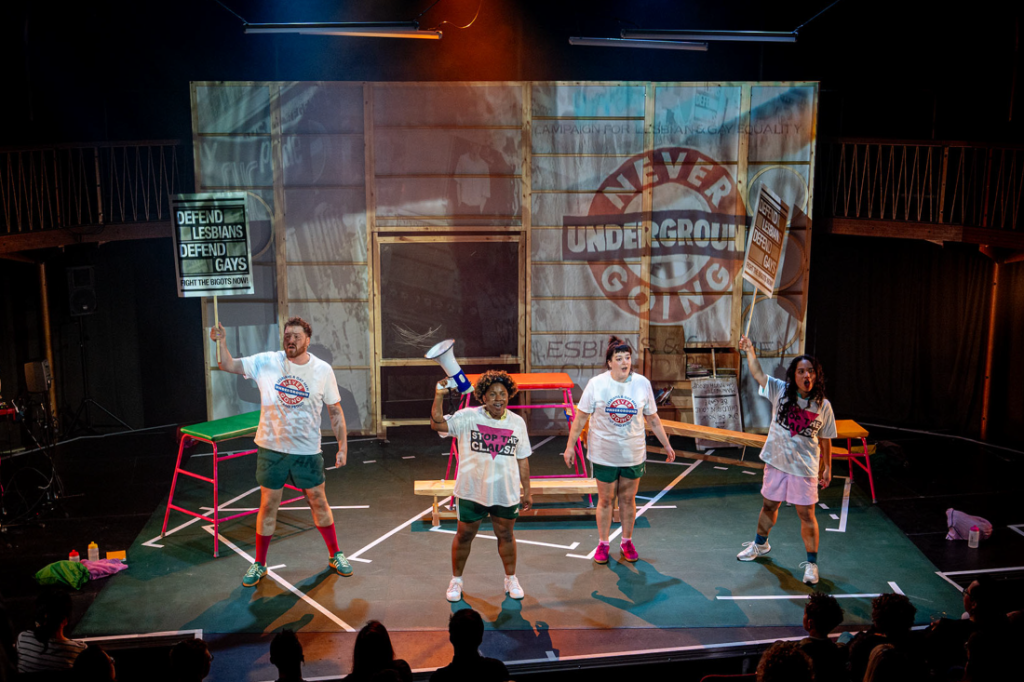
After the Act is a musical based on Section 28, a landmark piece of legislation that prohibited the “promotion” of homosexuality and thus, essentially, rendered queer people second-class citizens. The law was in place from 1988 until 2003 (2000 in Scotland). It’s wild to think that this horrendous law was in place until just 21 years ago, but we are seeing an increase in queerphobia, and especially, transphobia – thanks, in large part, to manufactured culture wars – so the musical speaks not only to the past, and how far we have come, but also the present, and how much we are regressing.
The musical lacks a firm linear narrative. There are no main characters. Instead, the cast of four take on numerous roles, but each playing a character that recurs throughout the piece. The musical is, essentially, real-life stories brought to life onstage. Each scene explores a new character and their experiences with Section 28. We hear from teenagers, teachers, politicians – even Thatcher – exploring every angle of this landmark law.
Whilst there have been many other plays with a similar format – a play made up of segments rather than scenes, so to speak – I don’t think that I have ever seen a musical take such an approach. Interestingly, though, this is closer to what musicals used to be, prior to the birth of the “book musical”. Thus, this is a production about the past in the style of the past. Poetic!
Written by Ellice Stevens (who also performs) and Billy Barrett (who directs), the production also stars original cast member Zachary Willis, alongside newbies Nkara Stephenson and Ericka Posadas. The actors’ ability to jump from one character to the next, each wonderfully characterised and many instantly recognisable, is testament to their talent. Whilst all the actors excel in this ambitious endeavour, Posadas might do it the best, with each and every of her characters appearing completely distinct. Stevens triumphs with comedy, Stephenson oozes likeability, and Willis is the heart of the show.
Live music is played by Frew (Composer, Orchestrator and Co Music Production). The synth-based score, which has some hints of Pet Shop Boys (including speak-singing), is queer and catchy. The lyrics are sharp and only occasionally a little clunky. Each and every song is a bop, though the earlier numbers are the catchiest. The second act contains less songs, and it feels a little disjointed, but it both opens and ends with big numbers.
The opening number of Act 1 sees Stevens live her drag queen fantasy as the Wicked Witch of Westminster, Margaret Thatcher, who we have to thank for the homophobic law. She wears a bad wig and rips off her coat to reveal a sparkly blue dress. Whilst it’s a thrilling number, I had been expecting even more drama and electricity from all the ads I kept seeing on social media about Maggie Thatcher singing a “power ballad”. The song could certainly be bigger, bolder and badder. This is an opportunity for a fabulous, flamboyant drag extravaganza to simultaneously disparage Thatcher and celebrate queer culture – à la Margaret Thatcher: Queen of Soho.
The musical does well not to pin all the blame on Thatcher; it does not shy away from showing concerned parents (which remains relevant with all the “parent’s rights” drama).
Designer Bethany Well’s set is versatile and intriguing. It looks like a school gym but is easily transformed into a newsroom or a gay club, with the help of Jodie Underwood’s luscious lighting and Zakk Hein’s vivacious video designs – which tell their own stories behind the performers; the attention to detail is impeccable, with everything from archive footage to newspaper headlines.
A memorable use of lighting is when one performer refers to someone being a silhouette or perhaps in the shadows, and Stevens appears behind the screen as a shadow, before emerging in front of it when the other performer refers to coming out of the shadows, or something along those lines.
Sung-Im Her’s choreography is powerful, passionate and electric, especially during the bops performed early on in Act 1 – immediately engrossing the audience and preparing us for an evening of queer chaos.
Whilst the first act is a real blend of emotions, the he second act becomes a bit solemn, which is a nice juxtaposition – we begin to understand the impact that the legislation had on people.
However, whilst the first act masterfully draws unspoken parallels, the second act becomes a bit preachy, with direct comparisons made between homophobia then and transphobia now. This feels a bit on the nose and unnecessary though Willis’ delivery is impassioned, heartfelt, and genuine.
Creating a narrative around a legal clause – heck, one without a linear narrative and main characters – one with musical numbers! – was awfully ambitious. This could have been a mess of a production – or, worse, boring. But Breach Theatre have somehow pulled it off. As entertaining as it is educational, After the Act should compel other creatives to step outside of their comfort zone and think outside of the box.
After the Act – A Section 28 Musical runs at HOME (Theatre 1) until November 16 before transferring to Chichester Festival Theatre (Minerva Theatre) from November 27 to 30, for the final stop of its UK tour.
Photo: Ali Wright
 JADAR
JADAR 