★★★★★
Opera North’s adaptation of Mozart’s The Magic Flute (Die Zauberflöte, K. 620) is nothing short of enchanting. As one of the most famous and frequently performed operas, it has captivated audiences since its 1791 premiere in Vienna. Yet this fresh interpretation managed to enthral a modern audience while staying true to the spirit of the original. It was a joyous celebration of music, storytelling, and theatrical innovation, demonstrating why this opera remains a cornerstone of the musical canon.
The Magic Flute is a complex work, deceptively simple in its light-hearted moments yet rich with dualities and deeper meanings. Its story unfolds in an undefined, mystical realm filled with contrasts—sun and moon, light and dark, day and night, man and woman. The narrative follows Prince Tamino, who embarks on a quest to rescue the beautiful Pamina, daughter of the powerful yet vengeful Queen of the Night. Aided by the comedic bird-catcher Papageno and guided by the wisdom of Sarastro, the Queen’s arch-nemesis, Tamino’s journey becomes not only one of romantic pursuit but also an allegorical path towards enlightenment and virtue.
Interestingly, the opera is infused with Masonic symbolism. Both Mozart and the librettist Emanuel Schikaneder were Freemasons, and the opera reflects their ideals of wisdom, fraternity, and the triumph of light over darkness. Even the number three—a significant figure in Freemasonry—permeates the work, from the three chords that open the overture to the three trials faced by Tamino and Pamina. This subtle layer of symbolism, combined with the opera’s mix of musical styles, has helped The Magic Flute endure as both entertainment and a profound philosophical statement.
This particular production stood out for its inclusivity and creativity. It was performed in English, adhering to the tradition of Singspiel, a German opera genre that blends sung arias with spoken dialogue. Originally intended for a broad, lower-class audience, the choice of language made the story accessible to modern viewers, many of whom may have been experiencing opera for the first time.
Before the performance, the Lowry’s Director addressed the audience, emphasising the importance of making opera more welcoming—a sentiment I wholeheartedly share. Classical music has long suffered from an air of exclusivity, but productions like this prove it can be enjoyed by all. For the same reason, the production was further elevated by thoughtful event programming, which extended beyond the performance itself. The educational and entertaining materials offered more than a simple summary of the plot and cast list, providing insights into the opera’s history and themes. This attention to detail reflected the care and creativity behind the entire event, making it an enriching experience for newcomers and opera aficionados alike.
The decision to frame the opera as a child’s dream, much like in The Nutcracker, was both bold and whimsical. The overture, traditionally a moment of pure orchestral music, began with a dinner party where a young girl fell asleep, introducing the notion that the fantastical events were part of her imagination. While this narrative device was an intriguing way to draw in the audience (as traditionally there is no acting during the overture), the child’s ongoing presence on stage felt rather redundant, as she contributed little to the unfolding drama. Nonetheless, the idea added a layer of whimsy, making the opera feel more like a fairy tale—a nod to its universal appeal.
Many view The Magic Flute as a light-hearted opera suitable for amateurs or even children, but it is, in fact, a serious and masterful work of art. It boasts an extraordinary range of musical styles and elements, showcasing Mozart’s ability to blend simplicity with sophistication. Papageno’s folk-inspired melodies are delightfully accessible, while Sarastro’s arias, sung with a resonant depth by Andri Björk Robertsson, evoke a hymn-like solemnity. Tamino’s lyrical love songs provide a romantic elegance, and, of course, the Queen of the Night’s virtuosic melodies remain some of the most technically challenging in the operatic repertoire. Fun fact: this iconic role was originally written for Mozart’s sister-inlaw, Josepha Hofer, renowned for her remarkable vocal range.
Musically, the performance was a triumph. Anna Dennis was a show-stopping Queen of the Night, navigating her infamous high Fs with ease and delivering her arias with both technical brilliance and dramatic flair. Claire Lees brought warmth and tenderness to Pamina, while Egor Zhuravskii’s Tamino was suitably noble and romantic. However, it was Emyr Wyn Jones as Papageno who truly stole the show. His rich baritone voice and impeccable comedic timing made him an audience favourite, eliciting laughter with his every appearance.
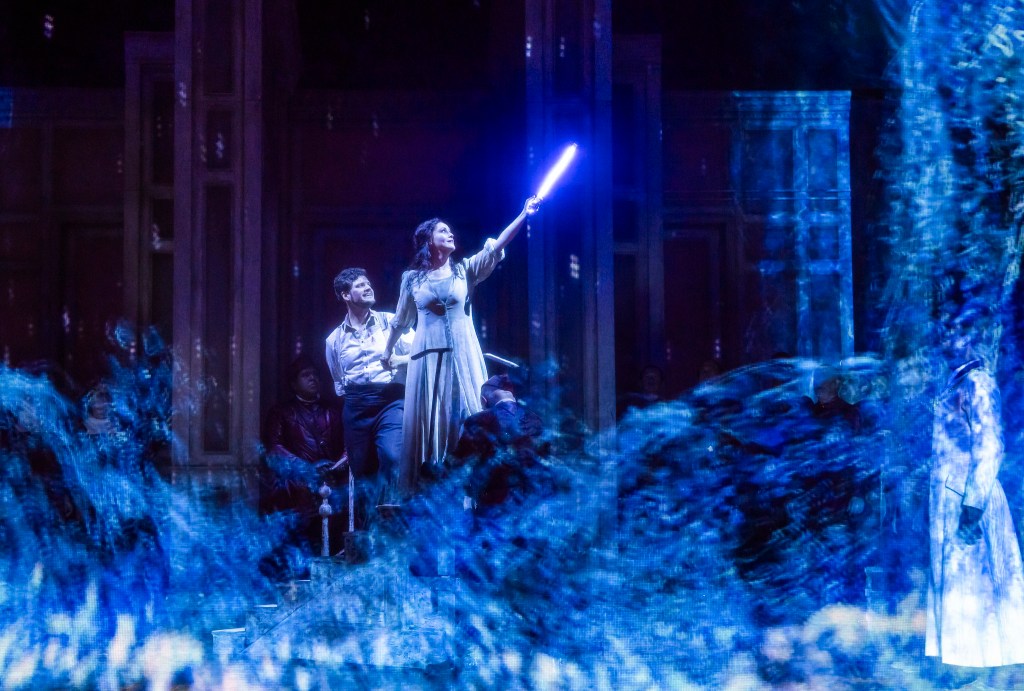
Special mention must go to the Three Ladies—Hazel Croft, Katie Sharpe, and Charlie Drummond—who, wielding laser swords reminiscent of Star Wars, added their own dose of humour, blending excellent vocal work with modern, tongue-in-cheek costuming. Their playful chemistry and impeccable vocal delivery provided many moments of comic relief.
Papageno’s duet with Papagena (Pasquale Orchard) earned one of the loudest ovations of the evening. Despite her brief role, Orchard’s hilarious portrayal left a lasting impression. Colin Judson’s Monostatos was deliciously villainous, adding tension and humour in equal measure.
The costumes were an eclectic feast for the eyes. Colin Richmond’s designs ranged from Papageno’s blue leather jacket adorned with bird droppings to the Queen of the Night’s magnificent black gown. Richmond describes his costume as “an odd mix of queen, scarecrow, plucked bird, and 1930s Hollywood glamour gone to seed.”
This imaginative design stems from her hatred of birds (hence hiring Papageno as her bird catcher), which symbolise daybreak, the time when her power is weakest. In a clever and macabre twist, these dead birds are transformed into her robes, highlighting the character’s dark and vengeful nature.
Richmond’s designs drew inspiration from diverse sources, including Doctor Who, Black Mirror, and The Handmaid’s Tale, blending modern references with the opera’s traditional roots.
Nevertheless, while the costumes were striking individually, they sometimes felt disconnected from each other, reflecting a mishmash of styles rather than a cohesive visual language. Still, this patchwork approach somehow worked,
mirroring the opera’s own blend of musical styles—folksy, operatic, and ceremonial.
The staging was nothing short of spectacular. The monstrous tentacles that emerged in the opening scene and the hanging trees of the magical forest added a touch of wonder and menace, immersing the audience in the opera’s
mystical world. The integration of cutting-edge projections added depth and movement. Doors transformed effortlessly into temple walls, creating a seamless flow between scenes. The attention to detail and use of modern technology demonstrated an understanding of how to engage a contemporary audience without detracting from the opera’s
timelessness.
The evening ended with a full house giving the cast a well-deserved standing ovation. The Magic Flute’s themes of love, forgiveness, and the pursuit of wisdom are as resonant today as they were in Mozart’s time, and this production proved that opera can be both entertaining and meaningful. With its innovative staging, stellar performances, and accessible presentation, this Magic Flute was a triumph—a magical evening that reminded us why this art form
continues to inspire.
Opera North’s The Magic Flute (Mozart) tours the UK until November 23 2024 and then again from February 12 to March 29 2025, returning to The Lowry (Lyric Theatre) from March 13 to 14.
Photo: ©Tristram Kenton
 JADAR
JADAR 