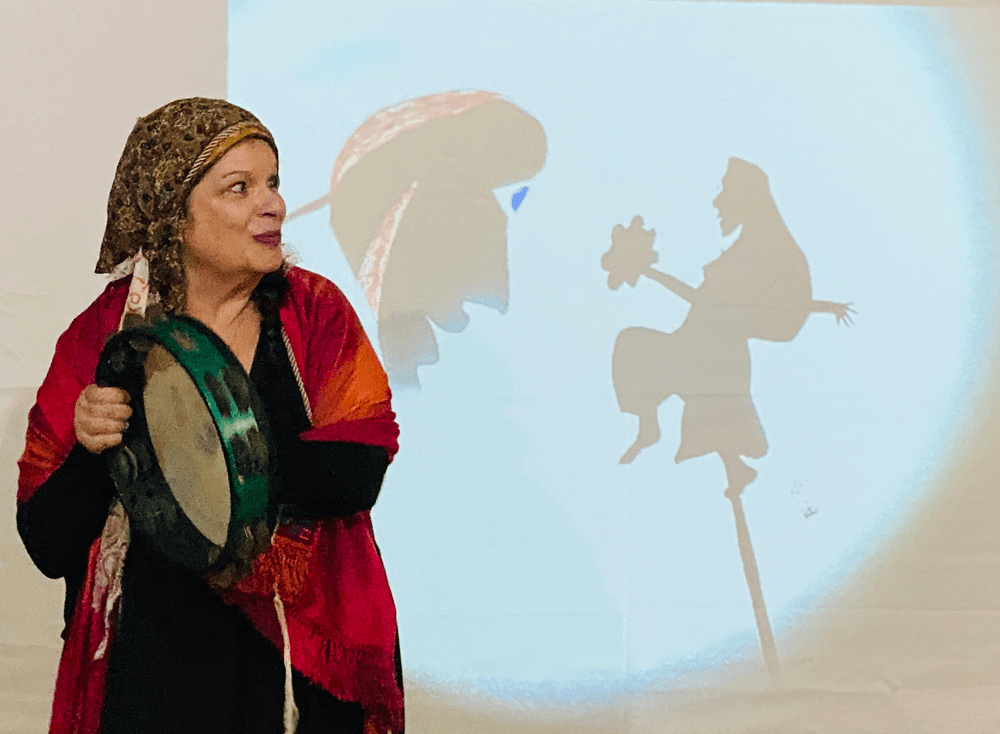
Matriarch is a work-in-progress experimental puppet play by Jessica Litwak about our relationship with ancestors, and how leaning back on the past can help us through tough times. It was the final instalment of Manchester Jewish Museums’ “Synagogue Nights” Season. It calls on stories of biblical matriarchs through shadow puppetry and live puppetry – attempting to give them their own stories.
“I will always be there watching you, loving you – always.”
As a young Jewish woman, I have grown up hearing stories of Jewish biblical matriarchs. I was excited to see how these age-old, typically patriarchal stories would translate to a one-woman piece of puppet theatre – especially in a place as wonderfully intimate as Manchester Jewish Museum’s Sephardi Synagogue.
The piece began with Litwak entering as Miriam and describing a girl called Shemie who is about to jump off a bridge after the death of her grandmother. Miriam then called on “the world of shadow” as Shemie’s struggle was projected through shadow puppetry on a screen. Litwak’s use of poetic language was engaging, with her calling on the female ancestors for strength, telling us, “Let this be medicine”.
Litwak explained in the Q&A afterwards that this was a work-in-progress piece with the aims of artistic experimentation – the main objective being whether we could recognise the character of Shemie in the forms of Shadow Puppetry, Live Puppetry, and a human performer.
While Shemie was recognisable, I can’t say she was emotionally accessible for me – despite her emotionally charged story, I never empathised as our encounters with her were so brief. Nor can I say the anthology narrative was fully about Shemie – the form more so resembled a whistlestop tour of the main biblical matriarchs (Sarah, Hagar, Leah, Rachel and Miriam) through a 40-minute video of shadow puppetry, and the occasional interjection of Litwak onstage with live puppets.
I think if this piece focussed more of its energy on fewer characters, the three artistic mediums could shine – but it felt as if it was trying to juggle too many stories in such a short one-hour piece.
While I did love the creative use of live puppetry and shadow puppetry, the main issue I had with this production was its lack of genuine live theatre. While it makes sense that Litwak – who is also an educator – would choose to present these biblical stories in the accessible form of shadow puppetry, the fact that the puppetry was merely a projected video on a small screen completely took away from the act of theatrical performance.
Additionally, Litwak was only onstage for 20 minutes (at most), and while she had a wonderful, large stage presence, her brief traipses across the tiny stage left me wanting more.
Litwak never fully engaged with us as an audience until after the show was finished.
I really enjoyed the Q&A portion at the end as we got a sense of the work and care put into making the puppets, and connecting with her ancestors. I really wish we could have seen more of the puppets onstage – as they all had so much character and meaning to Litwak as an artist.
The actual language and writing was extremely interesting – although possibly not as sacreligious or radical as Litwak perhaps hoped. The antagonistic, complex relationships between some of these women were so intriguing, and I wish there had been more time spent on each matriarch. It was quite disappointing that we mostly got to interact with these characters via a screen (our portal into this ‘shadow realm’), as they each had so much potential to be well-rounded, exciting characters but the miniscule amount of time spent with each matriarch meant they ultimately fell short.
The first person monologues did a good job humanising the Matriarchs, but this was often more an exposition-filled recount than an emotional fragment – meaning there was little opportunity to properly empathise. Again, I did feel that the projector element made the whole piece feel slightly like a Jewish Studies class and less like a one-woman show. I think if each matriarch had been given more time, and there had been a larger focus on the live puppetry the stories could have shone.
A moment that was genuinely touching was the inclusion of Shemie’s grandmother as the final matriarch. The overlapping shadow puppetry on screen, alongside Litwak performing a monologue about Jewish migration to New York through Ellis Island wearing a wonderful puppet mask of the grandmother. The live puppetry at this moment was extremely touching, and felt like a genuinely intimate moment of connection as we learn that her grandmother is dying.
I particularly enjoyed how the grandmother’s last words were the recipe to her liver dumplings – as Jewish food and recipes are such an important part of culture and heritage. I wish we could have spent more time with this intimate Grandparent relationship, as it was the most enjoyable and evocative part of the piece for me.
Overall, Matriarch is an extremely interesting idea for an experimental piece – that felt quite nostalgic in its use of shadow and live puppetry. There were some really interesting themes of spirituality, family, healing through the past and femininity that I would have loved to see explored more thoroughly onstage. I believe this concept has so much artistic and emotional potential, but unfortunately the brevity of each segment and the lack of live performance really took me out of the show – and made me question whether this was a piece of theatre, or educational film.
I would love to see how this piece develops, and hope it focuses more on the intimate potential of live theatre, and displays more of Litwak’s experimental live puppetry.

 JADAR
JADAR 