★★★★☆
Blood Brothers is the 4th-longest running West End musical, and it’s no surprise with its charming combination of witty and playful humour so wonderfully juxtaposing that looming sense of tragedy as it presses ever closer.
In full transparency, I have seen the show once before, and several times on YouTube having studied the musical for my GCSE’s, making this a show I have a pinch of nostalgia for despite some of its flaws.
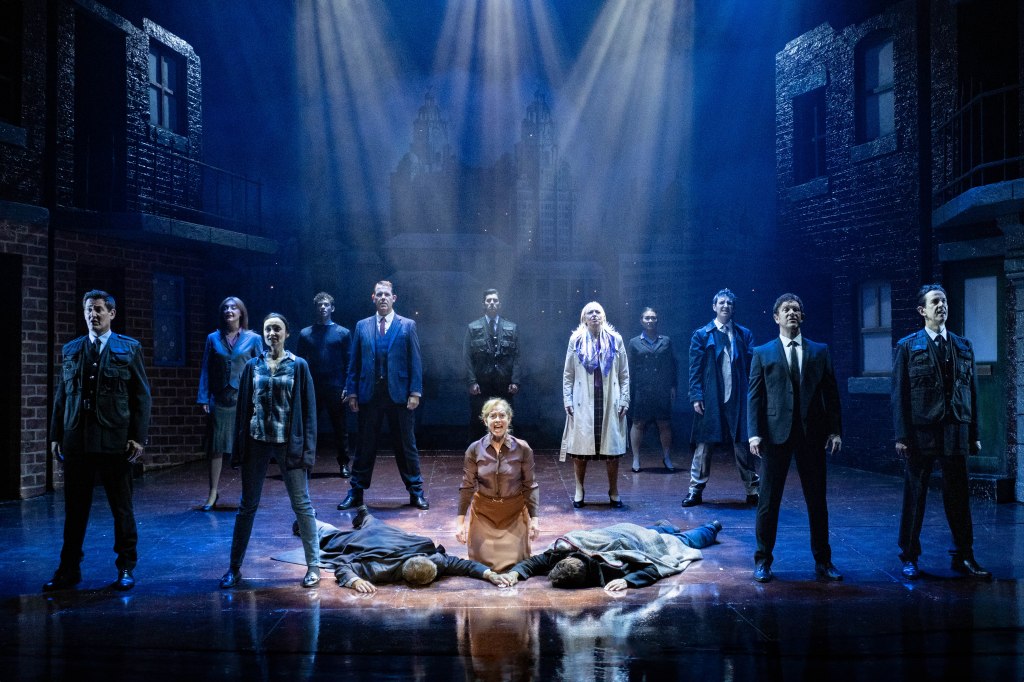
The stage slowly unveils the tragic ending of “the Johnstone twins” Mickey (Sean Jones) and Eddie (Joe Sleight) as they lie lifelessly across the stage, women hopelessly strewn around them, devastated before the narrator (Scott Anson) takes us back to what caused this untimely end… a gripping and unique opening for the usually optimistic musical genre. In a sense, it’s a play within a play, constantly circling through their fates with each performance, never able to escape the cycle.
Set in 1960s Liverpool, we follow Mrs Johnstone (Vivienne Carlyle), the big-hearted yet misguided mother whose financial struggles lead to her heart-breaking decision to separate the twins, giving one to her paranoid but wealthy employer Mrs Lyons (Sarah Jane Buckley) who constantly manipulates her through superstition and religion.
Both boys grow up never knowing about their relation, one day meeting and becoming best friends and blood brothers much to their mothers’ dismay.
After being separated once more with both brothers moving away, chance encounter (fate) brings them back together but class disparity, rising unemployment and relationship woes tears them apart once more. Will they find out they are true brothers? Will their relationship be mended before tragedy unfolds?
Willy Russell’s deep investigation of social class is one of the show’s primary concerns alongside the nature vs nurture argument, and a strong connection to fate and the supernatural. As twins, they are born into identical situations yet lead completely separate lives with Edward constantly studying dictionaries, reading books and looking prim and proper, while Mickey swears, spits, plays with air-guns, and runs around in his over-sized hole-ridden jumper.
Despite their obvious differences, both children admire the other without prejudice (unlike many of the adults), but constant parallels between the pair’s contrasting lifestyles (education, housing, brushes with the law, employment) deepen the disparity.
By the end, Mickey is forced to “grow up” after losing his job and committing crimes to stay afloat, while Eddie parties at university and is fruitlessly handed a position as a Councillor, cluelessly attesting Mickey doesn’t need a job and flaunting his money without understanding.
It also takes a dive into Liverpool’s politics and rife unemployment with ‘Take a Letter Miss Jones’, the upper-classes’ frivolous melody contrasting the moody and desperation of Mickey and fellows.
While Edward and childhood friend Linda (played mischievously by Gemma Brodrick) become frustrating characters towards the end of the show, its equally interesting to note that every single character is deeply flawed; Mrs Johnstone for agreeing to separate them, Mrs. Lyons for her manipulation, Mickey for his crimes, Edward for his disloyalty, and so on. They’re all humans suffering together in different ways.
However, while the show’s dated nature works well with its historical themes, it’s also to it’s detriment. The staging perfectly matches that quaint but crowded corridor of council housing with a nice touch of levelling, yet also feels drab and fairly outdated (having seen similar in previous iterations of the show).
Likewise, its heavy-handed approach to mental health is extremely uncomfortable and outdated with Mickey’s depression treated as something he can cure with a job, and his reliance on medication treated as a crippling addiction that changes his personality – all painfully outdated stigma around mental health and its treatments that feel out of place, even for a show set in the 1960s. Its nothing a lick of fresh paint and a rescripting couldn’t resolve, yet I find it unlikely that these changes would be made since the show continues to garner (mainly well-deserved) critical acclaim as it is.
Saying this, the show is surprisingly light-hearted for the majority of its runtime with a slew of eye-rolling puns and horny jokes, jabs at multi-rolling, a sprinkle of childish pranks, some self-deprecation, and a touch of outlandish “poshy” swearing.
While I’ve never been a fan of adults acting as children, the highly stylised acting along with the stereotypically childish imaginations, hilariously played physicality and silly retorts are perfectly suited and wonderfully absurd. Particular, shout-out to Jones’ performance as Mickey with all his charming buffoonery and unpredictable eccentrics.
The narrator has always amused me too. While its supposed to be a serious role, being the devil lurking in the corner of every scene to remind us in creepy rhymes and repeating leitmotifs, his part always seems hilarious to my modern sensibilities.
Perhaps it’s the way he inserts himself into the situation, his superstitious reminders, or the goofy sound effects and moody lighting before he breaks into the ominous ‘shoes upon the table’ Bonnie and Clyde-esque rock numbers… something just cracks me up every time I’ve seen the part (at no fault of the actors that play him). While it is charming, it also slightly undercuts the weight of the show’s heavier moments.
However, the music is simply astounding, constantly linking melodies from previous numbers, reprising old songs for new themes, and bringing in this upcoming sense of dread as it moves from the heart-felt mothers to the quirky brothers, and eventually this spiralling sense of insanity and loss.
Each melody is equally addictive, although ‘Marilyn Monroe’ and the development of ‘My Child’/ ‘Long Sunday Afternoon’ and ‘That Guy’ are particularly charming numbers. I also love the motif that carried through the children’s song about killing games with it echoes from the narrator’s song.
The finale is punchy and impactful, even if you’ve seen it before you’ll never know when it’s coming! You sense every ounce of pain and anguish with Jones’ performance as Mickey that honestly feels heart-breaking and left me shaking with its authenticity. Sleight’s performance as Eddie is equally warm with this sense of desperation and pain after realising what he’s done to Mickey.
Carlyle is devastating with her emotional rendition of ‘Tell Me It’s Not True’ and her blood-curdling cries of grief- indeed her whole performance had that touch of motherly charisma that is essential to making Blood Brothers such a moving and impactful piece.
Blood Brothers is a masterclass in musical tragedy, filling the audience with this sense of trepidation yet consistently winning us over with its charm, witty comedy, and the cast’s outstanding chemistry. It’s an emotional rollercoaster, but I guess that makes me a glutton for punishment as its enchanting score and outstanding story-line have haunted me for years. While it needs a little updating for elements of its storyline and sleeker staging, the show remains bloody brilliant.
Blood Brothers runs at Palace Theatre Manchester until Novembef 30 2024 and is currently touring the UK until April 12 2025, with more dates to be announced.
Photo: Jack Merriman
 JADAR
JADAR 