★★★★☆
Hypocrisy, a new play by Daniel Bradford, recently made its premiere in the heart of Manchester’s Northern Quarter, tucked away inside the ornate grand library of Chapter One Books. This daring drama maintains a short run in Manchester but is absolutely one worth seeing.
The play was written by Daniel Bradford and directed by Bradford and Hannah Ellis Ryan, forming the production company Play With Fire, and stars Patrick Jealey as spiritual leader Bhante; Tom Hardman as personal assistant, Cahya; and Simon Price as Jordan, a journalist with a passion for uncovering the truth.
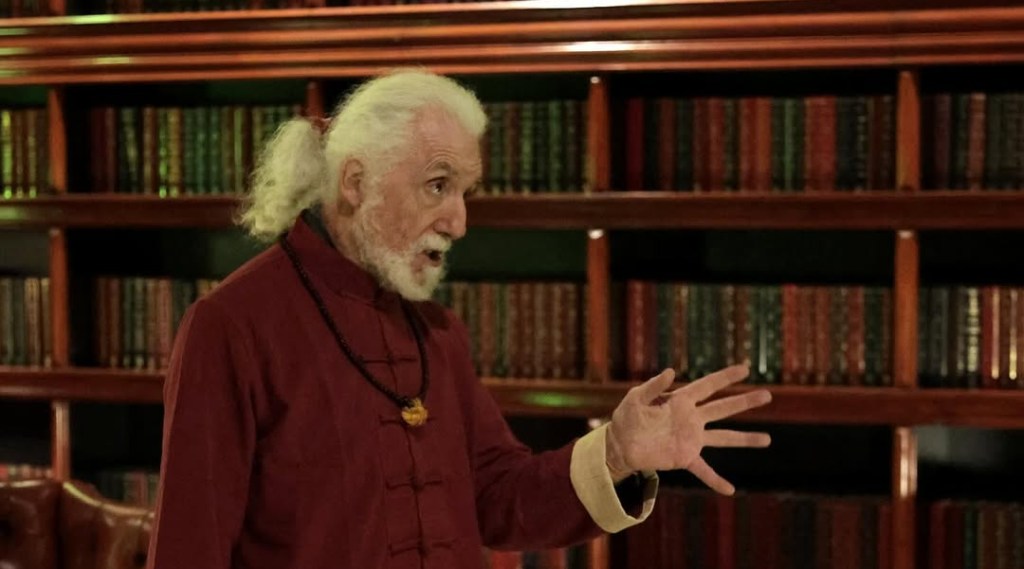
From the moment you step foot inside this dazzling site-specific production, audiences are greeted with a detailed immersive experience where Kealey is seated, breathing slowly. This moment invites audience members into his present space, immediately connecting spiritual practice with the dedication of the performer. The play dares to tackle the dark side of spirituality, intentionally marketing the show to be about consent and sex with little mention of plot. From the moment you enter the space, it is obvious that there are many layers to unfold, like the hundreds of books surrounding the audience delicately placed along the border of the ‘stage’.
With little mention to the darker themes that would arise during the production, I was curious to see how the narrative would unfold.
Upon entering the space, I was also made aware of the nature of the production being about Eastern Buddhism but made by an all-White cast and creative team. Despite my initial reservations, I was pleased to find that the story had a clear deviation from how we view Buddhism and what would be discussed in this narrative. Led by Bhante, there seemed to be a new spiritual awakening taking place within this narrative structure, and I believe the choice to cast an all-White team was a deeper reflection and critique on the power structure made in Western Culture.
The use of Buddhism (as opposed to creating a new social movement within the universe) is one to analyse. It draws to an established identity and as a connection for various individuals, however, it also runs the risk of reflecting one story unjustly. It allows for the playwright to discuss spiritual themes such as the Dharma, Karma and Rebirth loosely but I believe it did a good job establishing the fact that Buddhist practice is being abused in a cult-esque environment.
The beginning of any show is crucial to hook in audiences, and though the opening moments were quiet and jumpy, this set the stage perfectly for the narrative. Throughout the first third of the show, I truly felt like a fly on the wall, overhearing private conversations and interviews. There were moments I was reacting to the conversation like it was a conversation taking place in front of me. I would have been happy watching two hours of Kealey and Price debate common beliefs in spiritual practice without any intervention. Bradford’s writing is quick-witted and highly intellectual, demanding for audiences to be present with his writing and the performers.
I am weary to any production that claims to analyse one ‘dark’ side and was not surprised to find the narrative to be about sexual abuse in positions of power. There were allusions throughout the writing that made the ‘reveal’ of Bhante’s sexual history painfully obvious to audiences. I believe the physical narrative would benefit from the playwright trusting the audiences to understand darker themes without having to spell them out with over-extended scene changes in private rooms.
In future productions, it would be advised to disclose harsh emotional themes, rather allowing the audience to choose whether they would like to know or not. This production is bursting with themes analysing spiritual power, contradictions of Buddhism, the concept of consent–and what goes into consent–and dynamics in queer relationships.
Along a similar line, I found the portrayal of C-PTSD to be harsh and unnatural. Strong emotional reactions can make or break a good dramatic piece, and I would say there were a few moments this emotional response was broken for the audience. Given a longer production period and careful dedication given to the team and cast, I believe this show can go far and wide.
However, I do believe that to do that, there needs to be an intimacy coordinator present to breach accurate and safe portrayals of panic attacks, violence, and themes of sexual nature. I think this is one element the production was lacking, as the emotion remained stagnant with anger or deeply emotive portrayals from the character Jordan— this is not to say that these emotional responses are not present in C-PTSD — but I wanted to see a true fluttering of emotions given by the character.
He was described to be angry, scared, sad, confused and longing for love but, albeit within my eyeline, naturally floated towards anger (which is the natural response we experience in our day to day lives discussing paedophilia—but within the power dynamic described, there seemed to be an avalanche of hidden feelings that were alluded to but not explored).
I believe a script that begins to discuss themes such as paedophilia, spirituality, abuse, and power should have the emotional capacity to fully explore these theme, which Hypocrisy nearly had but it fell short at the moments of action.
This being said, I do believe this play is exactly what British audiences should be consuming. Every actor held up to a remarkably quick, funny and brilliantly intense script, while portraying a wide range of events. The direction was seamless, allowing the actors to almost feel raw. There was a casual aura to the performance that made audience members feel like they were encroaching into someone’s study — truly a mark of a solid performance with strong actors and a team to support them.
Daniel Bradford is a brilliantly keen writer to keep your eye on, creating a widely fascinating piece of theatre. The pieces holds up interestingly in 2025, following the #MeToo movement with a wry look at the ethics of implied consent (both in and out of sex). There were moments that the writing alluded to the dramatic ending carefully and with ease but there became painfully obvious moments in the writing where the reveal of Jordan’s true identity was not surprising. I would be curious to see how the show could keep the reveal by alluding to the mystery less, letting the story unfold for viewers without the guide of other character interactions.
Hypocrisy is a beautifully painful allegory for young queer relationships and our connection to our first sexual teacher, providing an absolute masterclass in the use of manipulation through power dynamics.
I have found myself to be something of a Hannah Ellis Ryan connoisseur–following her 4-Star review in Cock, less than two weeks later she is found directing another brilliant production. Bradford and Ryan should receive high praise for their production of Hypocrisy. We need to continue to push and support stories that highlight difficult conversations and gut-wrenching narratives, like this one. This is a true testament to what can be done by local artists and by remarkably talented individuals.
Hypocrisy runs at Chapter One Books until November 30.
Photo: Shay Rowan
 JADAR
JADAR 