
★★★★☆
After sell-out runs in Belfast and Edinburgh, Lies Where It Falls has come to the UK. Written and performed by Ruairi Conaghan, the one-man play is an honest, personal account of his dealings with grief and trauma. Conaghan lost his uncle aged eight in 1974, when he was shot dead by a member of the IRA. Years later in 2015, he was cast as Patrick Magee, the IRA man behind the 1984 Brighton Bomb Attack, and later as The Player King in Hamlet, performing a speech on the assassination of King Priam of Troy by Pyrrhus. Both plays triggered painful memories, culminating in his mental breakdown. Lies Where It Falls brings us through these moments with him, and out the other side.
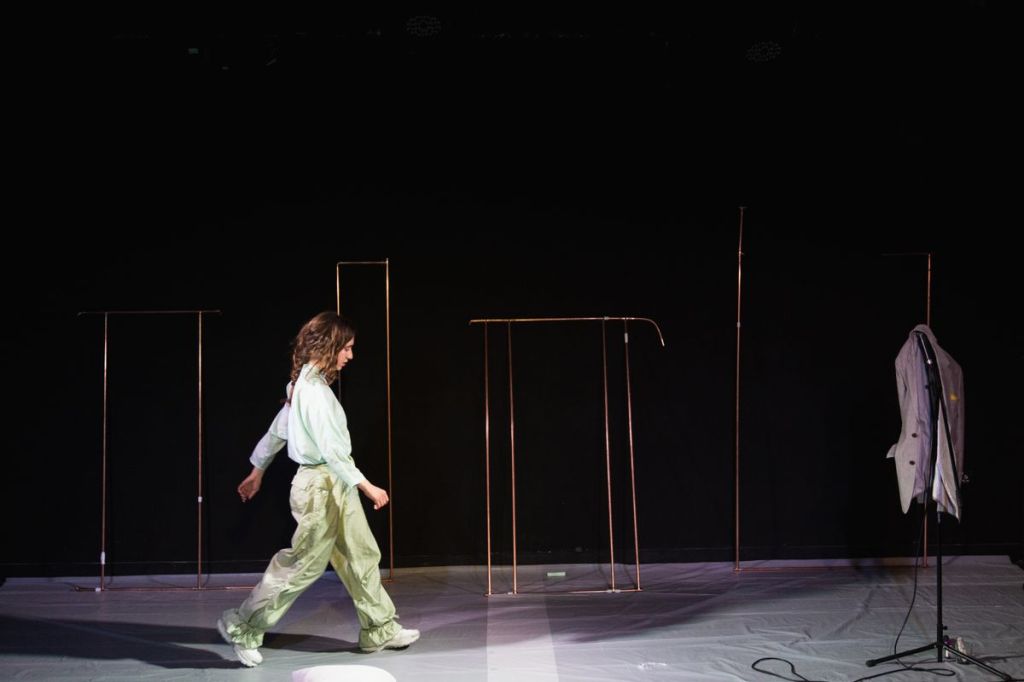
The play opens on the beach, with grey waves projected onto the rear wall and Conaghan looking on into the distance with the audience. Despite sounds of children’s laughter, it’s a bleak start, and is haplessly fitting for what is to come.
Conaghan retells his uncle’s death through a combination of plain, emotionless narration and a reenactment of himself as a child, growing slowly to understand what has happened. At first, child Conaghan is even excited by the event of violence, surmising that the “Conaghans are indestructible”; no harm will come from the gunshot. The result is harrowing, and painfully effective.
Another powerful moment is when Conaghan acts out his meeting with Pat Magee – part of his preparation to get into character of the bomber. Here, he flips effortlessly between playing himself and the murderer, with a full embodiment of the alternate stony persona. Seamlessly, he ranges between their conversation and a volatile internal monologue, battling with what he wants to say and what is actually said out loud.
Although its’ dark, laughter is something Conaghan made sure to include in his play, writing in his note for the audience: “I knew that my play had to make you laugh sometimes because that is my authenticity”. And it certainly does. Much of the play is peppered with sarcastic asides. In the scene with Pat Magee, levity comes from the unlikely comment, “Would you like a papadum, Pat?”, returned with a sizeable chuckle from the audience. Another notable injection of humour is when Conaghan is offered the role of Hamlet. He reenacts the good news in an animated fashion, to the tune of ‘Oh Happy Day’ nonetheless.
Nearing the end of the play, we see his complete breakdown transpire. Bravely, Conaghan plays it out unabridged, reducing himself to an emotional, weakened state in a vulnerable portrayal of self.
At the play’s end, we return to the beach. Projected grey waves resume. It’s New Year’s Day in Donegal, and Conaghan is with a friend, joking, about to run into the sea: the perfect close. What we are left with is a testament to the strength of love, and undeniably, to the rehabilitating power of art, and theatre.
 JADAR
JADAR 