★★★☆☆
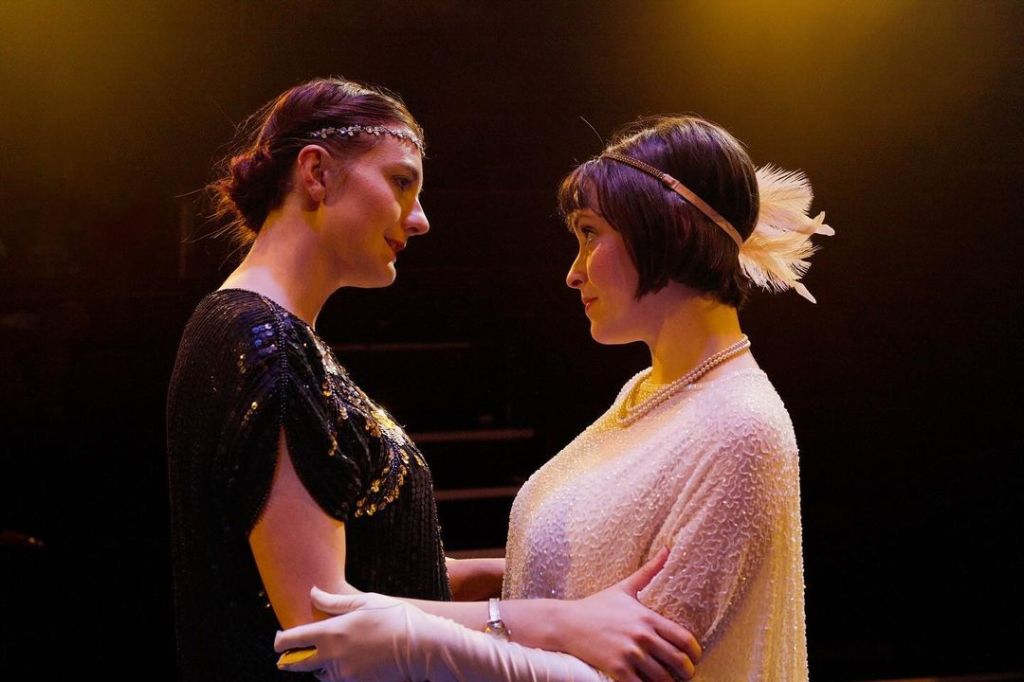
Scar Theatre’s adaptation of The Great Gatsby at The Cockpit subverts F. Scott Fitzgerald’s classic by blending contemporary social issues with the jazz-filled extravagance of the 1920s.
Casting Gatsby as a woman and queering the central love story is an ambitious reinterpretation, and the production certainly has its moments of intrigue. The decision to nonchalantly center a queer love story while still highlighting the original themes of class and ambition in a world of illusion feels compelling, providing a timely lens through which to view the original text’s critiques of the American Dream.
The show is carried by Ethan Bareham’s perfect tribute to Nick Carraway, which manages to convey the softness and curiosity of Fitzgerald’s narrator, gracefully pushing the story along.
Lily Carson found her Daisy Buchanan in Act II, mellowing the character out after shared scenes with Gatsby. It was beautiful to watch her find her voice.
Special mention also goes to Fitzroy “Pablo” Wickham’s George Wilson, who captivated the audience with each of his scenes.
However, despite the innovation, the updated version at times feels half-baked.
The decision to “modernize” Gatsby’s world doesn’t always land with the clarity or depth that the subject matter deserves. While the adaptation challenges Tom’s racism and adds layers to the characters’ unspoken queerness, these elements often feel shoehorned in without being addressed or fleshed out. The staging, while visually stunning in its intimacy, can sometimes feel disjointed, and the movement and dance sequences—though striking—occasionally detract from the emotional core of the narrative.
The adaptation has a lot of potential, but as it stands, it feels like a work in progress, still figuring out how to balance its modern social critique with the nuances of Fitzgerald’s original story. It’s an interesting take but hasn’t yet mastered the balance between honoring the original and reinventing something new.
For those interested in a reimagining that takes risks, it’s worth seeing, but its execution is still finding its footing.
 JADAR
JADAR 