★★★★☆
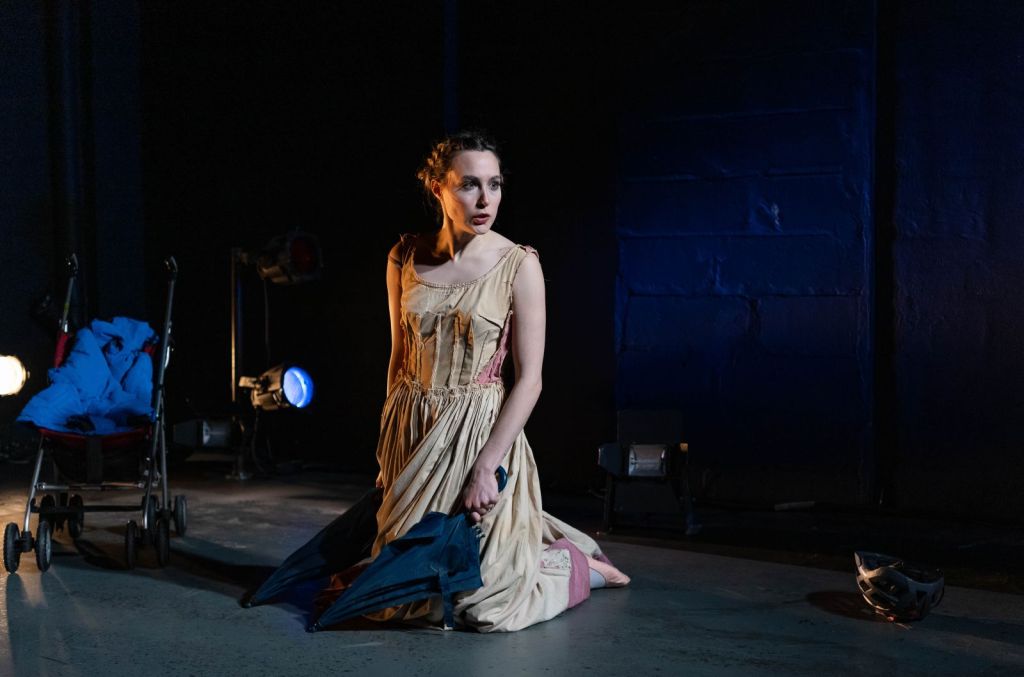
The lights go dark, a woman enters, wheeling a pram with a blue puffer coat, embodying her child. Repeated urgent refrains of “They don’t kill civilians” fills the theatre space. The audience is on the edge of their seat: what are we about to watch? Everyone is familiar with the basics of the Trojan War and we know it is one of tragedy. And A Trojan Woman is tragic: it’s a one-woman, one-hour emotional whirlwind performance, following the fates of the women of Troy after their city has been taken over by the Greeks.
A Trojan Woman, written by US playwright Sara Farrington and directed by Meghan Finn, is a modern reimagining of the play of the same name by Euripides. Having first premiered in Athens where it was performed as a protest against the Peloponnesian War, it is now playing for a modern audience, showing at the intimate space in King’s Head Theatre in Angel for a limited run. Anyone who knows me knows I live for retellings of Greek mythology, especially told from a woman’s perspective: Circe by Madeline Miller, The Silence of The Girls by Pat Barker… so it was fair to say I was particularly intrigued by this one!
With all one-woman shows, there is always a challenge of ensuring your play is coherent and each character is distinct and recognisable. A Trojan Woman does this fantastically using stage directions and props. Drita Kabashi lets the audience know of every new character she plays with the cue “Enter…” This is expertly coupled with props symbolic of every character: a bottle of water for Poseidon, a notepad for Talthybius, the Greek soldier who served as a messenger, a spear for Athena. Each transition is smooth, you almost forget that it is one woman playing all these characters.
What particularly stands out as phenomenal is the personality quirks Drita brings to acting each character: the chorus are whimsical and naïve, with an almost Marilyn Monroe-esque energy, Cassandra runs around the stage singing nonsense to symbolise her madness, while Talthybius puts his hand to his ear as if receiving a call when delivering messages, using music on hold to place the performance in the modern. Amongst the emotional tragic undertones of the play this characterisation brings satire and humour, making an ancient play accessible for audiences while keeping a fast pace to the performance.
The decision to use the framing of a nameless woman who has lost her kid to the war, almost suggesting she is the body that becomes possessed by all the Greek gods and their awful decisions, is also fantastic. Providing structure to the play, it suggests that this dialogue about the impact of the Trojan War could be about ANY war, not just one of ancient past. One particularly excellent moment was the entrance of Helen of Troy who is bound in chains and as she talks of her role in the war; the chains are slowly being unwound, showing the power of language during conflict.
Praise must also be given to sound designer Mike Cassedy and the light design. While the use of sound is sparse throughout the hour, when it is used, it’s a bold crashing crescendo that makes you jump in your seat. The use of warm, bright light for the female characters and the red light with loud sounds for the introduction of men superbly places the women in the role of victim, and the men villains.
While A Trojan Woman is masterly directed and phenomenally performed, it does fall victim to being a very niche topic. It’s excellent for those who love Greek mythology and are interested in the politics of heroes and gods, but for those who may not have much interest or knowledge of the war, it could potentially get a bit convoluted and repetitive around the 30-35 minute mark. Equally, the performance is primarily one of dialogue with little plot action, which could easily lead to wandering minds in the audience.
A Trojan Woman is a whirlwind of a play that will leave you thinking about the impact of war, long after it finishes. If you are a fan of Greek mythology, I would urge you to go see it while you can!
A Trojan Woman runs at King’s Head Theatre until December 9.
Photo: Stephanie Gamba

 JADAR
JADAR 