★★★★★
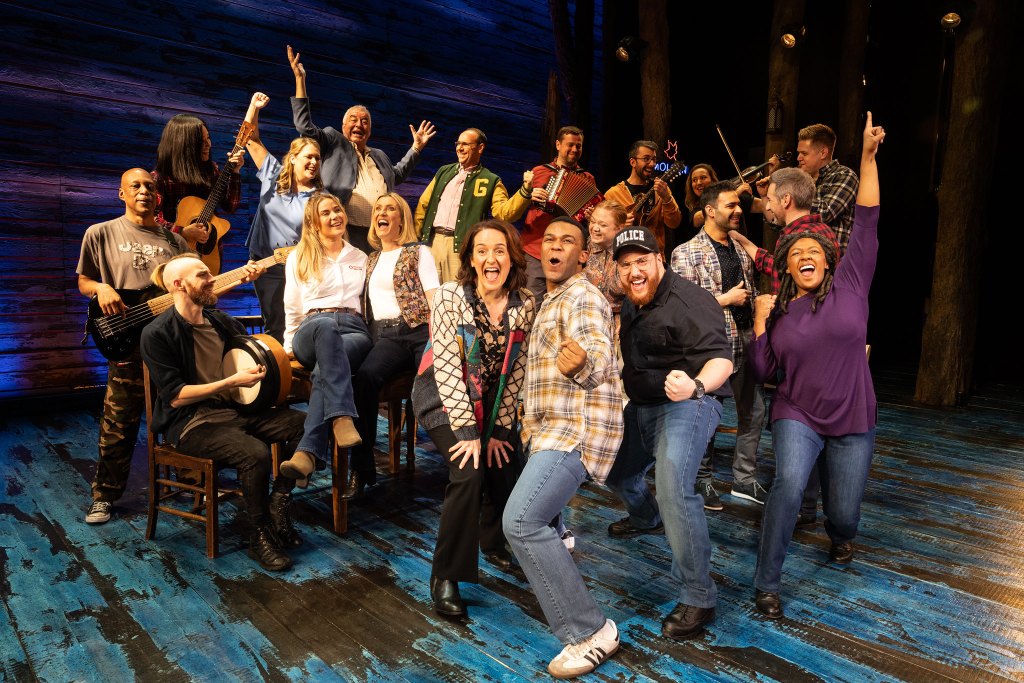
Come from Away is a musical based on the events in the Newfoundland town of Gander during the week following the September 11 attacks, when 38 planes, carrying approximately 7,000 passengers, were ordered to land unexpectedly at Gander International Airport. The characters in the musical are based on actual Gander residents and stranded travellers they housed and fed.
I first saw Come From Away on the West End, back in 2019, when I was still quite new to reviewing theatre. Back then, I liked a spectacle, and when the show begun – with its simple set and folky score – I thought I was going to hate it, but by the end, I was on my feet and in floods of tears.
Come From Away is one of those rare perfect shows. I’m sure there were producers who had worried about the concept – not only because of its subject matter (“the 9/11 musical?!”) but also because of its format, what with it being an ensemble-piece that is sort-of made up of a series of vignettes or segments.
But Irene Sankoff and David Hein’s book is so beautifully written that it all connects together smoothly, and the characters develop nicely over the course of the show. It’s a life-affirming musical that, though poignant, is surprisingly very funny. A memorable comedic moments come during the karaoke scene, where a character, who had previously sung ‘My Heart Will Go On’ on the plane, belting out, “Near, far, where ever we are!”
The only noticeable difference between the West End and touring productions is the latter’s lack of a revolve, which seemed so important to the original production – especially because its set (Beowulf Borritt) is otherwise simple – but the new direction has rendered the revolve redundant, much like in the touring production of & Juliet. It isn’t missed.
Boritt’s set design makes great use of wood, with trees enclosing the action, creating a feeling of both community and claustrophobia, capturing the close-knit community of Gander, overwhelmed by an influx of stranded travellers, who the residents are quick to adopt. Gareth Owen’s sound design helps bring Gander to life, with Howll Binkley’s lighting design masterfully signifying locations and times of day – which is important for a production with such a simple set.
The folksy music (Sankoff and Hein) is also authentically Gander, with choreography and dance numbers (Kelly Devine) bringing to life the region’s Irish heritage.
Toni-Leslie James’ costume design is culturally and period-appropriate. His attention to detail is seen in the throw-on costume-props for various characters, from religious minorities to pilots. The cast all play various characters, with a change in characters signalled by a change of wigs (David Brian Brown) or the addition of a jacket, and so on.
It could have been chaotic but Director Christopher Ashley’s direction and Kelly Devine’s choreography are seamless, and each character is so richly characterised that the phenomenal actors have no trouble switching from one to the other, sometimes in the matter of seconds.
Each actor has a main character or two, who they play throughout the play, but they also take on other roles – sometimes only for a few brief moments, helping the audience understand just how many people were there.
Natasha J Barnes plays Janice Mosher, a young Newfoundland journalist who recently moved to Gander and is now covering a major news story; she is a composite of two real-life journalists (Brian Mosher and Janice Goudie).
Rossie Glossop plays Bonnie, the manager of Gander Animal Hospital, who is tasked with protecting the animals from the planes; this storyline is so special because seldom do we think about the animal victims of 9/11.
Bree Smith plays Hannah, an African-American traveller, based on an Irishwoman, who is struggling to get in contact with her son, a firefighter in New York. She forms a supportive relationship with Beulah Davis (Amanda Henderson), the head of Gander Legion, whose son is a local firefighter. Beulah is a combination of Beulah Cooper (treasurer of the Ladies Auxiliary at the Legion) and Diane Davis (who, like Beulah’s character, is a teacher and helped organise the school).
Beulah’s relationship with Ali (Jamal Zulfiqar), an Egyptian Muslim who some of the others treat with suspicion, is very touching. After 9/11, the lives of Muslims changes overnight, something which is often ignored, but Come From Away explores it beautifully (and tragically). He is inspired by at least five passengers, including chef Vikram Garg, and an unidentified Muslim man whose strip-search Beverley Bass had to witness. Besides the come-from-aways, he’s also inspired by the writers’ friend Amal, a Muslim woman.
Zulfiqar also plays Kevin J, a New Yorker in a relationship with his Californian boss, Kevin T (Mark Dugdale). Through them, the musical explores how the tragedy put a strain on relationships. It also acknowledges the fears of queer people in small towns (and amongst southern Americans, such as Diane) but also cleverly explores how prejudice can work both ways.
The other couple in the musical is Nick (Daniel Crowder), a single Briton, and the aforementioned Diane (Kirsty Hoiles), a divorced American from Texas. Their story is the inverse of the Kevins; the tragedy brings them together.
The role of law enforcements is explored through Oz, who is played by Oliver Jacobson. Jacobson also plays a Rabbi, who sets up a kitchen for Jews, Muslims and vegetarians (lthe Kevins!). A local resident (played by Nicholas Pound), whose parents were Holocaust survivors and told him never to tell anyone he is Jewish, finally reveals his background to the Rabbi. This addresses how 9/11 emboldened people to stand up for freedom and liberty.
Pound also plays various Mayors, most noticeably Claude, the Mayor of Gander – through him/them we see what happens when politicians work to protect their citizens, rather than politicising tragedies, as is often the case these days – as well as the whiskey-loving Mayor of Arlington, who forms a sweet bond with Bob (Dale Mathurin), a Black traveller.
Whilst Come From Away is very much an ensemble piece, there is one character who stands out, especially because she is the only character with a solo song – the enchanting sung-narrative ‘Me and the Sky’ (which, spookily, started playing on my Spotify just as I was writing this sentence – I was listening to the soundtrack from start to finish to help me with the review!).
Beverly Bass (Sara Pozyer) is based primarily on the real captain of the same name – the first female American captain – but is also inspired by several other pilots’ experiences in Gander. Her song is based very closely on her real words (with other lyrics and quotes also taken from real people).
Poyzer also plays Annette, who works at the Legion with Beulah. She masters both the Texas and Gander accents!
Come From Away addresses both the best and the worst of humanity – how people came together after the worst terrorist attack in North American history, and how love can be found in the most surprising of places. It does not whitewash or sanitise the horrors that happened but it focuses more closely on the amazing aftermath – it’s more about 9/12 (that is 12/9 for us Brits!) than it is 9/11, and how a small-town community came together to champion humanity.
The British producers took to the stage after the show, welcoming some of the real-life people who inspired characters in the show. Earlier on in the day, there has been a press call, where I had the pleasure of interviewing some of them, as well as some members of the cast. The show closed with the enthusiastic band – who sat on the periphery of the stage for most of the show but had previously become “characters” in the bar scene – once again flocking to the front of the stage in a beautiful musical celebration of Gander.
Come From Away runs at The Lowry (Lyric Theatre) – the final stop of its UK tour – until January 5. It then transfers to Il Rossetti, Trieste, Italy from January 10 to 12.
Photo: Craig Sugden
 JADAR
JADAR 