★★★★☆
The best-known Christmas story since the birth of Christ himself, Charles Dicken’s A Christmas Carol has had many iterations, with everything and everyone from Doctor Who to Dolly Parton putting their own spin on it. There’s even an Alan Menken musical – and 30 years on from its premiere, and 20 years on from the release of its film adaptation, it is having its UK regional premiere in Manchester.
Hope Mill Theatre, one of the country’s most-loved independent theatres, has expanded its operations to produce musicals on a larger scale in other venues. It’s remarkable what they manage to do in their tiny black box studio but a bigger space allows them to show their full potential because there is only so much you can do in a studio space.
Last year, they produced a fully-staged concert performance of Gypsy at Manchester Opera House, and to celebrate their ninth birthday, they are producing a concert version of Nine (poetic) at The Lowry’s Lyric Theatre.
This holiday season is the first since the theatre’s inception that their much-anticipated Christmas musical is not playing at their iconic venue. Instead, it is playing at The Lowry’s Quays Theatre, a mid-sized venue which allows Hope Mill to go bigger and bolder, whilst still maintaining the intimacy and cosiness that they are known and loved for.
At a mere 90-minutes, this one-act musical manages to tell the story – which is based on a novella, not a novel – how it should be told, with intensity and pace, and without drawn-out scenes (or worse, filler scenes). Other writers could learn from this. Not all musicals need to be two and a half hours long (most don’t).
The musical follows the original story quite closely. Dickens’ themes, e.g. class consciousness, are ever pertinent, especially in a country devastated by a cost-of-living crisis. Yet, the story can feel dated because it is overdone (this musical adaptation, however, is lesser known). That is why, these days, people put their own spin on the story, to do something new with it and make it feel fresh and exciting.
Director Joseph Houston and Co-Director and Executive Producer William Whelton (who are both life and romantic partners) have stayed quite true to the original story but cast a woman as Scrooge – the first female Scrooge in this version of the story – which adds another layer. For example, how women were treated in Victorian times, especially “suspicious” spinsters, and how women can be vilified for their ambition (not to justify Scrooge’s greed).
But this is all just analysis; the book does not do enough with the gender swap, which is a missed opportunity. We see a young, angel-faced Scrooge (Sarah Graham) outnumbered by men in the stock exchange but there is not so much a suggestion that she faced additional hurdles because of her gender, nor how impressive it is that a woman, without the same level of education, manages to climb the ladder. I appreciate that script changes are not always allowed but these things can be shown or implied through movement and expression.
Scrooge is played by Olivier Award winner Claire Moore, who could not be more different to Ebenezer (now Evelina). This role is a far cry from the loveable characters she has played previously (including Mrs Fezziwig in the film adaptation), but she is clearly having the time of her life doing something rather different.
The musical nature of the story actually enhances it. In a world of song and dance, Scrooge appears even more cold and irritable. Sweet songs are cut short by her snaps, and when she does sing, her rich vocals contrast sharply with the chorus’ harmonies, as if she is freezing them out, like a sharp, icy gush of wind.
The lively chorus sprint around the stage whilst Scrooge scrunches over and shuffles across it. She’s a pitiful, lonely woman who cannot leave the house without being harassed by people in need. Moore evokes sympathy in even the most unlikeable of characters.
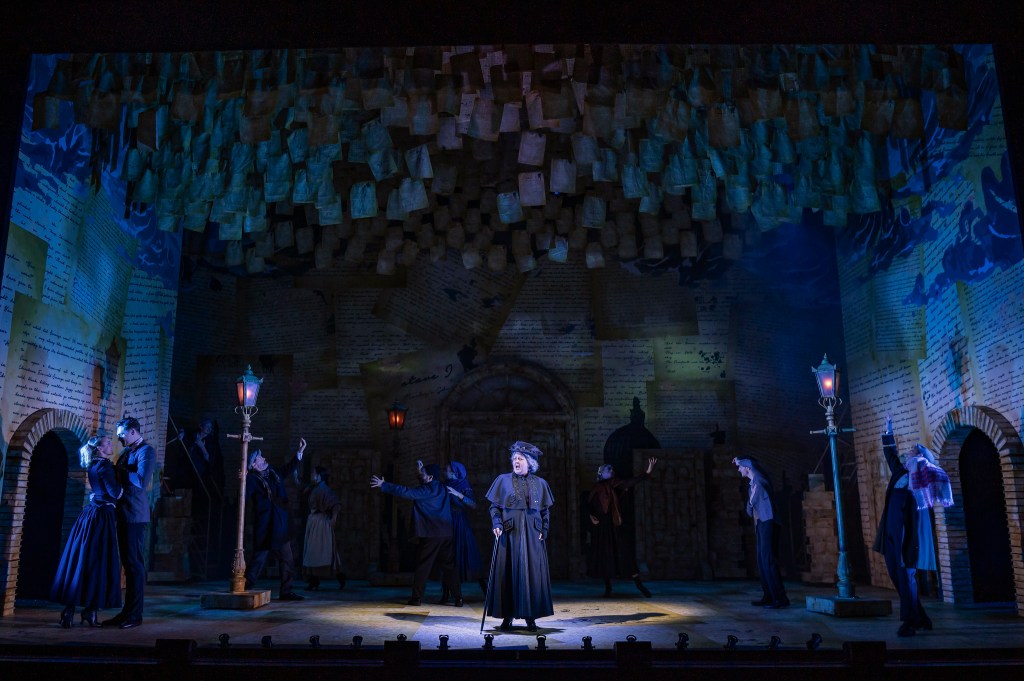
An embittered Scrooge spends most of the action in funeral attire, symbolising a life wasted, before switching to a coloured gown, which, (accidentally) poetically, evokes the early scenes in the musical that made a star out of Moore: The Phantom of the Opera (which, inversely, soon descends into darkness).
Scrooge’s metamorphosis is a bit hasty but there’s a hilarious moment where the changed Scrooge shows her true colours by having to force out, “Keep the change”.
Andrew Exeter’s set design is breathtaking. Countless contracts and deeds hang from the ceiling (and over Scrooge), occasionally drifting downwards and cloaking the stage, with projected documents (Alessandro Uragallo) filling the stage, their ink splashed across the walls like blood. Even Scrooge’s tablecloths are made of these inescapable and suffocating papers.
Alex Musgave enhances every scene with her vibrant lighting; no matter the context or the vibe, he gets the memo.
Lorraine Parry’s costumes are abundant and dramatic. She must have had a real good time sourcing and designing outlandish costumes that increase the whimsical nature of the production. I’d love to see all the costumes on rails backstage – you’d think Tim Burton, Baz Luhrmann and Lily Savage had all taken up residency!
Scrooge’s late business partner, Marley, is played by Barry Keenan, who chews up the scenery as the candyfloss-haired, Beetlejuice-esque ghost who visits Scrooge first. His cartoonish number seems to be inspired by Tim Burton, with ghouls exploding onstage, one with extendable arms. It is, perhaps, too ridiculous to be terrifying.
Christmas Past, played by Mari McGinlay, is a fiery redhead donning a holographic dress. She’s more like a fairy godmother, enticing Scrooge in, first showing her happier times before reminding her how and why she soured. As the Ghost’s true intentions are revealed, perhaps her appearance should change, becoming more sinister and a bit dischevelled, her glossy white dress darkening, her hair falling out of place, and so on. As it stands, the ghost is perhaps a little too merry – albeit wonderfully acted.
The creatives are even more ambitious with Christmas Present (James Hume), transforming him into a pantomime dame in Mother Goose, which is perfect for Christmas – and thus horrifying for the Christmas-hating Scrooge. The showgirl number is a lot of fun.
But it is the final ghost, the Grim Reaper-like Christmas Future, accompanied by eery monks, that sends Scrooge over the edge. It’s a wonderful contrast to the vibrant ghosts before it.
The loveable Mr and Mrs Fezziwig are played with abundant eccentricity by Alexander Evans and Josie Benson, respectively. Benson dons a Queen of Hearts-esque red wig but it might have looked better if Evans had a look that was similarly caricaturish. Benson is something of a character actress and slays in small but memorable roles, such as a gender-swapped Daddy Brubeck in Sweet Charity at the Royal Exchange several Christmases ago.
The core cast is rounded off with Matthew Jeans (Mr Cratchit), Marienella (Mrs Cratchit), and Chomba S. Taulo (Fred), and Nic Cain (Featured Ensemble – and Scrooge’s husband). The cast are at their best when all onstage. Hope Mill Theatre know how to choreograph the most stunning dance numbers, and this show, choreographed by George Lyons, is no exception.
‘Mr. Fezziwig’s Annual Christmas Ball’ is a fabulous, riotous showstopper that goes on forever yet not long enough. I don’t know if I’ll ever get “Ratatatatatatatat” out of my head. And you know what? I’m not mad about it.
Unfortunately, most of the songs bleed into one (it’s certainly one of Alan Menken’s weaker scores) but they are saved by divine singing and beautifully choreographed numbers in a daring, delightful new production of a lesser-known musical based on the most iconic Christmas story, which has been adapted countless times – yet this one feels different.
A Christmas Carol is a visual Christmas feast, with an important message, for all the family (especially your penny-pinching relatives who think they can take it to the grave). The only time this musical will have you saying ‘Bah, Humbug!’ is when it ends.
A Christmas Carol – The Musical runs at The Lowry (Quays Theatre) until January 5 2025.
Photo: Matt Crockett
 JADAR
JADAR 