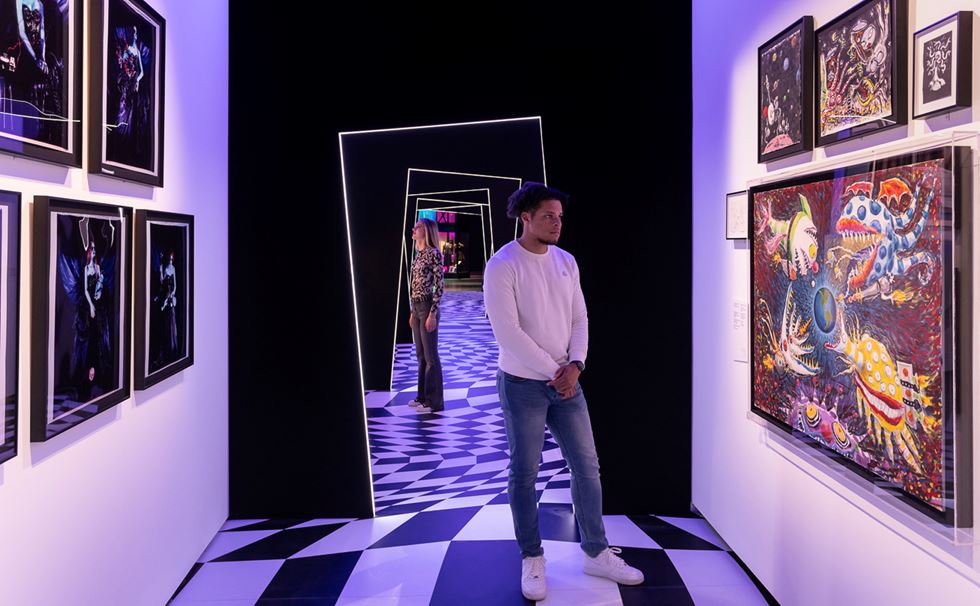
The World of Tim Burton, an exhibition showcasing the works of the iconic director, is ending its decade-long world tour at the Design Museum in London, with an updated and expanded production.
Perhaps surprisingly, Burton was not born in a Gothic landscape but, tragically, suburbia. It seems that his Gothic imagination is not inspired by his youth but was, rather, an escape from it. Whilst David Lynch, Stephen King, and Desperate Housewives subverted the suburb with the “behind closed doors” trope, Burton refers to Burbank, the archetypical suburb where he grew up, as “anywhere USA” and “a floaty, kind of semi-oppressive blank palette”.
The exhibition, though not entirely linear, does begin at the beginning. Burton’s early drawings are hung on a set made of identical suburban house fronts – with the only difference being their colour, each a different pastel.
The drawings contrast wonderfully with the houses, symboling Burton’s imagination in spite of “blankness” – or perhaps it is that “blank palette” that enabled him to imagine. The suburb, ironically, inspired some of his work – most noticeably, Edward Scissorhands – if only for a way for him to mock it.
Burton is presented as “the other”, an outcast, much like Edward, in a “semi-oppressive” suburb. A wall text dramatically reads, “Surviving Burbank”, yet we are not told what was so awful about Burbank – other than it being mundane – nor do we learn what Burton’s home life and family dynamic were like.
The following room is full of figurines from his best-known movies, such as The Nightmare Before Christmas and The Corpse Bride. It’s exciting seeing the animations brought to life – and one can appreciate all of the dazzling design details.
Another room features some of the most iconic costumes from Burton’s films, including the gorgeous costume worn by Johnny Depp in Edward Scissorhands and the school uniform and dance dress worn by Jenna Ortega in Wednesday.
There’s even the skin-tight PVC suit worn by Michelle Pfeiffer as Catwoman in Batman Returns. Burton had envisaged a character composed of patchwork with white stitching; Pfeiffer was literally stitched into the costume and painted in wet silicone to achieve the authenticity of shine.
The costume is, sadly, displayed flat, due to its intense delicacy and deterioration over time. Whilst it’s amazing to see such an iconic costume – which illustrates the stitched motif that Burton has returned to several times – without her in it, it falls flat (quite literally).
However, the mask is placed on a head modelled after Pfeiffer, and the sexy whip hangs from above, which adds some drama to the exhibit.
Whilst some pieces are secured behind glass, others are protected by black material, which allow you to see them without reflections, though it can prevent you from seeing the true colour of the piece. It’s a double-edged sword.
It would be good to be a little less precious and have some of the pieces out in the open, protected only by space, rope, and trust. The Naomi exhibition at the V&A has some of her iconic gowns presented like that so why can’t Burton?
Whilst there are some wonderful exhibits, some of Burton’s handiworks are perhaps not strong enough for an exhibition of this scale, and the exhibition’s choice to present some of his flops as high art is certainly interesting.
The exhibition, which, unsurprisingly, was devised by Burton’s “in-house curatorial team”, feels a little safe; it could be improved by asking tougher questions and diving deeper into Burton’s creative process and practices. It feels very much like a showcase; a celebration of Burton’s work that requires adoration rather than analysis.
Whilst Barbie: The Exhibition takes visitors on a linear journey and presents Barbie as a feminist icon (which is, of course, debatable – but exhibitions work best with a narrative), The World of Tim Burton does not have as much to say, let alone tell a story.
However, the exhibition is very much an immersive experience that allows fans to journey through the creative mind of one of the most-loved artists, with arguably the most recognisable aesthetic (if only because he has one style and sticks to it).
The exhibition is beautifully and cleverly designed; the space really does turn into “the world of Tim Burton”. The exhibits are placed in a Burton-esque installation, from white timber frames evoking suburban houses to a wonky portal, with a warped checkerboard pattern on the floor, which ends with a mirrored wall that makes it infinite, trapping visitors in an endless, inescapable abyss.
The World of Tim Burton runs at The Design Museum until April 21 2025.
Photo: Rob Harris for the Design Museum

 JADAR
JADAR 