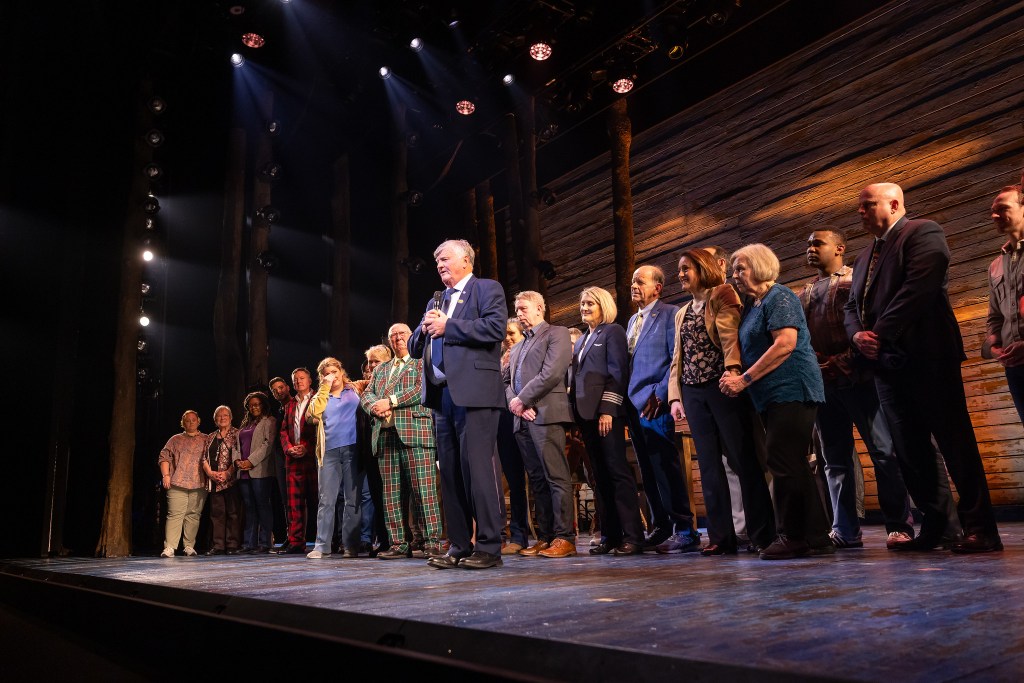
Come From Away, one of the most acclaimed musicals of all time, is based on the events in the Newfoundland town of Gander during the week following the September 11 attacks, when 38 planes, carrying approximately 7,000 passengers, were ordered to land unexpectedly at Gander International Airport. Ahead of the press night at The Lowry, there was a press call, where I had the opportunity to speak to the cast as well as some of the real-life people whose stories are featured in the musical.
Oz Fudge and Oliver Jacobson
Oz Fudge, who was the police constable in Gander, is played by Oliver Jacobson, who also plays the Rabbi (based on Rabbi Leivi Sudak).
I asked the gentlemen for a little information about themselves, and as soon as Oliver finished speaking, Oz joked, “You never asked him how privileged he was to play me,” before clarifying, “Now you know what I’m like.”
I then asked Oz if, when he was approached about this idea, he was immediately on board or thought that the creatives were crazy. “Well, I was on board, but I still thought they were crazy,” he admitted. “As Claude [Elliott – the then-Mayor of Gander] said, we figured we were gonna be on welfare by the time this was all done. I went and spoke to [the creatives] for 3-4 hours – I swore a lot – I didn’t think it was going anywhere! I did explain to them about ‘STFD’ [“Slow the f*ck down] and it ended up in the play.”
Oz never imagined he would see himself portrayed on stage – locally, let alone internationally.
“If they only had half the talent that I got, they’d be fine,” he joked.
“Speaking of the talent,” I said, bringing Oliver back into the conversation, before asking him about the challenges of playing real people.
“There are other musicals where you play real people but they’re like Eva Peron – big, famous, historical figures,” he explained, highlighting the difference between musicals such as Evita and Come From Away.
Oliver referred to the Newfoundlanders as “heroes”, even though they themselves say that they just did what everyone would do – but Oliver believes that most people would not.
“It’s just an incredible piece of writing; it’s written so well – it’s hard to do it wrong,” he said. “You’d have to be a really shit actor,” I laughed.
Oz said that he does not think they are heroes. Whilst there were only a few Newfoundlanders there, he said that everyone back home is like that, and they did not mind putting their lives on hold for a week to get it done. Whilst they felt good about having helped people, they never expected any praise.
“I always tell people that when I watched those towers come down, there was a burning desire in my heart to go down there and say, ‘Here, I’m here to help.’ And then all of a sudden, you look up at the sky, and there’s 38 planes – and that’s what everybody in the town was thinking: ‘I wanna help, and here’s the planes.’ God, we can do it.’”
I told the guys that 9/11 is one of those events where everyone remembers where they were at the time before clarifying that I don’t because I was only two. “I was on the potty,” laughed Oz.
Oliver was on a school trip, camping, and his teachers told them that they were all going home early because something had happened. A picture was then passed around the students. He said he was glad to be home with his family, not because he was worried that something would happen to him, but because people just needed to be with their loved ones. He then told me that, during rehearsals, the cast spoke about where they were during 9/11.
Oz agreed with me that Come From Away explores both the best and the worst of humanity.
“There’s two police officers from New York that I know – Joe and Paul – and that was one of the things that they talked about ’cause they came to Gander in 2015 or 16. They said, ‘We got to experience the worst of humanity, and coming here to Gender, we feel like we’re experiencing some o the best of humanity’ – and that’s the key to it all,” Oz said.
“The world needs this play. I’m kind of disappointing that it’s ending in five weeks and New York is done.”
Oliver said that this musical is unlike any other musical. He said that, walking out of the theatre, he has heard people’s conversations, such as people saying that they’d hope they’d react similarly if anything like that happened.
“We all love our jukebox musicals; we all love Mean Girls and Clueless, whatever’s coming next – but this is real, it’s real, and it teaches you things that everyone needs to know, and it’s so important.”
Derm Flynn and Jamal Zulfiqar
Derm Flynn was the Mayor of Appleton during the events of the musical. In the musical, Flynn is played by Nicholas Pound, who had been paired with Claude Elliott, the then-Mayor of Gander, who is his most significant character.
Jamal Zulfiqar plays two Come From Aways: Kevin J (a gay man in a relationship with Kevin T) and Ali (a Muslim man based on several real-life people). Unfortunately, none of Jamal’s “characters” were in attendance. Kevin T had been paired with Mark Dugdale, who plays Kevin T and Garth.
I must admit, it was weird interviewing somebody with the same forename as me – though I spell mine with an additional “A”!
Whilst Derm thinks that Come From Away has done the real-life story justice, he admitted, “We were apprehensive initially, when they were talking about doing a musical about 9/11, that was not what we envisioned – not that we envisioned anything.”
Derm thinks that the music is authentically Newfoundland, especially with its Irish influence.
“Little did we know that here, today, we’d be in Manchester, Salford, talking about what happened, even in 2016, because once it went to Toronto and then to Broadway, we thought, this is probably the end – you make it to Broadway, you’ve done it – what else? The longevity of the whole thing and the worldwide reach of it was something that we couldn’t anticipate.
“Little did we know that giving somebody a bowl of soup and a sandwich and a place to lay their heads, 25 years ago, would lead to this today.
“A good news story – there’s not a lot of good news in the world anymore – but a good news story that is sending a different message than you see when you turn on the TV and there’s bombs falling here and there’s somebody blowing up something there and there’s somebody shooting somebody there. 25 years later, we’re in a pretty safe place in our Provenace – and Canada itself is considered a fairly safe haven – notwithstanding, we have our problems, like everywhere else.”
“Well, you’ve got tariffs coming your way,” Jamal laughed.
Derm admitted that Newfoundland is probably not as accepting and gentle as they are portrayed in the musical because it was a different time. Indeed, some people have criticised the musical for playing a part in protecting Newfoundland from the history of Islamophobia post 9/11. The area is described as being largely altruistic and friendly in nature. Although the show goes into some detail about the Islamophobia one man faces, the Canadian stereotype of unending kindness arguably looks past racism and hateful rhetoric found in and beyond Newfoundland.
Jamal admitted that he has not found it to much pressure playing real-life people. Firstly, he has not met the people that he is playing.
“And also, you kind of have to let go of that a little bit and just trust yourself and just go to the script and trust that the writers have written the script with respect and done their research. What’s good about this script is a lot of the words are pulled from real-life interviews. So, you know, the way that Derm articulates it, it’s really his; you just can’t make this stuff up. So, the writing is so good, and we have an amazing creative team – Broadway came to teach us the show – and so I didn’t actually feel that much pressure.
“If they were in, maybe I would. But what this musical highlights so much is the Gander spirit, and so having them here, it doesn’t feel intimidating; it feels really warm and friendly and encouraging and selfless. So, if anything, it’s been really helpful for us as performers to meet them.”
Jamal was in secondary school during 9/11. His school called an assembly to reveal what had happened.
“Being Pakistani, and being a brown boy in the UK, it hit different, in a way, because of the Islamophobia that was ignited, overnight, as a result of 9/11. Even as a young teen, I realised the power of media and how influential they are. It kind-of was a bit of a dark eye-opening to propaganda, in a sense, because they were showing footage on the news of people in the Middle-East celebrating 9/11, when actually, that was stock footage from Eid. It highlighted a layer of what was going on that was quite dark.
“This is why I think something like Come From Away is so important because what it illustrates is we have so much more in common than what we have that divides us. A number in the musical like ‘Prayer’ really showcases the melting pot that was in Gander at the time and the respect that the people of Gander had for that. Derm says it was a different time but, actually, it was really beautiful that they let people like Ali find a safe space to play, and the rabbi, and facilitating people’s dietary requirements. That was a level of understanding that was kind-of groundbreaking.
“So, what’s interesting about Come From Away is how relevant it is today as well, and themes that we’re seeing happen in the world right now; it’s kind of scary how much it’s still so relevant. But people walk away from this musical feeling quite life-affirmed, in a good sense, because it’s ultimately about human kindness and selflessness. There was no ego in what they were doing. It was just, ‘You know what? Let’s just get on with it.’ And there’s something to be said about not overthinking something and just getting on with it, and that’s what I adopt when you ask me is it intimidating playing real people – just get on with it! Adopt their spirit.
“What’s nice about the character of Ali is they acknowledge the fear-mongering, the Islamophobia – they acknowledge that but he’s not defined by that. He’s ultimately defined by his kindness, his cooking skills, his relationship with Beulah – that is what defines him; it’s human connection. We’re all layered; we’re nuanced.
“It’s a series of vignettes, this musical, so it’s not what throughline. Beverly Bass gets her own number but there’s not really a main character – and that’s, again, echoing the town of Gander: there wasn’t a main character; everyone had a role,” Jamal said poetically.
“It’s like a real-life ensemble,” I said.
Derm agreed. He said that everyone who came threw their doors was treated exactly the same. People with lots of money were not given nicer accommodation.
“Put the billionaire right there and put the fella that had his last dime spent travelling right next to him, where some lady with two kids screaming and crying next to him,” he said. “You were given a bowl of soup the same as the other guy was given – and same kind of soup!”
Jamal said the musical reminds him of lockdown, with us all being in the same situation – and how reassuring that was.
“There’s something freeing about everyone being in that same scenario,” he said.
“Very communal,” I said. “That’s an interesting parallel.
Derm agreed; he said that, regardless of the travellers’ “status or stature”, they were in the same situation.
“There was three Black guys and three White guys and three brown guys,” Derm said, with Jamal adding, “Which would have been very unusual.”
Derm said that locals would invite “the plane people” into their houses and drive them around.
“We’re really fortunate to be in this position, to be able to travel because of the musical, to tell our stories to you and everyone else. We’re delighted with the opportunity but it’s also a responsibility for us to tell the stories of the other people that didn’t get selected to be portrayed in the musical, because you can’t portray a thousand people – and you can’t take a thousand people on the trip!”
He also revealed that people are visiting the Provence because of the musical. Jamal joked that Derm should start charging people for meet-and-greets.
Janice Goudie and Natasha J Barnes
Natasha J Barnes plays Janice Mosher, a composite character, based on two journalists: Janice Goudie (a journalist from about an hour away from Newfoundland who had moved to Gander a mere week before 9/11) and Brian Mosher. Brian was also in attendance but had not been paired with Natasha.
As with the others, I asked Janice if she was immediately on board with the idea or she thought that the creatives were crazy.
“Yep, the second one – thought they were nuts,” she admitted.
She revealed that the organisation she was working for at the time had created a media room so that they could know who was in town for the tenth anniversary of 9/11. The writers walked in to the room and they got talking. A week later, they interviewed her over the phone.
“I said, ‘I don’t know where that’s going or what’s going to happen with that but it’s done, whatever’ – and look, here we are,” she said eloquently.
She admitted that seeing herself portrayed onstage is “the weirdest thing ever” and “is like a dream.”
“Whoever grows up and thinks, ‘Oh yes, I’m going to be portrayed onstage somewhere,’ right? Celebrities maybe but not just normal people.”
All these years later, she still finds it bizarre. She said that people introduce her to others as being portrayed in Come From Away.
Natasha is an established actress who has done auto-/semi-/biographical shows before but this is different because “It’s not everyday that you get to portray somebody who is still living their life on this planet.”
Natasha said that everybody has their own memories of 9/11 – she remembers which carpark she was in and what her mum said to her – which creates a sense of “duty” to the musical because it happened within our lifetimes.
“Janice, as a character” – she laughed – “has so many timestamps and dates and statistics and figures, and I think, for me, the biggest pressure is making sure they’re exactly right. And I don’t think I’ve really, really, really messed up – yet – but that, for me, has been the scariest thing. Chuck me on a stage with a script and another person, and I can have a conversation, and you can’t go too far wrong, but stick on a microphone in front of my face and then make me just say facts out to an audience – for me, that is actually a really, really frightening thing to do.”
Janice was surprised that Natasha did not have all the facts and statistics written down. Natasha admitted that some people on the show have suggested that she just write everything down in the notebook. However, “What happens when that notebook slides out of your back pocket in your jeans, and you go there and it’s not there? What happens then? As a catastrophic thinker myself, I was like, ‘I must know these.’”
I told Natasha that I know how good she is at learning things last minute because I saw her in Hex.
Natasha explained that she had joined the company a mere week before previews because somebody had broken their leg.
“I was like, ‘Sure, it’s the National’ – of course I’m going to go to the National,” she revealed.
The secondary lead character, Queenie, was played by Tamsin Carroll, who fell ill with Covid-19. Her understudy, Tamsin Dowsett, then went down with a throat infection. So Natasha was pulled aside by the Artistic Director, Rufus Norris – who revealed the information regarding the two Tamsins ahead of each performance – and asked to cover the role, which she refused.
However, she went on the next night, with a script in hand, but had learned the script by the end of the week.
“I have a habit of doing crazy things,” she laughed. I told her that when I saw the show, she only needed the script for a few moments, but it was so smooth that you could hardly tell, which was a testament to her talent as an actress. However, she modestly said, “I don’t call it talent; I just think I’m a little bit stupid and a bit brave and a bit careless.” “That as well,” I joked.
“It’s the National Theatre – I’ve waited my whole career, and here I am, with a script in my hand, to a full, packed audience, and I was like, ‘Well, you just chuck it at the walls, see what sticks,’” she said.
“And it stuck,” I said.
Talking about learning experiences – and how Natasha grew as an actress – I asked Janice if what she went through in Gander helped her become a better journalist.
“Oh, absolutely,” she said. “It made me more brave to go up and talk to somebody who I don’t know, and just kind of say, ‘I have a role to play as a journalist, as a reporter’. ‘Cause, as a young reporter, a lot of people kind of shy away from walking to the front of a room to take that good picture, and they’ll take it from the back of the room. But what worse thing could happen? It was 9/11, right? Can’t get any worse than that!” she laughed.
“I definitely learned the community pretty quickly, and who was who, what roles they played.”
The musical says that Janice has moved from [Channel-]Port aux Basques but she’s not actually from there; she had just been a journalist there from a little bit.
“The street lights thing was real,” she revealed. “I put it in a piece in the paper when I first moved to town. I said, ‘If you see me going through the stoplights – in Port aux Basques, we don’t have any, so I apologise.’ Anyway, my husband cut it out, and he said, ‘I’m going to meet this girl,’ and we still have it. That was before he even met me.”
“That kind of just makes you feel all warm inside, doesn’t it?” I said, to which Janice responded, “Well, the whole show makes you feel warm inside, doesn’t it?”
“And also cry your eyes out,” I said.
“And laugh and sing,” she added.
“It’s just a perfect show,” I said.
“Yeah, I think so too,” Janice said.
“You have to say that,” I joked, to which Janice laughed, “No, I don’t!”
“No, she doesn’t. She really doesn’t have to say that,” Natasha laughed.
“You have to say that,” I laughed.
Whilst some of the real people had seen the show the night prior, press night was going to be Janice’s first time seeing Natasha in the role. Natasha admitted to being terrified.
“It’s impossible to be nervous because you join a family when you get cast in Come From Away, and a lot of people say that, a lot of casts will say, ‘Oh, we’re a family’ – but you join an extended family. I have probably an extra 85 aunties and uncles. It really is like that. I’m just excited for you to see this version of it.
“I was saying earlier, I think my accent’s actually a little bit off, and I was really confident in my accent, and I found myself yesterday, having chatted with everybody, I was starting to tweak things already. I’ve been doing the show for quite awhile now and so my body’s going, ‘You can’t change things now!’ So I’ve more just got to live with what we’ve done.”
Janice admitted that “It’s a hard accent” and thinks that the actors do good jobs with it. She said that the accent differs depending where you live – and that the real people in attendance all sound slightly different.
“Don’t get us excited and let us start talking ’cause you’ll never understand what we’re saying to each other!”
I asked the women what they hope that audiences take away from the musical.
“That you always have a choice to be kind – and a small act of kindness can lead to massive, massive changes,” said Natasha. “It’s that single grain of rice tips the scale thing. This isn’t one great big act of kindness – that’s not what this show is about; it’s about a million tiny, single acts of kindness – you just do what you can. If you’re ahead of somebody, you open that door for them; if somebody drops something, you pick it up. That’s not going to change your day but it could change theirs. That’s the crux of this show, that’s what it’s about, and that’s what will get us out of dark and tricky times – it has done before and it will again.”
Janice added, “People are referencing it as being a show that works with the times but I don’t think it ever stopped working with the times. It’s always been relevant. And sometimes, we get in our way, and we just need to stop and, like Natasha said, just help your fellow person. We all need a helping hand once in awhile, and we can certainly lend it – doesn’t cost anything, right? Easy.”
Beulah Davis, Amanda Henderson and Bree Smith
Bree Smith plays Hannah O’Rourke, an African-American based on an Irishwoman, who is struggling to get in contact with her son, Kevin, a firefighter in New York – who is later revealed to have died. She forms a supportive relationship with Beulah Davis, the head of Gander Legion, whose son is a local firefighter. Beulah is a combination of Beulah Cooper (treasurer of the Ladies Auxiliary at the Legion) and Diane Davis (who, like Beulah’s character, is a teacher and helped organise the school).
Hannah no longer travels, due to her age, but Bree was fittingly paired with Amanda and Beulah. Diane was originally going to attend, and she was going to be paired with Sara Poyzer, but did not end up being there.
Beulah admitted to being dumbfounded when she approached about the idea for the musical.
“I made a tray of sandwiches, brought it to the Legion – and it hasn’t stopped since. Interviews, people, the friends I’ve made and the places I’ve been – unreal. But little did I know – or I could put it the other way around, said, ‘Yeah, I knew when I brought a tray of sandwiches to the Legion, I was gonna get all these trips!’ But then I’d be lying,” she laughed.
Beulah said that the cast have done a fantastic job of playing the real people. “I’ll pay her later,” joked Amanda.
“It’s so heart-warming to see that somebody up there is playing you.”
“It’s about finding that absolute truth,” said Amanda. “Everything we’re telling is what happened. Because it’s written so well, and it’s been directed so well. I mean, it’s not been easy – when we all found out they were all in watching last night, I think the pressure was on! And more about the accent than anything else, to be like, :I need to get this accent right!’ And I think for me, that was the hardest thing, was the accent.”
Bree met Hannah in August in New York. Hannah invited her to her house. Hannah’s daughter, Patricia, was there, as well as Kevin’s widow, Maryann, and another friend.
“So, it was four women that knew Kevin so well, and they were just sharing stories, and we were laughing, and it was beautiful. But she’s 91 now so she couldn’t make it. It’s amazing to find the truth of her story – because they are actual facts – and then also to not be copying someone,” she explained.
“We’re not mimicking,” Amanda added.
“”It’s an interpretation, in a way,” I agreed.
“Even in looks – most people, except Claude [Elliot and Nicholas Pound], don’t really look like their people,” she said, before Amanda joked, “I don’t think we’re far off.”
“I’m nothing like Hannah,” said Bree, who is a Black woman playing a character based on a White woman (the character has always been Black).
“Also, when this happened, she would have been 60-something, late 60s,” said Bree, before Beulah revealing that she would have been 68. Bree said that she plays the part as a 50-something, and she wears a grey wig.
“It’s also allowing yourself, as an actor, to be able to bring your influences into the truthful story.”
Bree, who was eight when 9/11 happened, has family in New York and visits all the time, so she remembers her mum calling her family in Brooklyn. Just last year, at a wedding, when she was talking about the musical, an aunt (who was visiting her aunt) told her that she was blocks away from the Twin Towers and could not travel back to the UK for 11 days. Hannah’s mother went to New York a year or two afters but would not take her, her sister or her father. They finally visited when Bree was 13, and she visited the memorial.
Amanda admitted that her story is “nowhere near as interesting as that.” She was in high school – “I was a little bit older than you two, thank you” – and her mum similarly tried to shelter her from the news; when she got home, she turned the news off. She remembers looking at the footage and thinking that it looked like a movie, not real life.
Bree said that she had to do a lot of research into 9/11 during her first year of drama, where she had to do a project on 9/11, which is the first time that it felt real to her.
“It’s horrible,” she said. I said that’s why this musical – and Beulah’s story – is so good because we saw the worst of humanity and then-“
“The best,” said Beulah.
“And the best is sat right here,” said Amanda.
“To me, this show shows a lot of kindness and goodness of other people,” said Beulah. You never know what tomorrow’s gonna bring; you could be in the same situation tomorrow. If you can help somebody then do it. Help them. Whatever you can do to help somebody, you should do it. Show a little kindness.”
Beulah thinks that a lot of countries and people have learned from 9/11, regarding helping others out.
Amanda said that she is trying to get #BeMoreBeulah trending. “It’s the true Gander spirit, and the Queen of Gander is obviously Beulah.”
“They’ve got a Come From Away sign at the Legion, and on the back of it, it says – well, I can’t even say it with a straight face – ‘Home of the famous Beulah Cooper,’” revealed Beulah. “And then my name is on the one at the firehall ’cause my son was a fireman -and he passed away seven and a half years ago – and he always said, ‘Mom, there’s one word not in your vocabulary.’ I said, ‘What’s that, Aubrey?’ He says, ‘No. You don’t say no to anything.’ And it’s true, I don’t. I just can’t.”
“See?” said Amanda. “Hashtag Be More Beulah.”
“Anyone can watch [the show], and they’ll be laughing and crying within the same sentence,” said Bree.
Sara Poyzer
Sara Poyzer’s primary character is Beverly Bass, who is based primarily on the real captain of the same name – the first female American captain – but is also inspired by several other pilots’ experiences in Gander. Her song, ‘Me and the Sky’ is based very closely on her real words. Beverly was originally going to attend but had to drop out because she is currently retiring. Poyzer, who also plays Annette (who works at the Legion with Beulah Davis) was then going to be paired with Diane Davis (who the Beulah character is partially based on, alongside Beulah Cooper) but she did not end up attending. Instead, Sara got to be interviewed alone!
Poyzer has starred in some major musicals – most noticeably, Mamma Mia!, where she played Donna Sheridan – but now she’s playing a real (living) person, which she has found a lot of pressure.
“We didn’t wanna do impressions but we wanted to kind of take the spirit of who they were, and Beverly, for me, is a woman who is strong, she’s kind, she’s formidable, but she’s really warm as well, so I was trying to get all of those dynamics.
“And then, of course, the Gander people that we play too. So, last night was a real pressure, ’cause for some people, they had the real person that they’re playing. So yeah, the pressure’s been there. As you say, ‘Me and the Sky”s become an iconic song already, and Mamma Mia!‘s iconic.
“I think, what you have to do, is just, for me, as an actor, do the script that’s in front of you and try and do that as truthfully as you can and take away the pressure of this big song, this big character. I mean, I was absolutely crapping myself on the first night, I’m not gonna lie – but you’ve just gotta do the show, do the part, and do it as truthful as you can.”
“And do it justice,” I added.
Another pressure for Sara was, interestingly, the sheer talent of the cast.
“This cast, I have to say, I was watching them in rehearsal, going, ‘Oh, my God, I need to up my game. These people are – I think they’re all brilliant.’ And I don’t often say that in a show; usually, there’s a few people that you think, ‘Ah, they’re quite good’ – but I swear, in this show, I’m like, ‘How am I with 11 immense actors?’ They are brilliant – truly, they are great. There is no main part in this – 12 people have all got a really important story to tell, and I think they tell it brilliantly.”
Whilst there is no main part, Sara is the only actor who gets a solo song – ‘Me and the Sky’, which is becoming a musical theatre standard, which I saw Sara sang at the exclusive showcase.
Whilst ‘Me and the Sky’ is very much Beverly’s story, Sara relates to it as a woman.
“I think women still have a lot of battles. I think there’s still a lot we can do for women going forward. I have many stories about [being a woman] – she says it, ‘People saying, ‘You can’t or you won’t,’ or ‘you know you’re not anything ’cause you’re a girl” – and that’s still a thing for me. Even just becoming an actor – when I was younger, at school, it was like, ‘Well, you’re gonna a nurse, you’re gonna be a secretary’ – and there’s nothing wrong with either of those careers, they’re very noble professions, but how about, ‘No, I wanna be something else’?
“And Beverly says, ‘Yeah, I’m gonna be something that people didn’t think I could be’ – and what a great model to tell to any young person, to say, don’t be limited by the expectations that others have of you. If you wanna be a secretary, be a secretary – but if you wanna be the pilot of a commercial plane, you can be that too. And I think it’s a wonderful story.
“I remember saying to my parents, ‘I wanna be an actor’, and I’m from a working-class background; they were like, ‘Well, that’s really precarious. Do you really wanna do that? You’re gonna be unemployed; you’re gonna be poor; you’re not gonna get any work.’ I said, ‘Well, all those things in mind, yeah, I’m gonna follow my dream’ – and I think that’s what Beverly talks about. Follow your dream.
“And I think that’s a really important message, whether you’re a young woman, a young man, doesn’t matter who you are, follow your dream. And that alone takes such courage because we’re told that actually we need to do something safe, and she says, ‘No, follow the dream’, and I just think that’s a wonderful message.”
Whilst the song is about Beverly achieving her dream, it ends with her dream turning into a nightmare: “The one thing I loved more than anything was used as the bomb.”
Sara admitted that it doesn’t take much to put yourself in those shoes, especially when looking at the footage of 9/11, which they revisited in rehearsal.
“I think, as an actor, you either draw on personal life experience or you empathetically put yourself in those shoes, and that’s what I did with that storyline. It’s still, to this day, is something that I can’t quite fathom that I’m watching. It feels almost film-like. That was was it was for me; it was more of an empathetic kind of understanding of her story. And then being able to speak to her – I spoke to her on Zoom. She was extraordinary.”
Sara said that Beverly told her that she was friends with Charles Burlingame, whose plane was flown into the Pentagon.
“She saw him the week before in a pub, and now he’s dead.”
However, Sara wants people to know that the musical is also really funny.
“It’s hard to say that – it’s about 9/11 – but, my God, there’s so much laughter in it, because the people of Gander are heartfelt, wonderful, heartwarming people. It’s actually really funny as well as really emotional, and I think that’s really important because we, as human beings, are able to actually find comedy and humour and warmth, even in the most tragic of circumstances.
“And you know what else I say, which you might think is a slightly crowbarred idea but I believe it? It’s Christmas time, right? And this show is not about Christmas, but Christmas is about humanity and kindness, and so is this show. And I think, actually, in a weird way, even if you wanna take kind of the Biblical element of Christmas, there’s a family wandering to Bethlehem, and they go, ‘Come in. Welcome you in.’ And I think this story is that; it’s like, ‘Welcome. You are welcome in our community. You’re a stranger but you are welcome.’ And it just fills my heart. I mean, I cry most nights at this show.”
Sara admitted that when she was watching the show in the West End, she immediately wanted to be in it – and play Bev! On the Friday, her Mamma Mia! colleague Daniel Crowder (Nick, Doug & Others) told her that he had been cast, so she presumed that she had not made the cut. She called her agent on Monday only to be told that she had gotten the part but they had been too busy on the Friday to tell her!
She told me that there a few people in the show who were in Mamma Mia! “Range,” I laughed.
During 9/11, Sara was an out-of-work actor. She heard something on the radio as she was travelling to her temp job in the afternoon.
“News filtered in in such a kind of disjointed way. Now it’s like boom boom boom boom on your phone,” she explained to me (I had just told her that I was two during 9/11).
She got to work and told her colleagues to put the news on. Work stopped that day and they just sat and watched the TV. She held hands with her colleagues, who she did not really know. The first thing she wanted to do was speak to her family – as everyone did.
“Somebody – the producer – said, ‘This show isn’t about 9/11; it’s about 9/12’. It’s about what happened in the wake of something so awful, and how brilliant people were in the face of something so hideous… You may have heard this already, they said, they welcomed in 7000 strangers; halfway through the week, they had 7000 friends, and then they said goodbye to 7000 family members.”
“It fills my heart, this show. There’s 43 of us, I think, in the whole company, including the backstage people, and we are like a family, and we have become so close during this show, and I have such love and respect for my fellow cast members. They’re just glorious people, and it’s gonna be a strange day when we say goodbye to this beautiful show.”
I asked Sara what she wants audiences to take away from the show, to which she responded, “That kindness is everything. Open up your heart. The news can make us fearful and distrustful of people. But I think most people in the world are fundamentally good. And you touched upon the repeat President of America, who doesn’t represent kindness, really, I would say. But I think, ultimately, when the chips are down, most people wanna be good. There are a few bad apples out there, and politically and socially, there are some people who are doing a bad thing.
“But I would say to people, trust and love and be kind, because it’s amazing what can happen if you – there’s a great line in a movie; Hotel Budapest [The Grand Budapest Hotel] is one of my favourite movies – and Ralph Fiennes character [M. Gustave] says, ‘If you treat people like kindness, they open like a flower’ [‘The most dreadful and unattractive person only needs to be loved, and they will open like a flower’].”
I asked Sara if she has a dream role but she said, “I just want to work; I just want to tell stories.”
She did, however, reveal that she’d love to star in Suffs, which is currently on Broadway with Jenn Colella, the original Beverly Bass!
There are also some classic roles she’d like to do, such as Madame Thénardier in Les Mis and Madame Morrible in Wicked.
“I’m suddenly in that bracket now I’m playing all the Madames ’cause I’m a bit older,” she laughed. “All the misses have gone. Miss Congeniality. It’s all that Madames now.”
I noted that there are a lot of good roles for women in their 30s, 40s and 50s. Sara said that’s why she did Mamma Mia! for so long – because Donna Sheridan is such a “classic, iconic” role.
She thinks that Bev is slowly becoming an iconic role to play, and “‘Me and the Sky’ has become one of those numbers that loads of people, when I meet them at stage door, they say, ‘Oh, I’m singing it for my drama school.’ It’s a beautifully written piece of drama. It’s like ‘The Winner Takes It All’ is a beautiful piece of drama, and I think there that’s what resonates with people. And even ‘Defying Gravity’ – yes, it’s a big song, but it’s also a piece of drama; the narrative is really important to me.”
Come From Away runs at The Lowry (Lyric Theatre) – the final stop of its UK tour – until January 5. It then transfers to Il Rossetti, Trieste, Italy from January 10 to 12.
Photo: copyright Phil Tragen
 JADAR
JADAR 