★★★☆☆
A selkie is a seal creature present in Scottish and Irish folklore, where folktales detail the creatures removing their seal skin and turning human under a full moon. Tmesis Theatre formed SealSkin based on this idea, telling the story of a selkie that was stolen from her home through vivid physical theatre, live music, and projection.
Recommended by The Guardian‘s ‘Guide to This Week’s Entertainment in the UK’ in the stage section, I ventured to The Lowry to hear the tale of SealSkin.
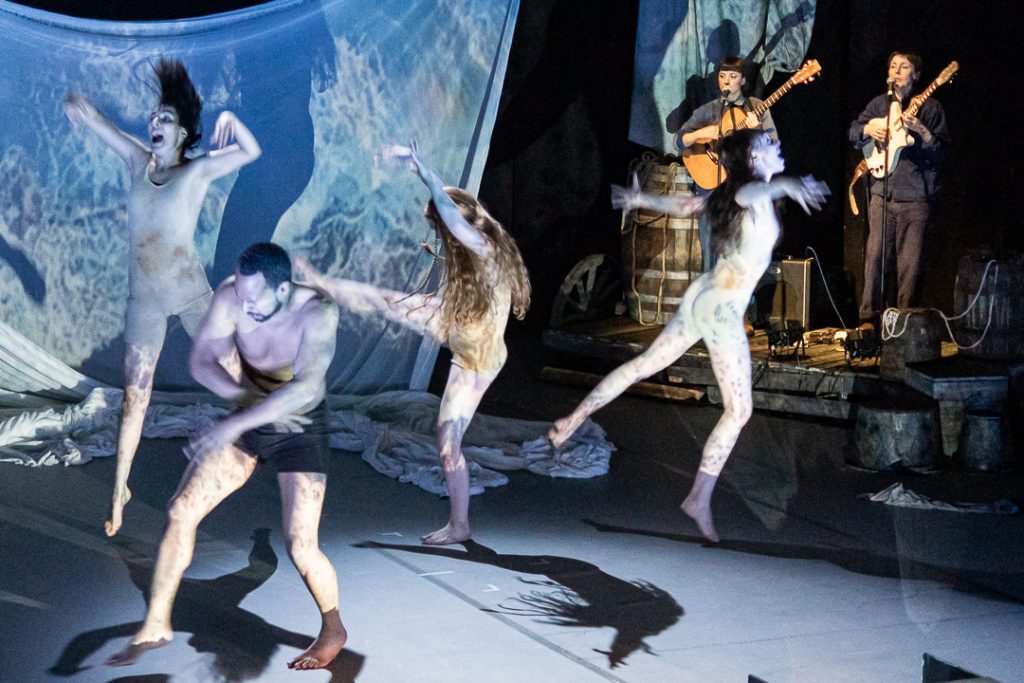
The Quays Theatre stage was pre-set with two musicians, acoustic duo me + deboe gently strumming their guitars as the audience took their seats, complete with a full moon projected above. The pair remained on stage throughout, accompanying the theatrics beautifully with their acoustic ballads, communicating the characters’ emotions through song.
The music picked up pace, the lights dimmed, and the piece began by introducing a host of lively fishermen hunting the ocean for their next catch. A flowing piece of white cloth was used to represent the sea around them and as a means to project oceanic imagery across the stage. Drama ensued where a selkie was caught in their net, and a remorseful fisherman (Samuel Perez Duran) finished off the creature, killing her in his arms. Blood splattered across the cloth and performers on stage, and the fisherman stared out into the audience, horrified at his own actions. Technologically, the blood projection looked quite synthetic, needing some fine-tuning to correspond with the subtleties of the performers’ sentiments.
A group of selkies (Stephanie Greer, Faye McCutcheon, Mariana Pires, and Valentine Ojochegbe Onogu) playfully danced, wailed, and moved together under the waves and moonlight, shed their seal skins, and transformed into human forms. The guilty fisherman returned, not learning his lesson, and stole one of the selkie’s skins, trapping her in human form and in his world, as the rest of the creatures floated away.
The fisherman captured the selkie (Faye McCutcheon), bringing her home to his bewildered mother (Mariana Pires), where they put her in human clothes and tried to change her mannerisms and seal ways to turn her fully human. Mariana Pires’s primary role was the elderly mother of the fisherman. Her physicality was spot on and, in turn, earned the majority of the audience’s laughs; her comedic timing was superb. The story probed into human traditions and ideals, for example, religion and mealtime etiquette, when the family forced the selkie to perform the sign of the cross before eating, even though she didn’t understand what she was actually doing.
The ensemble cast skilfully took on a handful of roles each, transitioning from bustling townspeople into flowing and animated selkies. Alongside their physicality, they communicated using a mixture of Spanish and Portuguese (I believe), which, at times, left me feeling confused about the plot but picking up words here and there. However, the singing duo were the highlight of the performance for me, carrying the piece through with soft, folksy tunes. They watched over the stage and performers as the story progressed.
Letting out a wail, flapping her arm against her thigh, or stealing a fish at the market, the selkie’s real nature kept escaping out of her human form, resulting in the fisherman being aggressive with the creature, desperately trying to hide her otherness in front of the other humans. Faye McCutcheon’s portrayal of the selkie reflected a hunger for freedom and a struggle to conform to civilisation. She performed with great energy, often flapping about around the stage like a fish, but also with absolute subtlety within more emotional moments.
The story went on to explore themes of motherhood and marriage, as the fisherman’s mother took out her old bridal veil and placed it on the selkie, signifying that she would be married soon. The mother got trapped in the veil as she tried it on, suggesting that she, too, was potentially a victim of forced marriage—but she continued the cycle by leading the selkie to the same fate.
Donning the veil and fashioning the white projection fabric as a dress, the selkie and the fisherman were married by the priest. The creature soon after began birthing their child—a puppet made of recycled plastic emerging from the ocean. The babe grew from a newborn to an infant to a young child through a series of puppeteered movements, who miraculously found their mother’s stolen sealskin, freeing her and releasing her back to the ocean, to the horror of their father and grandmother.
It was a beautiful moment witnessing the selkie finding her freedom, but unfortunate that she had to suffer through the marriage and birth of the child. That was the way that I interpreted the story anyhow, as much of it felt ambiguous. The selkie’s journey to reclaim her freedom embodied the core message Tmesis conveyed: a creature’s or person’s true nature cannot be confined and must ultimately be set free.
The story was brutal and, at times, difficult to watch. Despite the beautiful movement choreography and music, the tale revolved around a female creature who was stolen, forced into marriage, and made to bear children. I would have appreciated seeing the fisherman’s remorse reflected in meaningful character development, perhaps leading him to change his ways. Instead, the story primarily focused on his relentless determination to transform the selkie into human form and keep her as his bride.
While this approach simplified the narrative, it positioned the show effectively for a younger audience and served as an excellent educational tool for actors to explore the possibilities of physical theatre and movement. Tmesis Theatre excelled in portraying humanity’s darker tendencies to take what did not belong to them and defy the natural order—an especially relevant theme in an era of climate change driven by humanity’s impact on the environment.
SealSkin tours the UK until March 20, with more dates coming in Spring.

 JADAR
JADAR 