★★★☆☆
Psychological thrillers and whodunnit mysteries often make for the most intriguing play genres. There’s nothing quite like experiencing a classic Agatha Christie tale, but The Girl on the Train was my first time seeing a modern twist on the beloved genre.
The Girl on The Train flips the genre on its head with a voyeuristic unreliable narrator piecing together her fragmented memories after the disappearance of a Megan (Natalie Dunne) – a woman she’s been secretly observing from the train.
The characters are a little less whimsical than Christie’s but equally as mysterious with the victim’s easily irritated husband, Scott (Samuel Collings), becoming DI Gaskell’s (Paul McEwan) prime suspect followed by our forgetful and obsessive protagonist, Rachel (Giovanna Fletcher), and secretive therapist, Kamal (Daniel Burke). Rachel’s constant obsession with her ex-husband, Tom (Jason Merrells), and his frustrated partner, Anna (Zena Carswell), fuels her alcoholism and erratic behaviour, veiling her memories of Megan’s disappearance.
Based on Paula Hawkins’ 2015 best-selling novel, which was further popularised by the Americanised 2016 movie starring Emily Blunt, this touring production, adapted by Rachel Wagstaff and Duncan Abel, provides an artistic yet flawed glimpse into a world of constructed and fragmented memories, abuse, secrecy and heartbreak.
The first half is a little bloated and tedious, failing to garner the same momentum or intrigue as the second act’s more suspenseful drama and gripping reveals. One could call it a slowcomotive! It constantly reminds the audience in every interaction that Rachel is an obsessive and nosy alcoholic. Little snippets of information slowly gleam through act one but are constantly undercut by snide remarks, references to her instability and oddly-placed humour that sometimes at her alcoholism and other times chucked in for absurdity’s sake.
Fletcher’s performance as Rachel was filled with the perfect amount of desperation and despair as she transformed into the character with ease. I do wish we could have seen a touch more of her more calculated façade or her mixture of warmth and wit with Scott as these moments were well-performed touches to the character’s dynamics but rarely allowed to flourish.
Collings and Dunne are show-stealing performers, switching between happy loving couple to explosive with ease- a terrifying yet poignantly portrayed abusive relationship during flashbacks. Merrells was also incredibly versatile, especially when his tenderness and sympathy for Rachel slowly fade with exhaustion and anger.
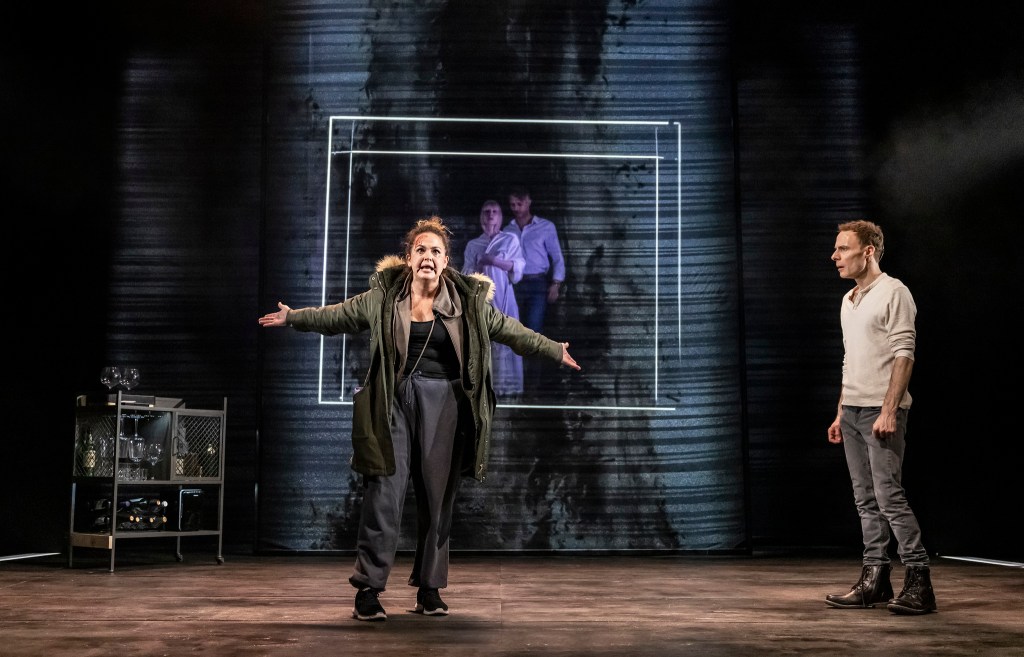
Unlike the impressive 2018 production, with its oppressive voids and doorways enclosing Rachel in her obsessive little world, this production opts for screens, a hauntingly lit box peering through the projections, and a handful of props like shabby beds with scattered bras bottles and cans, mini-bars or rugs thrown on-stage each transition. While the screens allow for interesting flashes of train boarding times, trance-like drunken raves, and pixelated reflections of Rachel’s mind, the set itself often feels too incorporeal as we oscillate between houses and dream states. It was an engaging way to play with her constant mental health and memory troubles, but a drab choice visually during sprawling conversations.
Disjunct freeze frames constantly derailed conversations with flashback reenactments in the middle of new discoveries, some of which made me jump with their startling difference in volume and tone. The effect ultimately felt a little drama-school-y and awkward within fairly tense scenes (but it did allow for some nice moments of acting from Dunne).
Additionally, I found the music a little tiresome, with the creepy magpie song feeling a little irrelevant aside from one mention of a dead magpie, and the show’s motif playing during almost every transition.
However, the light box behind the screen did add an extra layer of mystery with hazy memories solidifying inside, her memories of seeing Megan slowly seeping through the cracks of her mind (and literally through the screens themselves). Later the box slowly turned with Rachel trapped inside, creating some great symbolism of entrapment, but losing its seriousness when I realised it slightly resembled a hamster wheel.
The most endearing set choice was the train scene during the finale where (spoiler) a character is killed on the tracks as the train approaches, with the lights and rumble gradually increasing before a momentary jump scare as it hits. The sheer intensity of the scene and the believable fear portrayed by the actors was incredible here. My only grumble was that the final effect would have been more effective; it was fairly hilarious to see the random handful of leaves thrown into the air before the dead character casually stands up and strolls off the fully-lit stage.
The Girl On The Train is an interesting psychological piece visually highlighting the complexity of fragmented memories and trauma, but it’s often side-tracked by its strange creative choices, and undercut by oddly placed humour and an incredibly slow first half. While the twists are extremely satisfying, I’m left questioning how much of that is down to the original story, rather than the show’s execution of it.
The Girl on the Train runs at The Lowry (Lyric Theatre) until February 15 and tours the UK until August 30.
Photo: (c) Pamela Raith
 JADAR
JADAR 