
★★★★☆
This was a double-bill of Caryl Churchill’s work, with both plays having premiered at the Royal Court Theatre and performed together in Australia a couple of years ago.
Thinking about Churchill’s previous work (having watched A Number at the Young Vic in 2022 and read Blue Heart, another double bill of one-act plays), I was prepared to work as an audience member; work to understand the play.
The first play, Escaped Alone, begins with four principal characters, who chatter amongst themselves, and then breaks into soliloquous or monologues from Sally, played by Maureen Beattie, whose voice among the group is light, almost bird-like chirping, but in the solos, her voice became a thundering, ranging, declaration of a society unlike anything.
The tone of these solos, describing what feels like a dying society, literally, morally, figuratively, contrast hugely with the chatter amongst the four who talk about birds, kitchen, cats, careers. There is a feeling of the overlapping dialogue, the Top Girl style though where in Top Girl, each sentence linked to another, here, the realism of overlapping dialogues with multiple tangents in the conversations.
All four – Annette Badland, Maureen Beattie, Souad Faress and Margot Leicester – were brilliant at playing their characters’ nuances, their snarky-ness, and their secrets from each other. The lighting (Bethany Gupwell) was utilised effectively, switching from soft yellow on to group chatter (reminding me of overlapping, excitable group chats) to the solo monologues with harsh white, lights.

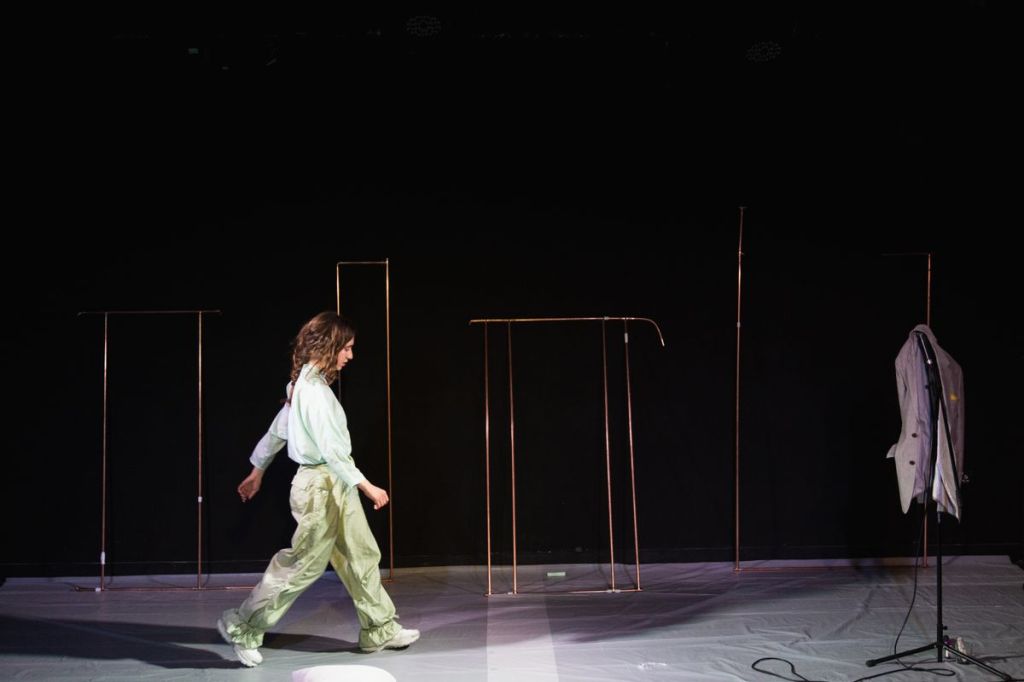
The next play, What If If Only, began with the grass floor of the royal exchange lifting, becoming a ceiling. Rose Revitt’s design is simple but effective. Visual movement was quite a beginning, making me think in overdrive whether we were in an underworld, or below reality in a way. The floor stopped halfway, with a weirdly textured ceiling.
Someone, played by Danielle Henry, enters a set which was quite bare with a lamp and sofa. She opens a shoe box, and out comes photos as she speaks of apples, painted right, painted wrong. This abstract dialogue leads Someone looking at the empty armchair, addressing someone else that no one can see. There appears to be a feeling here, the feeling of a “what if”, when Annette Badland appears again here, playing Future, goading Someone that she can bring them back. Who “they” are, not sure. But she smiles brightly, coaxing her to believe in her.
Suddenly, multiple actors appear – all want Someone to pick them, for different reasons, all stationed around the stage pulling our eyes all around. This sense of claustrophobia in voices was overwhelming.
This play was very short. Present, played by Lamib Touray, appears, with Bea Glancy, playing Child, not giving Someone full answers, or questions.
This is definitely a play I want to read to see the interaction of dialogue as it felt very fast-paced here, and I was struggling to keep up with the play’s pacing. I can describe it better than assess it, which is not my fault entirely. This is what I mean with Churchill’s work making us work, not just to understand the meaning, but even the actions in front of us.
The slick creative team is rounded off with Nicole T. Chang (Sound Designer and Composer) and Sundeep Saini (Movement Director).
Churchill’s work is for you if you enjoy how the form of theatre can be stretched and pushed to create meaning in different ways. A beautiful quotation from Maureen Beattie in the programme sums up a sense of these two plays, in that, “It starts off looking back, but [Churchill is] really looking forward through those characters.”
Escaped Alone and What If If Only runs at the Royal Exchange Theatre until March 8.
Photo: Escaped Alone by Johan Persson
 JADAR
JADAR 